
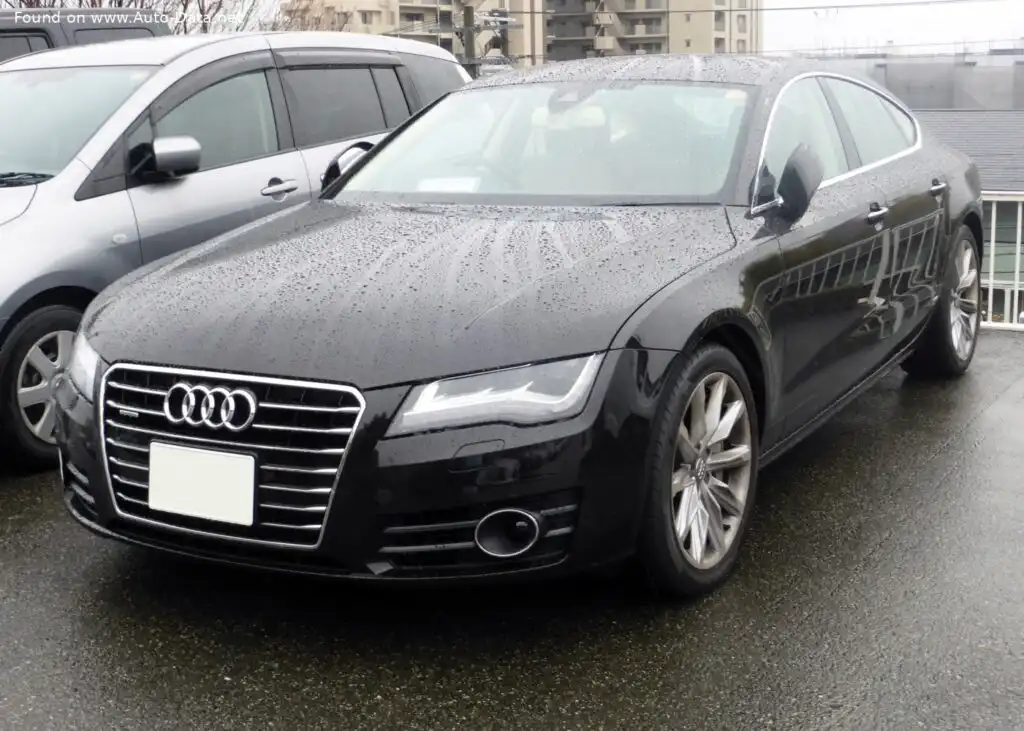
Technical Specifications
| Brand | Audi |
| Model | A7 |
| Generation | A7 Sportback (C7) |
| Type (Engine) | 3.0 TDI V6 (240 Hp) quattro Tiptronic |
| Start of production | 2013 |
| End of production | 2015 |
| Powertrain Architecture | Internal Combustion engine |
| Body type | Liftback |
| Seats | 5 |
| Doors | 5 |
| Fuel consumption (economy) – urban (EPA) | 9.8 l/100 km (24 US mpg, 28.8 UK mpg, 10.2 km/l) |
| Fuel consumption (economy) – extra urban (EPA) | 6.2 l/100 km (37.9 US mpg, 45.6 UK mpg, 16.1 km/l) |
| Fuel consumption (economy) – combined (EPA) | 8.1 l/100 km (29 US mpg, 34.9 UK mpg, 12.3 km/l) |
| Fuel Type | Diesel |
| Acceleration 0 – 60 mph | 5.5 sec |
| Maximum speed | 210 km/h (130.49 mph), Electronically limited |
| Emission standard | ULEV II |
| Weight-to-power ratio | 7.9 kg/Hp, 126 Hp/tonne |
| Weight-to-torque ratio | 3.3 kg/Nm, 304.5 Nm/tonne |
| Power | 240 Hp @ 3500 rpm |
| Power per litre | 80.9 Hp/l |
| Torque | 580 Nm @ 1750 rpm (427.79 lb.-ft. @ 1750 rpm) |
| Engine layout | Front, Longitudinal |
| Engine Model/Code | CPNB |
| Engine displacement | 2967 cm3 (181.06 cu. in.) |
| Number of cylinders | 6 |
| Engine configuration | V-engine |
| Cylinder Bore | 83 mm (3.27 in.) |
| Piston Stroke | 91.4 mm (3.6 in.) |
| Compression ratio | 16.8:1 |
| Number of valves per cylinder | 4 |
| Fuel injection system | Diesel Commonrail |
| Engine aspiration | Turbocharger, Intercooler |
| Valvetrain | DOHC |
| Engine oil capacity | 6.4 l (6.76 US qt | 5.63 UK qt) |
| Coolant | 12 l (12.68 US qt | 10.56 UK qt) |
| Kerb Weight | 1905-1935 kg (4199.81 – 4265.94 lbs.) |
| Trunk (boot) space – minimum | 535 l (18.89 cu. ft.) |
| Trunk (boot) space – maximum | 1390 l (49.09 cu. ft.) |
| Fuel tank capacity | 72 l (19.02 US gal | 15.84 UK gal) |
| AdBlue tank | 19 l (5.02 US gal | 4.18 UK gal) |
| Length | 4968 mm (195.59 in.) |
| Width including mirrors | 2139 mm (84.21 in.) |
| Height | 1420 mm (55.91 in.) |
| Wheelbase | 2912 mm (114.65 in.) |
| Front track | 1644 mm (64.72 in.) |
| Rear (Back) track | 1635 mm (64.37 in.) |
| Ride height (ground clearance) | 112 mm (4.41 in.) |
| Drag coefficient (Cd) | 0.30 |
| Minimum turning circle (turning diameter) | 11.9 m (39.04 ft.) |
| Drivetrain Architecture | The Internal combustion engine (ICE) drives permanently the four wheels of the vehicle. |
| Drive wheel | All wheel drive (4×4) |
| Number of gears and type of gearbox | 8 gears, automatic transmission Tiptronic |
| Front suspension | Coil spring, Independent multi-link suspension, Transverse stabilizer |
| Rear suspension | Independent on trapezoidal lever, Transverse stabilizer, Coil spring |
| Front brakes | Ventilated discs, 345 mm |
| Rear brakes | Ventilated discs, 330 mm |
| Assisting systems | ABS (Anti-lock braking system) |
| Steering type | Steering rack and pinion |
| Power steering | Electric Steering |
| Tires size | 255/40 R19; 265/35 R20 |
| Wheel rims size | 8.5J x 19; 9J x 19; 9J x 20 |
The Audi A7 Sportback (C7) 3.0 TDI, produced from 2013 to 2015, represents a sophisticated blend of luxury, performance, and efficiency within the C7 A7 lineup. Positioned as a mid-range offering, it sat between the more economical 2.0 TDI variants and the higher-performance 3.0 TFSI (supercharged petrol) models. This variant was primarily targeted at buyers seeking a refined grand tourer experience, leveraging the strong torque characteristics of a diesel engine and the added security of Audi’s quattro all-wheel-drive system. The A7 Sportback, characterized by its sleek, five-door coupe design, offered a practical and stylish alternative to traditional sedan configurations.
Powertrain & Engine Architecture
The core of the A7 3.0 TDI is the CPNB engine code, a 3.0-liter V6 turbodiesel. This engine belongs to Audi’s modular engine family, renowned for its robust construction and advanced technology. It employs a common rail direct injection system, delivering fuel at exceptionally high pressures to optimize combustion efficiency. A single turbocharger, coupled with an intercooler, boosts power and torque while effectively managing exhaust gas temperatures. The engine’s valvetrain utilizes double overhead camshafts (DOHC) with four valves per cylinder, maximizing volumetric efficiency. Complementing this engine is Audi’s 8-speed Tiptronic automatic transmission. This transmission provides smooth and rapid gear changes, and allows for manual gear selection through steering wheel-mounted paddles or the gear selector. The Tiptronic transmission is engineered to handle the substantial torque output of the diesel engine with ease.
Driving Characteristics
The 3.0 TDI engine delivers 240 horsepower and 427.79 lb.-ft. of torque, providing a strong and versatile driving experience. Acceleration from 0 to 60 mph is achieved in a respectable 5.5 seconds. While not as overtly sporty as the TFSI variants, the TDI offers ample power for effortless highway cruising and confident overtaking maneuvers. The Tiptronic transmission is generally well-tuned for smooth operation, although it can occasionally exhibit slight hesitation during quick downshifts compared to a dual-clutch transmission. The quattro all-wheel-drive system ensures excellent traction in various weather conditions, enhancing stability and control. The gear ratios are optimized to strike a balance between fuel efficiency and performance, with taller gearing in higher gears promoting relaxed cruising.
Equipment & Trim Levels
The A7 3.0 TDI typically came generously equipped, reflecting its premium positioning. Standard features generally included leather upholstery, tri-zone automatic climate control, a multi-function steering wheel, and Audi’s MMI infotainment system with a central display screen. A range of optional extras were available, such as adaptive cruise control, a Bang & Olufsen sound system, ventilated front seats, and a head-up display. Trim levels varied slightly depending on the market, but generally offered choices for upgraded interior materials, exterior styling enhancements, and additional driver-assistance systems.
Chassis & Braking
The A7 Sportback features a sophisticated chassis designed to deliver both comfort and responsive handling. The front suspension utilizes a multi-link setup with a transverse stabilizer, while the rear employs an independent trapezoidal link suspension, also incorporating a stabilizer bar. This configuration contributes to a smooth and controlled ride quality. Braking is provided by ventilated disc brakes on all four wheels, with larger discs at the front for enhanced stopping power. The A7 is equipped with ABS (Anti-lock Braking System) and electronic stability control as standard safety features.
Market Reception & Comparison
The Audi A7 3.0 TDI received generally positive reviews from automotive critics. It was praised for its stylish design, luxurious interior, and refined driving experience. The diesel engine was particularly lauded for its fuel efficiency and substantial torque output. Compared to the 2.0 TDI models, the 3.0 TDI offered a noticeable increase in performance and a more relaxed driving experience. However, it came at a higher purchase price and with potentially increased maintenance costs. In comparison to the 3.0 TFSI, the TDI provided superior fuel economy but less outright power and a slightly less engaging driving experience. The TDI appealed to buyers who prioritized fuel efficiency and long-distance comfort.
Legacy
The 3.0 TDI engine, in its various iterations, has proven to be a durable and reliable powertrain. While diesel engines have faced increased scrutiny regarding emissions in recent years, the CPNB engine is generally considered to be relatively robust. Regular maintenance, including timely oil changes and adherence to recommended service intervals, is crucial for ensuring long-term reliability. On the used car market, the A7 3.0 TDI remains a desirable option for buyers seeking a luxurious and efficient grand tourer. However, prospective buyers should be aware of the potential for diesel particulate filter (DPF) issues and the overall cost of maintaining a complex vehicle like the A7.
