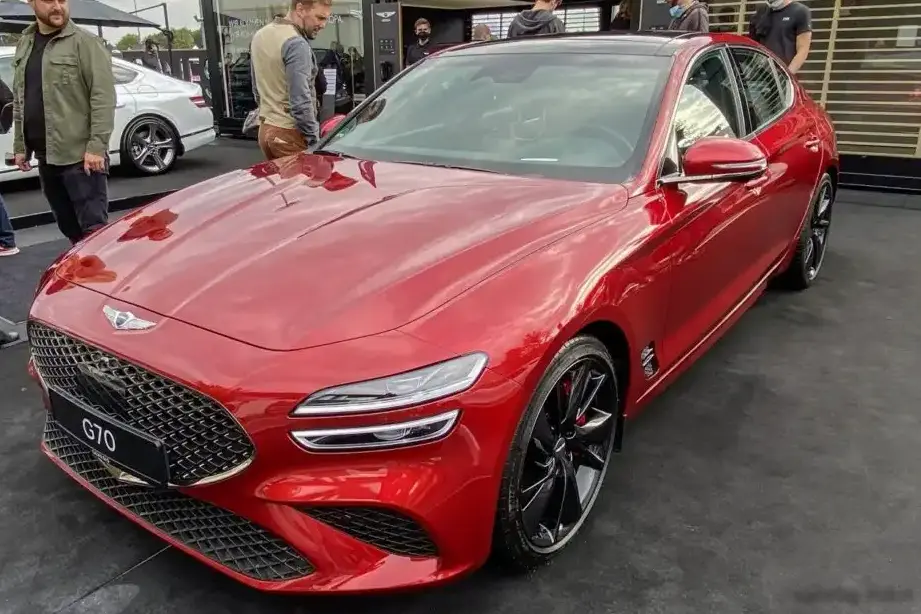
The Genesis G70 2.0T-GDi Automatic, introduced with the facelift in November 2021, represents a key offering in the luxury sport sedan segment. Positioned as the entry-level powertrain option within the G70 range, it provides a balance of performance and efficiency for buyers seeking a premium driving experience. This variant is built upon the LH platform, shared with the Kia Stinger, and aimed to compete with established European rivals like the BMW 3 Series and Mercedes-Benz C-Class, offering a compelling alternative with a focus on value and a comprehensive warranty. The facelift brought significant styling updates and technological enhancements to the G70, further refining its appeal.
Technical Specifications
| Brand | Genesis |
| Model | G70 |
| Generation | G70 (facelift 2020) |
| Type (Engine) | 2.0 T-GDi (245 Hp) Automatic |
| Start of production | November, 2021 |
| Powertrain Architecture | Internal Combustion engine |
| Body type | Sedan |
| Seats | 5 |
| Doors | 4 |
| Fuel consumption at Low speed (WLTP) | 12.8-13.2 l/100 km (18.4 – 17.8 US mpg, 22.1 – 21.4 UK mpg, 7.8 – 7.6 km/l) |
| Fuel consumption at Medium speed (WLTP) | 7.8-8.5 l/100 km (30.2 – 27.7 US mpg, 36.2 – 33.2 UK mpg, 12.8 – 11.8 km/l) |
| Fuel consumption at high speed (WLTP) | 6.5-7.4 l/100 km (36.2 – 31.8 US mpg, 43.5 – 38.2 UK mpg, 15.4 – 13.5 km/l) |
| Fuel consumption at very high speed (WLTP) | 7.4-8.5 l/100 km (31.8 – 27.7 US mpg, 38.2 – 33.2 UK mpg, 13.5 – 11.8 km/l) |
| Combined fuel consumption (WLTP) | 7.9-8.8 l/100 km (29.8 – 26.7 US mpg, 35.8 – 32.1 UK mpg, 12.7 – 11.4 km/l) |
| CO2 emissions (WLTP) | 181-201 g/km |
| Fuel Type | Petrol (Gasoline) |
| Acceleration 0 – 100 km/h | 6.1 sec |
| Acceleration 0 – 62 mph | 6.1 sec |
| Acceleration 0 – 60 mph | 5.8 sec |
| Maximum speed | 240 km/h (149.13 mph) |
| Emission standard | Euro 6d |
| Weight-to-power ratio | 6.8 kg/Hp, 146.3 Hp/tonne |
| Weight-to-torque ratio | 4.7 kg/Nm, 210.7 Nm/tonne |
| Power | 245 Hp @ 6200 rpm |
| Power per litre | 122.6 Hp/l |
| Torque | 353 Nm @ 3500 rpm (260.36 lb.-ft. @ 3500 rpm) |
| Engine layout | Front, Longitudinal |
| Engine Model/Code | Theta II / G4KL |
| Engine displacement | 1998 cm3 (121.93 cu. in.) |
| Number of cylinders | 4 |
| Engine configuration | Inline |
| Cylinder Bore | 86 mm (3.39 in.) |
| Piston Stroke | 86 mm (3.39 in.) |
| Compression ratio | 10:1 |
| Number of valves per cylinder | 4 |
| Fuel injection system | Direct injection |
| Engine aspiration | Turbocharger, Intercooler |
| Engine oil capacity | 5.7 l (6.02 US qt | 5.02 UK qt) |
| Coolant | 7.27 l (7.68 US qt | 6.4 UK qt) |
| Kerb Weight | 1675 kg (3692.74 lbs.) |
| Max. weight | 2140 kg (4717.89 lbs.) |
| Max load | 465 kg (1025.15 lbs.) |
| Trunk (boot) space – minimum | 330 l (11.65 cu. ft.) |
| Fuel tank capacity | 60 l (15.85 US gal | 13.2 UK gal) |
| Permitted trailer load with brakes (12%) | 1500 kg (3306.93 lbs.) |
| Permitted trailer load without brakes | 750 kg (1653.47 lbs.) |
| Length | 4685 mm (184.45 in.) |
| Width | 1850 mm (72.83 in.) |
| Height | 1400 mm (55.12 in.) |
| Wheelbase | 2835 mm (111.61 in.) |
| Front track | 1592 mm (62.68 in.) |
| Rear (Back) track | 1596 mm (62.83 in.) |
| Front overhang | 805 mm (31.69 in.) |
| Rear overhang | 1045 mm (41.14 in.) |
| Ride height (ground clearance) | 130 mm (5.12 in.) |
| Drag coefficient (Cd) | 0.28 |
| Minimum turning circle (turning diameter) | 11 m (36.09 ft.) |
| Drivetrain Architecture | The Internal combustion engine (ICE) drives the rear wheels of the vehicle. |
| Drive wheel | Rear wheel drive |
| Number of gears and type of gearbox | 8 gears, automatic transmission |
| Front suspension | Independent type McPherson |
| Rear suspension | Independent multi-link suspension |
| Front brakes | Ventilated discs, 345-350 mm |
| Rear brakes | Ventilated discs, 330-340 mm |
| Assisting systems | ABS (Anti-lock braking system) |
| Steering type | Steering rack and pinion |
| Power steering | Electric Steering |
| Tires size | Front wheel tires: 225/45 R18; 225/40 ZR19 Rear wheel tires: 225/45 R18; 255/35 ZR19 |
| Wheel rims size | Front wheel rims: 8.0J x 18; 8.0J x 19 Rear wheel rims: 8.0J x 18; 8.5J x 19 |
Powertrain & Engine Architecture
At the heart of the G70 2.0T-GDi lies the Hyundai-Kia Theta II engine, specifically the G4KL variant. This 1.998-liter, turbocharged inline-four cylinder engine produces 245 horsepower at 6,200 rpm and 260 lb-ft of torque at 3,500 rpm. The engine utilizes direct injection technology, enhancing fuel efficiency and responsiveness. A twin-scroll turbocharger with an intercooler minimizes turbo lag and maximizes power delivery. The engine’s architecture is longitudinal, meaning it’s mounted lengthwise in the engine bay, contributing to a rear-wheel-drive layout. The G70 2.0T-GDi is paired with an eight-speed automatic transmission, providing smooth and efficient gear changes. This transmission is designed for both comfortable cruising and spirited driving, with paddle shifters available for manual control.
Driving Characteristics
The 2.0T-GDi Automatic offers a refined and engaging driving experience. While not as overtly powerful as the G70 3.3T, it delivers ample acceleration, achieving 0-60 mph in approximately 5.8 seconds. The eight-speed automatic transmission is well-tuned, providing quick and seamless shifts. The gear ratios are optimized for both fuel economy and performance, with a focus on providing strong mid-range torque. Compared to the manual transmission version, the automatic offers greater convenience, particularly in urban driving. However, some driving enthusiasts may prefer the more direct control offered by the manual. The rear-wheel-drive configuration contributes to balanced handling and a sporty feel.
Equipment & Trim Levels
The G70 2.0T-GDi Automatic typically comes standard with a generous array of features, including leather upholstery, a 10.25-inch touchscreen infotainment system with Apple CarPlay and Android Auto compatibility, a premium sound system, and a suite of advanced driver-assistance systems (ADAS) such as forward collision avoidance assist, lane keeping assist, and adaptive cruise control. Optional extras include a panoramic sunroof, ventilated front seats, and a Lexicon premium audio system. Trim levels often build upon this base, adding cosmetic enhancements and additional convenience features.
Chassis & Braking
The G70 features a multi-link rear suspension, contributing to a comfortable ride and precise handling. The front suspension utilizes a McPherson strut design. Braking duties are handled by ventilated discs on all four wheels, providing strong stopping power. The G70 2.0T-GDi typically features 345-350mm front rotors and 330-340mm rear rotors. ABS (Anti-lock Braking System) is standard, enhancing safety and control during emergency braking situations. The chassis is designed to provide a balance between comfort and agility, offering a composed ride quality without sacrificing handling performance.
Market Reception & Comparison
The Genesis G70 2.0T-GDi Automatic was generally well-received by automotive critics. It was praised for its stylish design, comfortable interior, and engaging driving dynamics. Compared to its competitors, the G70 offered a compelling value proposition, providing a similar level of luxury and performance at a lower price point. Fuel economy figures are competitive within its class, averaging around 29.8-26.7 US mpg combined. Reliability has been generally good, although some owners have reported minor issues with the infotainment system. Compared to the higher-output 3.3T model, the 2.0T-GDi appeals to buyers who prioritize fuel efficiency and a more balanced driving experience.
Legacy
The Genesis G70 2.0T-GDi Automatic has established itself as a strong contender in the luxury sport sedan segment. The Theta II engine, while not without its share of reported oil consumption issues in some Hyundai/Kia applications, has proven to be relatively durable when properly maintained. On the used car market, the G70 2.0T-GDi offers a compelling combination of luxury, performance, and value. Its comprehensive warranty and relatively low maintenance costs make it an attractive option for buyers seeking a premium sedan without the premium price tag. The G70 helped establish Genesis as a legitimate luxury brand, challenging the established players in the market.