
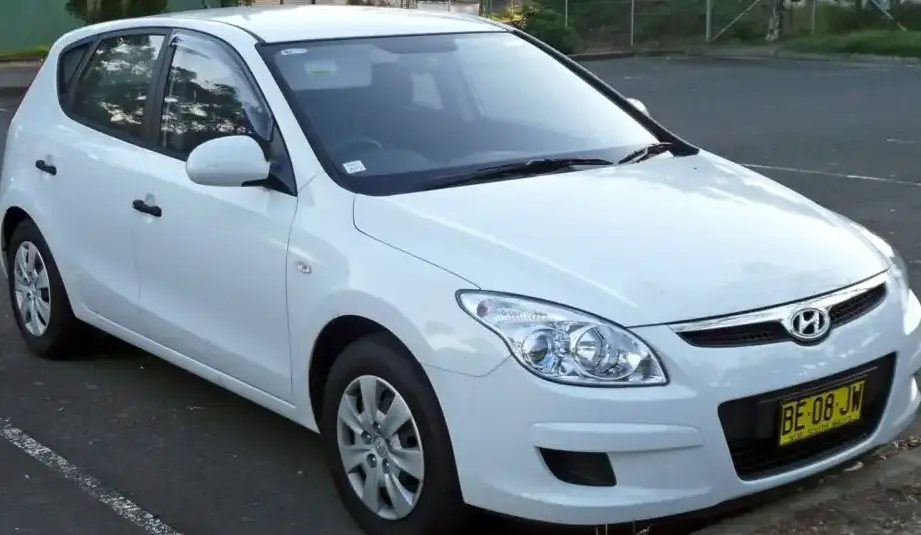
The Hyundai i30 1.6 (126 hp) Automatic, produced between 2007 and 2010, represented a significant step forward for Hyundai in the competitive European C-segment hatchback market. Part of the first generation i30 (FD) series, built on the Hyundai-Kia PB platform, this variant aimed to offer a comfortable and economical driving experience, appealing to buyers prioritizing ease of use over outright performance. It served as a mid-range offering within the i30 lineup, positioned between the base 1.4L engine and the more powerful 1.6L manual and diesel options. The i30 was Hyundai’s first car to be conceived, designed and tested in Europe, and this model was crucial in establishing the brand’s presence and reputation for value and reliability in the region.
Technical Specifications
| Brand | Hyundai |
| Model | i30 |
| Generation | i30 I |
| Type (Engine) | 1.6 (126 Hp) Automatic |
| Start of production | 2007 |
| End of production | 2010 |
| Powertrain Architecture | Internal Combustion engine |
| Body type | Hatchback |
| Seats | 5 |
| Doors | 5 |
| Fuel consumption (urban) | 9 l/100 km (26.1 US mpg) |
| Fuel consumption (extra urban) | 5.7 l/100 km (41.3 US mpg) |
| Fuel consumption (combined) | 6.9 l/100 km (34.1 US mpg) |
| Fuel Type | Petrol (Gasoline) |
| Acceleration 0 – 100 km/h | 12.1 sec |
| Acceleration 0 – 62 mph | 12.1 sec |
| Acceleration 0 – 60 mph | 11.5 sec |
| Maximum speed | 183 km/h (113.71 mph) |
| Emission standard | Euro 4 |
| Weight-to-power ratio | 9.6 kg/Hp |
| Weight-to-torque ratio | 7.9 kg/Nm |
| Power | 126 Hp @ 6200 rpm |
| Torque | 154 Nm @ 4200 rpm (113.58 lb.-ft. @ 4200 rpm) |
| Engine layout | Front, Transverse |
| Engine Model/Code | G4FC |
| Engine displacement | 1591 cm3 (97.09 cu. in.) |
| Number of cylinders | 4 |
| Engine configuration | Inline |
| Cylinder Bore | 77 mm (3.03 in.) |
| Piston Stroke | 85.4 mm (3.36 in.) |
| Compression ratio | 10.5:1 |
| Number of valves per cylinder | 4 |
| Fuel injection system | Multi-port manifold injection |
| Engine aspiration | Naturally aspirated engine |
| Valvetrain | DOHC |
| Engine oil capacity | 3.3 l (3.49 US qt | 2.9 UK qt) |
| Coolant capacity | 6 l (6.34 US qt | 5.28 UK qt) |
| Kerb Weight | 1214 kg (2676.41 lbs.) |
| Max. weight | 1740 kg (3836.04 lbs.) |
| Max load | 526 kg (1159.63 lbs.) |
| Trunk (boot) space – minimum | 340 l (12.01 cu. ft.) |
| Trunk (boot) space – maximum | 1250 l (44.14 cu. ft.) |
| Fuel tank capacity | 53 l (14 US gal | 11.66 UK gal) |
| Length | 4245 mm (167.13 in.) |
| Width | 1775 mm (69.88 in.) |
| Height | 1480 mm (58.27 in.) |
| Wheelbase | 2650 mm (104.33 in.) |
| Front track | 1546 mm (60.87 in.) |
| Rear track | 1544 mm (60.79 in.) |
| Drag coefficient (Cd) | 0.33 |
| Minimum turning circle | 10.2 m (33.46 ft.) |
| Drivetrain | Front wheel drive |
| Number of gears | 4 |
| Gearbox type | Automatic transmission |
| Front brakes | Ventilated discs |
| Rear brakes | Disc |
| Assisting systems | ABS (Anti-lock braking system) |
| Steering type | Steering rack and pinion |
| Tires size | 185/65 R15 H |
| Wheel rims size | 15 |
Powertrain & Engine Architecture
The i30 1.6 Automatic was powered by Hyundai’s G4FC engine, a 1.6-liter inline-four cylinder gasoline engine. This engine featured a dual overhead camshaft (DOHC) valvetrain with four valves per cylinder, and utilized multi-point fuel injection. The G4FC was a relatively simple and robust design, prioritizing reliability and fuel efficiency over outright power. The engine produced 126 horsepower at 6,200 rpm and 154 Nm (113.58 lb-ft) of torque at 4,200 rpm. The automatic transmission was a conventional four-speed unit, chosen for its smoothness and ease of use. While not offering the efficiency of more modern transmissions, it suited the target demographic of drivers seeking a comfortable and uncomplicated driving experience. The engine code ‘G4FC’ is a key identifier for this specific engine variant, and parts availability remains reasonable in many markets.
Driving Characteristics
The i30 1.6 Automatic offered a comfortable, if not particularly sporty, driving experience. Acceleration from 0-60 mph took around 11.5 to 12.1 seconds, and top speed was approximately 113.71 mph. The four-speed automatic transmission, while smooth, lacked the responsiveness of more modern gearboxes and could sometimes feel hesitant during quick acceleration. The gear ratios were optimized for fuel economy and cruising comfort rather than performance. Compared to the manual transmission version of the same engine, the automatic suffered a slight performance penalty due to the transmission’s inherent inefficiencies. The 1.6L engine provided adequate power for everyday driving, but felt strained when fully loaded or tackling steep inclines. It was noticeably less powerful than the higher-spec 1.6L manual or the diesel variants.
Equipment & Trim Levels
The i30 1.6 Automatic typically came equipped with air conditioning, power steering, electric front windows, and a basic audio system. Safety features included ABS brakes and front airbags. Higher trim levels, often denoted by ‘Comfort’ or ‘Style’ packages, added features such as alloy wheels, rear electric windows, a trip computer, and upgraded interior trim. Interior upholstery was typically cloth, with a relatively simple dashboard layout. Optional extras included a sunroof, parking sensors, and a more advanced audio system with CD player. The overall interior ambiance was functional and well-built, but lacked the premium feel of some competitors.
Chassis & Braking
The i30’s chassis featured a MacPherson strut front suspension and a coupled torsion beam rear suspension. This setup provided a comfortable ride quality, although it wasn’t particularly engaging for enthusiastic drivers. The front brakes were ventilated discs, while the rear brakes were solid discs. ABS (Anti-lock Braking System) was standard. The suspension was tuned for comfort and stability, prioritizing ride quality over sharp handling. The steering was light and easy to use, making it well-suited for urban driving. The 15-inch wheels and 185/65 R15 tires contributed to the comfortable ride, but didn’t offer a great deal of grip.
Market Reception & Comparison
The Hyundai i30 1.6 Automatic was generally well-received by critics as a practical and affordable family hatchback. It was praised for its comfortable ride, spacious interior, and competitive price. However, it was often criticized for its lack of performance and the somewhat dated four-speed automatic transmission. Compared to rivals like the Ford Focus, Volkswagen Golf, and Opel Astra, the i30 offered a compelling value proposition, but lacked the brand prestige and driving dynamics of some competitors. Fuel economy was respectable, averaging around 34.1 US mpg in combined driving, but was not class-leading. Reliability was generally good, and the i30 proved to be a durable and dependable vehicle.
Legacy
The Hyundai i30 1.6 Automatic has proven to be a reliable and affordable used car. The G4FC engine is known for its durability, and the four-speed automatic transmission, while not the most sophisticated, is generally robust. Parts availability is good, and maintenance costs are relatively low. While not a particularly sought-after variant, the i30 1.6 Automatic remains a practical and economical choice for buyers seeking a comfortable and dependable family hatchback. Its contribution lies in establishing Hyundai as a serious contender in the European market, paving the way for the brand’s continued success and growth.
