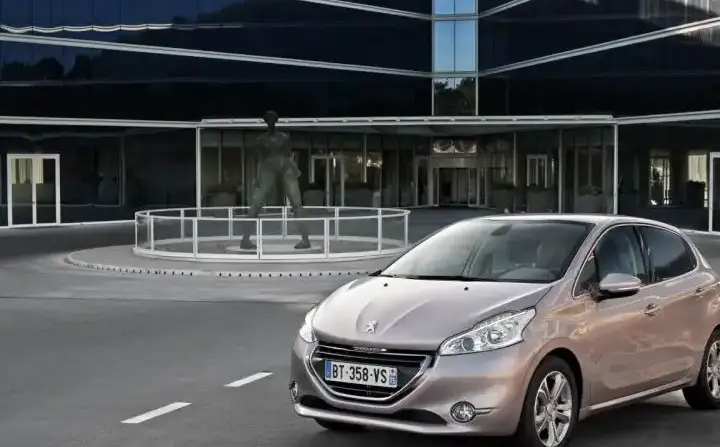
The Peugeot 208 I (Phase II), specifically the 1.6 BlueHDi 75 horsepower variant, was a popular subcompact hatchback produced from 2015 to 2018. This model represented a mid-life refresh of the first-generation 208 (T1 series), building upon the success of the original launch in 2012. Positioned as an entry-level diesel option within the 208 range, it aimed to provide fuel efficiency and affordability to a broad customer base, particularly in European markets where diesel engines were prevalent. It sat below the more powerful BlueHDi 100 and 120 variants, and alongside the petrol-powered options.
Technical Specifications
| Brand | Peugeot |
| Model | 208 |
| Generation | 208 I (Phase II, 2015) |
| Type (Engine) | 1.6 BlueHDi (75 Hp) |
| Start of production | 2015 |
| End of production | 2018 |
| Powertrain Architecture | Internal Combustion engine |
| Body type | Hatchback |
| Seats | 5 |
| Doors | 3-5 |
| Fuel consumption (urban) | 4.2 l/100 km (56 US mpg, 67.3 UK mpg, 23.8 km/l) |
| Fuel consumption (extra urban) | 3.2 l/100 km (73.5 US mpg, 88.3 UK mpg, 31.3 km/l) |
| Fuel consumption (combined) | 3.6 l/100 km (65.3 US mpg, 78.5 UK mpg, 27.8 km/l) |
| CO2 emissions | 93 g/km |
| Fuel Type | Diesel |
| Acceleration 0 – 100 km/h | 13.3 sec |
| Acceleration 0 – 62 mph | 13.3 sec |
| Acceleration 0 – 60 mph | 12.6 sec |
| Maximum speed | 171 km/h (106.25 mph) |
| Emission standard | Euro 6 |
| Weight-to-power ratio | 14.2 kg/Hp, 70.4 Hp/tonne |
| Weight-to-torque ratio | 4.6 kg/Nm, 216 Nm/tonne |
| Power | 75 Hp @ 3500 rpm |
| Power per litre | 48.1 Hp/l |
| Torque | 230 Nm @ 1750 rpm (169.64 lb.-ft. @ 1750 rpm) |
| Engine layout | Front, Transverse |
| Engine Model/Code | BHW DV6FE |
| Engine displacement | 1560 cm3 (95.2 cu. in.) |
| Number of cylinders | 4 |
| Engine configuration | Inline |
| Number of valves per cylinder | 2 |
| Fuel injection system | Diesel Commonrail |
| Engine aspiration | Turbocharger, Intercooler |
| Engine oil capacity | 3.75 l (3.96 US qt | 3.3 UK qt) |
| Coolant capacity | 6 l (6.34 US qt | 5.28 UK qt) |
| Kerb Weight | 1065 kg (2347.92 lbs.) |
| Max. weight | 1635 kg (3604.56 lbs.) |
| Max load | 570 kg (1256.63 lbs.) |
| Trunk (boot) space – minimum | 285 l (10.06 cu. ft.) |
| Trunk (boot) space – maximum | 1076 l (38 cu. ft.) |
| Fuel tank capacity | 50 l (13.21 US gal | 11 UK gal) |
| Permitted trailer load with brakes (12%) | 660 kg (1455.05 lbs.) |
| Length | 3973 mm (156.42 in.) |
| Width | 1829 mm (72.01 in.) |
| Width including mirrors | 2004 mm (78.9 in.) |
| Height | 1460 mm (57.48 in.) |
| Wheelbase | 2538 mm (99.92 in.) |
| Front track | 1475-1470 mm (58.07 – 57.87 in.) |
| Rear (Back) track | 1471-1467 mm (57.91 – 57.76 in.) |
| Ride height (ground clearance) | 123-129 mm (4.84 – 5.08 in.) |
| Minimum turning circle (turning diameter) | 10.4 m (34.12 ft.) |
| Drivetrain Architecture | The Internal combustion engine (ICE) drives the front wheels of the vehicle. |
| Drive wheel | Front wheel drive |
| Number of gears and type of gearbox | 5 gears, manual transmission |
| Front suspension | Independent type McPherson |
| Rear suspension | Elastic beam |
| Front brakes | Ventilated discs |
| Rear brakes | Drum |
| Assisting systems | ABS (Anti-lock braking system) |
| Steering type | Steering rack and pinion |
INTRODUCTION
The Peugeot 208 I Phase II 1.6 BlueHDi 75, launched in 2015, was a key variant in Peugeot’s popular subcompact hatchback range. Built on the 1HX0/A3 platform, this version aimed to deliver exceptional fuel economy and low running costs, appealing to buyers prioritizing practicality and efficiency. The Phase II update brought styling revisions, improved interior materials, and updated technology, including a touchscreen infotainment system. This particular engine and transmission combination was designed to be the most accessible diesel option, offering a balance between affordability and acceptable performance.
Powertrain & Engine Architecture
At the heart of the 208 1.6 BlueHDi 75 lies the DV6FE engine, specifically the BHW variant. This 1.6-liter, four-cylinder diesel engine utilizes a common rail direct injection system, delivering fuel directly into the combustion chamber at extremely high pressure. This, combined with a turbocharger and intercooler, optimizes combustion for improved power and efficiency. The engine features two valves per cylinder and operates with a compression ratio of around 16:1. The 75 horsepower output is achieved at 3500 rpm, while the peak torque of 230 Nm (169.64 lb.-ft.) is available from just 1750 rpm, providing good low-end responsiveness. The engine is paired with a five-speed manual transmission, chosen for its simplicity and cost-effectiveness. While an automatic transmission was available on other 208 models, it wasn’t offered with this specific engine configuration.
Driving Characteristics
The 1.6 BlueHDi 75 hp variant of the 208 offered a comfortable, if not particularly exhilarating, driving experience. Acceleration from 0-60 mph took around 12.6 seconds, and top speed was limited to 106.25 mph. The focus was clearly on fuel economy rather than outright performance. The engine’s strong low-end torque made it suitable for urban driving and overtaking at lower speeds. However, on the highway, the engine could feel strained when climbing hills or accelerating quickly. Compared to the more powerful BlueHDi 100 and 120 models, the 75 hp version felt noticeably slower. The five-speed gearbox was well-matched to the engine’s characteristics, with relatively short gear ratios aiding acceleration, but also contributing to a higher engine speed at cruising speeds.
Equipment & Trim Levels
The 1.6 BlueHDi 75 typically came equipped with a reasonable level of standard equipment. This included air conditioning, electric front windows, a basic audio system with USB connectivity, and ABS brakes. Higher trim levels, such as Active and Allure, added features like alloy wheels, a touchscreen infotainment system, Bluetooth connectivity, cruise control, and rear parking sensors. Interior upholstery was typically cloth, with a functional and durable design. Optional extras included a panoramic sunroof, navigation system, and automatic headlights and wipers.
Chassis & Braking
The 208 1.6 BlueHDi 75 utilized a McPherson strut front suspension and an elastic beam rear suspension. This setup provided a good balance between ride comfort and handling. The front brakes were ventilated discs, offering adequate stopping power, while the rear brakes were drums, a cost-saving measure for this entry-level variant. The steering was a rack and pinion system, providing precise and responsive control. The relatively lightweight nature of the vehicle (1065 kg / 2347.92 lbs.) helped to contribute to its agility.
Market Reception & Comparison
The Peugeot 208 1.6 BlueHDi 75 was generally well-received by critics for its exceptional fuel economy and low running costs. It was praised as a practical and affordable option for urban commuters. However, some reviewers noted its lack of outright performance compared to higher-powered variants and competitors. Compared to the petrol-powered 1.2 PureTech engines, the BlueHDi 75 offered significantly better fuel economy, but at the cost of refinement and responsiveness. Against other diesel-powered subcompacts, such as the Volkswagen Polo and Renault Clio, the 208 offered a competitive package in terms of price and efficiency.
Legacy
The 1.6 BlueHDi engine proved to be a reliable and durable powertrain, although, like all diesel engines, it was susceptible to issues related to the diesel particulate filter (DPF) if not driven on longer journeys regularly. In the used car market, the 208 1.6 BlueHDi 75 remains a popular choice for buyers seeking an economical and practical hatchback. Its reputation for fuel efficiency and relatively low maintenance costs continues to make it an attractive option, even as newer, more technologically advanced models have emerged. The engine’s longevity and availability of spare parts contribute to its continued appeal.