
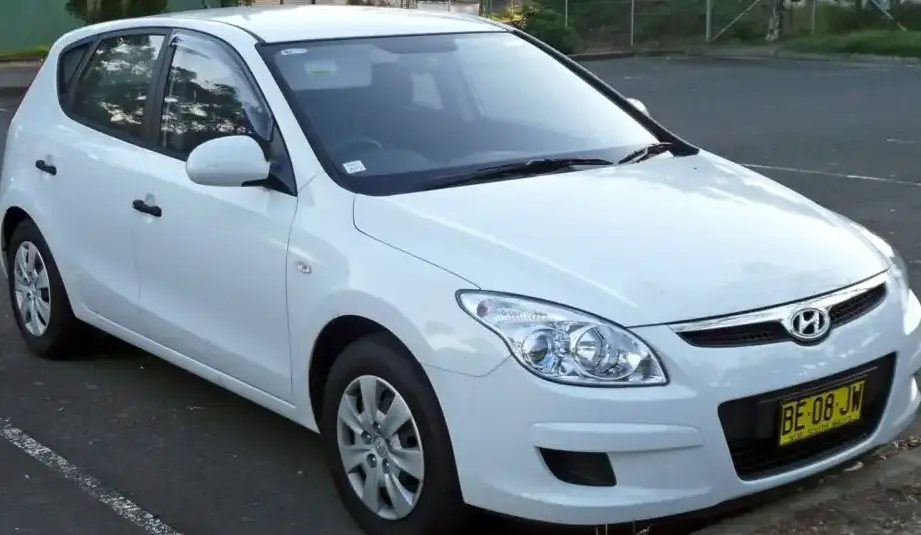
Technical Specifications
| Brand | Hyundai |
| Model | i30 |
| Generation | i30 I |
| Type (Engine) | 2.0 (143 Hp) |
| Start of production | 2007 |
| End of production | 2010 |
| Powertrain Architecture | Internal Combustion engine |
| Body type | Hatchback |
| Seats | 5 |
| Doors | 5 |
| Fuel consumption (urban) | 9.3 l/100 km (25.3 US mpg) |
| Fuel consumption (extra urban) | 5.9 l/100 km (39.9 US mpg) |
| Fuel consumption (combined) | 7.1 l/100 km (33.1 US mpg) |
| Fuel Type | Petrol (Gasoline) |
| Acceleration 0 – 100 km/h | 10.6 sec |
| Acceleration 0 – 62 mph | 10.6 sec |
| Acceleration 0 – 60 mph | 10.1 sec |
| Maximum speed | 205 km/h (127.38 mph) |
| Emission standard | Euro 4 |
| Weight-to-power ratio | 9.3 kg/Hp |
| Weight-to-torque ratio | 7.1 kg/Nm |
| Power | 143 Hp @ 6000 rpm |
| Torque | 186 Nm @ 4500 rpm (137.19 lb.-ft. @ 4500 rpm) |
| Engine layout | Front, Transverse |
| Engine Model/Code | G4GC |
| Engine displacement | 1975 cm3 (120.52 cu. in.) |
| Number of cylinders | 4 |
| Engine configuration | Inline |
| Cylinder Bore | 82 mm (3.23 in.) |
| Piston Stroke | 93.5 mm (3.68 in.) |
| Compression ratio | 10:1 |
| Number of valves per cylinder | 4 |
| Fuel injection system | Multi-port manifold injection |
| Engine aspiration | Naturally aspirated engine |
| Valvetrain | DOHC |
| Engine oil capacity | 4 l (4.23 US qt | 3.52 UK qt) |
| Coolant capacity | 6.6 l (6.97 US qt | 5.81 UK qt) |
| Kerb Weight | 1327 kg (2925.53 lbs.) |
| Max. weight | 1780 kg (3924.23 lbs.) |
| Max load | 453 kg (998.69 lbs.) |
| Trunk (boot) space – minimum | 340 l (12.01 cu. ft.) |
| Trunk (boot) space – maximum | 1200 l (42.38 cu. ft.) |
| Fuel tank capacity | 53 l (14 US gal | 11.66 UK gal) |
| Length | 4245 mm (167.13 in.) |
| Width | 1775 mm (69.88 in.) |
| Height | 1480 mm (58.27 in.) |
| Wheelbase | 2650 mm (104.33 in.) |
| Drivetrain Architecture | Front wheel drive |
| Number of gears | 5 |
| Gearbox type | Manual transmission |
| Front brakes | Ventilated discs |
| Rear brakes | Disc |
| Assisting systems | ABS (Anti-lock braking system) |
| Tires size | 205/55 R15 |
| Wheel rims size | 15 |
The Hyundai i30 2.0, produced from 2007 to 2010, marked a significant step for Hyundai in establishing a presence in the competitive European compact hatchback market. Based on the 1HX0 platform – also shared with the Kia Cee’d – the i30 aimed to deliver a practical, well-equipped, and affordable vehicle. The 2.0-liter engine variant occupied a mid-range position within the i30 lineup, offering a performance upgrade over the base 1.6-liter models while remaining a more accessible option than any potential future performance-focused trims. It was designed to appeal to drivers who needed a bit more power for highway driving or regularly carried passengers and cargo.
Powertrain & Engine Architecture
The i30 2.0 is powered by the G4GC engine, a 1.975-liter (120.52 cubic inches) inline-four cylinder gasoline engine. This engine is naturally aspirated, meaning it doesn’t rely on a turbocharger or supercharger for increased power. It features a double overhead camshaft (DOHC) valvetrain with four valves per cylinder, optimizing airflow for improved performance. Fuel is delivered via a multi-port fuel injection system, ensuring precise fuel metering for efficient combustion. The engine generates 143 horsepower at 6000 rpm and 186 Nm (137.19 lb-ft) of torque at 4500 rpm. While a five-speed manual transmission was the standard offering, a four-speed automatic transmission was available as an option. The automatic, however, generally resulted in reduced fuel economy and a less engaging driving experience due to its less efficient operation and wider gear ratios.
Driving Characteristics
The i30 2.0 equipped with the five-speed manual transmission provided a reasonably enjoyable driving experience. Acceleration from 0 to 60 mph took around 10.1 seconds, and the vehicle could achieve a top speed of 127.38 mph. The engine offered sufficient power for everyday driving situations, providing a noticeable improvement in responsiveness compared to the smaller 1.6-liter engines. The five-speed gearbox was well-matched to the engine’s powerband, allowing for comfortable cruising at highway speeds. The automatic transmission version, however, suffered from a noticeable decrease in performance due to the transmission’s inherent inefficiencies. The i30’s suspension was tuned for comfort, providing a compliant ride quality, but it didn’t offer the same level of handling precision found in some of its more dynamically focused competitors.
Equipment & Trim Levels
The i30 2.0 typically came with a solid set of standard features. These included air conditioning, power windows, central locking, and a CD player-equipped audio system. Higher trim levels, such as the Style and Comfort variants, added features like alloy wheels, front fog lights, a trip computer, and upgraded interior materials. Interior upholstery was generally cloth, with leather options available on the higher-specification models. Optional extras included a sunroof, parking sensors, and a more sophisticated audio system. The dashboard design was functional and user-friendly, prioritizing ease of use over elaborate styling.
Chassis & Braking
The i30’s chassis utilized a MacPherson strut front suspension and a coupled torsion beam rear suspension. This configuration struck a good balance between ride comfort and handling stability. Braking was handled by ventilated discs at the front and solid discs at the rear. Anti-lock Braking System (ABS) was standard across all i30 models, enhancing safety. The i30 2.0’s weight of approximately 2925.53 lbs meant the braking system was adequately sized for its performance capabilities. Stabilizer bars were fitted to both the front and rear axles to minimize body roll during cornering maneuvers.
Market Reception & Comparison
The Hyundai i30 2.0 generally received positive reviews from automotive journalists. It was praised for its value proposition, comfortable ride, and spacious interior. However, some critics pointed out that the engine, while adequate, wasn’t as refined or powerful as some of its competitors. Compared to the 1.6-liter i30 models, the 2.0-liter offered a significant performance improvement, but at the expense of slightly increased fuel consumption. When compared to established rivals like the Volkswagen Golf and Ford Focus, the i30 2.0 offered a more affordable alternative, but lacked the same level of brand recognition and dynamic driving experience. Combined fuel economy was rated around 33.1 US mpg, which was competitive for vehicles in its class.
Legacy
The Hyundai i30 2.0 proved to be a reliable and durable vehicle. The G4GC engine is known for its longevity, and with proper maintenance, can achieve high mileage without major issues. The i30’s relatively simple mechanical design contributes to its ease of repair and affordability of parts. In the used car market, the i30 2.0 remains a popular choice for buyers seeking a practical and dependable hatchback. While not a performance icon, it represents a crucial milestone in Hyundai’s evolution towards becoming a major player in the European automotive landscape. Spare parts availability remains good, and the i30’s relatively low running costs continue to make it an attractive option for budget-conscious buyers.
