
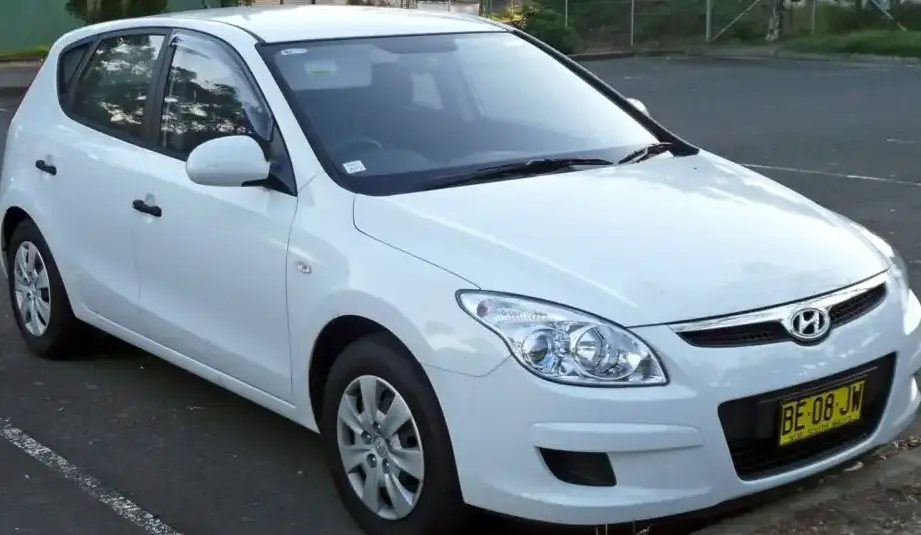
The Hyundai i30, launched in 2007, represented a significant step forward for the Korean automaker in the European compact hatchback market. Designed as a direct competitor to established players like the Volkswagen Golf and Ford Focus, the i30 aimed to offer a compelling blend of style, practicality, and value. The first generation, designated the i30 I (and internally as FD), was produced from 2007 to 2010, with a facelift arriving in 2009. Within the i30 I range, the 2.0-liter (143 hp) automatic variant occupied a mid-range position, offering a more refined driving experience than the base 1.6-liter models, but at a slightly higher price point. This model was primarily targeted towards buyers seeking comfort and convenience, rather than outright performance.
Technical Specifications
| Brand | Hyundai |
| Model | i30 |
| Generation | i30 I |
| Type (Engine) | 2.0 (143 Hp) Automatic |
| Start of production | 2007 |
| End of production | 2010 |
| Powertrain Architecture | Internal Combustion engine |
| Body type | Hatchback |
| Seats | 5 |
| Doors | 5 |
| Fuel consumption (urban) | 10.3 l/100 km (22.8 US mpg) |
| Fuel consumption (extra urban) | 6.1 l/100 km (38.6 US mpg) |
| Fuel consumption (combined) | 7.6 l/100 km (30.9 US mpg) |
| Fuel Type | Petrol (Gasoline) |
| Acceleration 0 – 100 km/h | 10.6 sec |
| Acceleration 0 – 62 mph | 10.6 sec |
| Acceleration 0 – 60 mph | 10.1 sec |
| Maximum speed | 195 km/h (121.17 mph) |
| Emission standard | Euro 4 |
| Weight-to-power ratio | 9.4 kg/Hp |
| Weight-to-torque ratio | 7.2 kg/Nm |
| Power | 143 Hp @ 6000 rpm |
| Torque | 186 Nm @ 4500 rpm (137.19 lb.-ft. @ 4500 rpm) |
| Engine layout | Front, Transverse |
| Engine Model/Code | G4GC |
| Engine displacement | 1975 cm3 (120.52 cu. in.) |
| Number of cylinders | 4 |
| Engine configuration | Inline |
| Cylinder Bore | 82 mm (3.23 in.) |
| Piston Stroke | 93.5 mm (3.68 in.) |
| Compression ratio | 10:1 |
| Number of valves per cylinder | 4 |
| Fuel injection system | Multi-port manifold injection |
| Engine aspiration | Naturally aspirated engine |
| Valvetrain | DOHC |
| Engine oil capacity | 4 l (4.23 US qt | 3.52 UK qt) |
| Coolant capacity | 6.6 l (6.97 US qt | 5.81 UK qt) |
| Kerb Weight | 1342 kg (2958.6 lbs.) |
| Max. weight | 1790 kg (3946.27 lbs.) |
| Max load | 448 kg (987.67 lbs.) |
| Trunk (boot) space – minimum | 340 l (12.01 cu. ft.) |
| Trunk (boot) space – maximum | 1200 l (42.38 cu. ft.) |
| Fuel tank capacity | 53 l (14 US gal | 11.66 UK gal) |
| Length | 4245 mm (167.13 in.) |
| Width | 1775 mm (69.88 in.) |
| Height | 1480 mm (58.27 in.) |
| Wheelbase | 2650 mm (104.33 in.) |
| Drivetrain | Front wheel drive |
| Number of gears | 4 |
| Gearbox type | Automatic transmission |
| Front brakes | Ventilated discs |
| Rear brakes | Disc |
| Tires size | 205/55 R15 |
| Wheel rims size | 15 |
Powertrain & Engine Architecture
The heart of the i30 2.0 Automatic is the Hyundai G4GC engine, a 1.975-liter inline-four cylinder gasoline engine. This engine utilizes a naturally aspirated configuration, meaning it doesn’t employ turbocharging or supercharging. It features a double overhead camshaft (DOHC) valvetrain with four valves per cylinder, contributing to its relatively efficient breathing. Fuel delivery is managed by a multi-port fuel injection system, a common setup for engines of this era. The G4GC engine produces 143 horsepower at 6000 rpm and 186 Nm (137.19 lb-ft) of torque at 4500 rpm. Paired with this engine is a four-speed automatic transmission. While not as sophisticated as the five or six-speed automatics becoming more prevalent at the time, it provided smooth, if not particularly sporty, gear changes. The transmission was chosen to prioritize comfort and ease of use over outright performance.
Driving Characteristics
The i30 2.0 Automatic offered a comfortable and predictable driving experience. The four-speed automatic transmission, while lacking the responsiveness of a manual gearbox or a more modern automatic, provided smooth shifts and made city driving particularly easy. Acceleration from 0-60 mph took around 10.1 seconds, which was adequate for everyday driving but didn’t position it as a performance-oriented hatchback. The engine delivered its peak torque at 4500 rpm, meaning that drivers needed to apply a reasonable amount of throttle to access its full power. Compared to the 1.6-liter i30 models, the 2.0-liter offered noticeably more punch, especially when fully loaded or tackling inclines. However, it wasn’t as engaging to drive as the manual transmission versions, which allowed for more driver control.
Equipment & Trim Levels
The 2.0-liter Automatic i30 typically came equipped with a reasonable level of standard features. These generally included air conditioning, power windows, central locking, and an integrated audio system with CD player. Safety features such as ABS (Anti-lock Braking System) and front airbags were also standard. Higher trim levels offered options like alloy wheels, a sunroof, and upgraded interior upholstery. Interior materials were generally durable and functional, though not particularly luxurious. The dashboard layout was straightforward and user-friendly, prioritizing practicality over aesthetic flair.
Chassis & Braking
The i30 I utilized a MacPherson strut front suspension and a coupled torsion beam rear suspension. This setup provided a good balance between ride comfort and handling. The front brakes were ventilated discs, offering good stopping power, while the rear brakes were solid discs. The steering was hydraulically assisted, providing a reasonably direct feel. The i30’s suspension was tuned for comfort, absorbing bumps and imperfections in the road surface effectively. Stabilizer bars were fitted to both the front and rear axles to reduce body roll during cornering.
Market Reception & Comparison
The Hyundai i30 2.0 Automatic was generally well-received by automotive critics as a practical and well-equipped hatchback. However, some reviewers noted that the four-speed automatic transmission felt dated compared to the more advanced gearboxes offered by competitors. Fuel economy was respectable, but not class-leading, averaging around 30.9 US mpg in combined driving. Compared to the 1.6-liter i30 models, the 2.0-liter offered a noticeable performance improvement, but at a higher price. The 2.0-liter was also a more compelling option than diesel variants for drivers who preferred the refinement of a gasoline engine.
Legacy
The Hyundai i30 I 2.0 Automatic, while not a particularly rare or collectible vehicle, has proven to be relatively reliable over the long term. The G4GC engine is known for its durability, and the four-speed automatic transmission, while simple, is generally robust. In the used car market, these i30s represent a good value proposition for buyers seeking an affordable and practical hatchback. Maintenance costs are typically reasonable, and parts availability is generally good. The i30 I laid the foundation for Hyundai’s continued success in the European market, establishing the brand as a credible alternative to established European automakers.
