
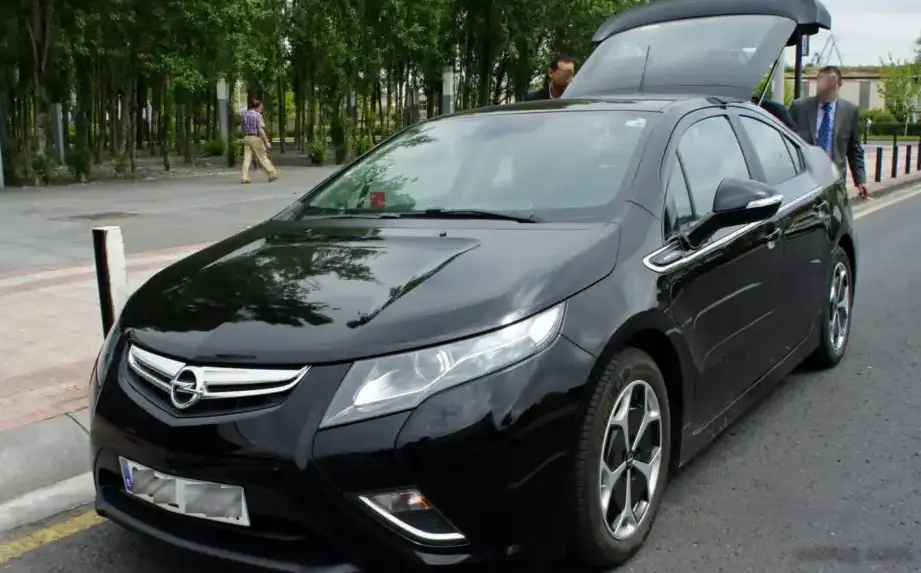
The Opel Ampera, launched in January 2012 and produced through November 2016, represented Opel’s entry into the burgeoning plug-in hybrid electric vehicle (PHEV) market. Based heavily on the Chevrolet Volt, the Ampera was primarily aimed at the European market, offering a blend of electric driving for daily commutes and gasoline-powered range for longer journeys. This specific variant, equipped with a 1.4-liter gasoline engine paired with an electric motor producing a combined 150 horsepower, occupied a unique position within Opel’s lineup, targeting environmentally conscious buyers seeking a technologically advanced and fuel-efficient vehicle. It was part of the first generation Ampera, built on the GM Delta II platform.
Technical Specifications
| Brand | Opel |
| Model | Ampera |
| Generation | Ampera |
| Type (Engine) | 1.4 (150 Hp) Hybrid |
| Start of production | January, 2012 |
| End of production | November, 2016 |
| Powertrain Architecture | PHEV (Plug-in Hybrid Electric Vehicle) |
| Body type | Hatchback |
| Seats | 4 |
| Doors | 5 |
| Fuel consumption (combined) | 3.8 l/100 km (61.9 US mpg, 74.3 UK mpg, 26.3 km/l) |
| Fuel Type | Petrol / electricity |
| Acceleration 0 – 100 km/h | 10 sec |
| Acceleration 0 – 62 mph | 10 sec |
| Acceleration 0 – 60 mph | 9.5 sec |
| Maximum speed | 161 km/h (100.04 mph) |
| Emission standard | Euro 5 |
| Gross battery capacity | 16 kWh |
| All-electric range | 40-80 km (24.85 – 49.71 mi) |
| Electric motor power | 150 Hp |
| Electric motor Torque | 370 Nm (272.9 lb.-ft.) |
| System power | 150 Hp |
| System torque | 370 Nm (272.9 lb.-ft.) |
| Engine Power | 86 Hp @ 4800 rpm |
| Power per litre | 61.5 Hp/l |
| Engine layout | Front, Transverse |
| Engine Model/Code | A14XFL |
| Engine displacement | 1398 cm3 (85.31 cu. in.) |
| Number of cylinders | 4 |
| Engine configuration | Inline |
| Cylinder Bore | 73.4 mm (2.89 in.) |
| Piston Stroke | 82.6 mm (3.25 in.) |
| Fuel injection system | Multi-port manifold injection |
| Engine oil capacity | 3.5 l (3.7 US qt | 3.08 UK qt) |
| Coolant | 6 l (6.34 US qt | 5.28 UK qt) |
| Max. weight | 2135 kg (4706.87 lbs.) |
| Trunk (boot) space – minimum | 310 l (10.95 cu. ft.) |
| Fuel tank capacity | 35 l (9.25 US gal | 7.7 UK gal) |
| Length | 4498 mm (177.09 in.) |
| Width | 1787 mm (70.35 in.) |
| Height | 1439 mm (56.65 in.) |
| Wheelbase | 2685 mm (105.71 in.) |
| Front track | 1546 mm (60.87 in.) |
| Rear (Back) track | 1573 mm (61.93 in.) |
| Minimum turning circle | 11 m (36.09 ft.) |
Powertrain & Engine Architecture
The Ampera’s powertrain is a series hybrid system. The 1.4-liter A14XFL engine doesn’t directly drive the wheels; instead, it functions as a generator, powering the electric motor. This engine, producing 86 horsepower at 4800 rpm, is a naturally aspirated inline-four cylinder with multi-port fuel injection. The electric motor, delivering 150 horsepower and a substantial 272.9 lb.-ft. of torque, is the primary source of propulsion. A 16 kWh lithium-ion battery pack provides an all-electric range of 40-80 kilometers (25-50 miles), depending on driving conditions. The Ampera utilizes a planetary gearset to seamlessly blend power from the engine and electric motor. The transmission itself isn’t a traditional multi-speed automatic; it’s a single-speed reduction gear optimized for electric motor efficiency.
Driving Characteristics
The 1.4-liter Ampera offers a distinctly different driving experience compared to gasoline-only vehicles. In electric mode, acceleration is brisk and quiet, with the instant torque of the electric motor providing responsive performance. Once the battery is depleted, the gasoline engine kicks in, operating primarily as a generator. While the transition is generally smooth, there’s a noticeable change in engine note and a slight reduction in responsiveness. The single-speed transmission means there’s no gear shifting, but the engine’s operation is tuned to maintain optimal efficiency. Compared to a manual transmission version (which wasn’t offered), the automatic setup prioritizes ease of use and fuel economy over outright performance. Acceleration from 0-60 mph takes around 9.5 seconds, which is adequate but not particularly sporty.
Equipment & Trim Levels
The Ampera was generally well-equipped, even in its base trim. Standard features typically included air conditioning, a touchscreen infotainment system with navigation, Bluetooth connectivity, and a suite of safety features like ABS, traction control, and multiple airbags. Higher trim levels added features such as leather upholstery, heated front seats, a premium sound system, and advanced driver-assistance systems like adaptive cruise control. Interior upholstery was typically cloth on base models, with leather options available. The dashboard layout was modern and functional, with a focus on displaying information related to the hybrid system, such as battery charge level and energy flow.
Chassis & Braking
The Ampera’s chassis is tuned for comfort and efficiency rather than sporty handling. It utilizes a MacPherson strut front suspension and a torsion beam rear suspension. Brakes are ventilated discs at the front and drums at the rear, providing adequate stopping power for the vehicle’s weight. ABS (Anti-lock Braking System) is standard. The relatively heavy battery pack, located under the floor, lowers the car’s center of gravity, contributing to improved stability. Stabilizer bars are present at both the front and rear to reduce body roll during cornering.
Market Reception & Comparison
The Opel Ampera received generally positive reviews from critics, who praised its fuel efficiency, quiet operation, and advanced technology. However, some criticized its relatively high price compared to conventional gasoline-powered vehicles and its limited all-electric range. Compared to other Opel models, the Ampera appealed to a different demographic – those prioritizing environmental responsibility and technological innovation. Against competitors like the Toyota Prius Plug-in Hybrid, the Ampera offered a more conventional hatchback body style and a slightly more engaging driving experience, but the Prius generally had a lower price point. Fuel economy was a major selling point, with the Ampera achieving a combined fuel consumption of 3.8 l/100 km (61.9 US mpg).
Legacy
The Opel Ampera, while not a massive sales success, played a significant role in establishing Opel as a pioneer in electric vehicle technology. The powertrain, while complex, proved to be relatively reliable in the long term, with many Amperas still on the road today. The battery pack, while initially expensive to replace, has demonstrated reasonable longevity. On the used car market, the Ampera represents a relatively affordable entry point into the world of plug-in hybrids, offering a unique combination of fuel efficiency and practicality. Its influence can be seen in subsequent Opel/Vauxhall electric and hybrid models, paving the way for the brand’s current commitment to electrification.
