
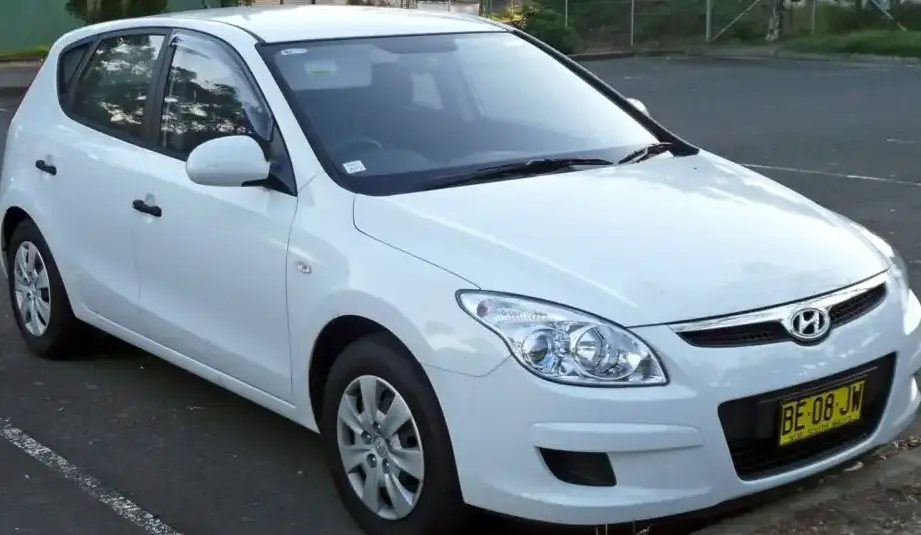
The Hyundai i30 I 2.0 CRDi (140 hp) was a significant offering in Hyundai’s expanding European lineup, produced from 2007 to 2010. Positioned as a mid-range trim within the first generation i30 (FD) series, built on the Hyundai ED platform, it aimed to provide a balance of fuel efficiency, performance, and practicality for the compact hatchback segment. This model represented Hyundai’s increasing focus on diesel technology and its ambition to compete directly with established European manufacturers. The i30 was Hyundai’s first car to be designed entirely in Europe, and the 2.0 CRDi variant was particularly important in markets where diesel fuel was favored due to taxation and fuel economy benefits.
Technical Specifications
| Brand | Hyundai |
| Model | i30 |
| Generation | i30 I |
| Type (Engine) | 2.0 CRDi (140 Hp) |
| Start of production | 2007 |
| End of production | 2010 |
| Powertrain Architecture | Internal Combustion engine |
| Body type | Hatchback |
| Seats | 5 |
| Doors | 5 |
| Fuel consumption (urban) | 7.2 l/100 km (32.7 US mpg) |
| Fuel consumption (extra urban) | 4.4 l/100 km (53.5 US mpg) |
| Fuel consumption (combined) | 5.5 l/100 km (42.8 US mpg) |
| Fuel Type | Diesel |
| Acceleration 0 – 100 km/h | 10.3 sec |
| Acceleration 0 – 62 mph | 10.3 sec |
| Acceleration 0 – 60 mph | 9.8 sec |
| Maximum speed | 205 km/h (127.38 mph) |
| Emission standard | Euro 4 |
| Weight-to-power ratio | 10.2 kg/Hp |
| Weight-to-torque ratio | 4.7 kg/Nm |
| Power | 140 Hp @ 4000 rpm |
| Torque | 305 Nm @ 1800 rpm (224.96 lb.-ft. @ 1800 rpm) |
| Engine layout | Front, Transverse |
| Engine Model/Code | D4EA |
| Engine displacement | 1991 cm3 (121.5 cu. in.) |
| Number of cylinders | 4 |
| Engine configuration | Inline |
| Cylinder Bore | 83 mm (3.27 in.) |
| Piston Stroke | 92 mm (3.62 in.) |
| Compression ratio | 17.3:1 |
| Number of valves per cylinder | 4 |
| Fuel injection system | Diesel Commonrail |
| Engine aspiration | Turbocharger, Intercooler |
| Engine oil capacity | 6.7 l (7.08 US qt | 5.9 UK qt) |
| Coolant capacity | 7.3 l (7.71 US qt | 6.42 UK qt) |
| Kerb Weight | 1429 kg (3150.41 lbs.) |
| Max. weight | 1900 kg (4188.78 lbs.) |
| Max load | 471 kg (1038.38 lbs.) |
| Trunk (boot) space – minimum | 340 l (12.01 cu. ft.) |
| Trunk (boot) space – maximum | 1200 l (42.38 cu. ft.) |
| Fuel tank capacity | 53 l (14 US gal | 11.66 UK gal) |
| Length | 4245 mm (167.13 in.) |
| Width | 1775 mm (69.88 in.) |
| Height | 1480 mm (58.27 in.) |
| Wheelbase | 2650 mm (104.33 in.) |
| Drivetrain | Front wheel drive |
| Number of gears | 6 gears, manual transmission |
| Front brakes | Ventilated discs |
| Rear brakes | Disc |
| Tires size | 205/55 R15 |
| Wheel rims size | 15 |
Powertrain & Engine Architecture
The heart of the i30 2.0 CRDi was the Hyundai D4EA engine, a 1991cc inline-four cylinder diesel. This engine utilized a second-generation common-rail direct injection system, delivering fuel at extremely high pressure for improved combustion efficiency and reduced emissions. A variable geometry turbocharger (VGT) with an intercooler was employed to boost power and torque across a wider rev range. The D4EA featured four valves per cylinder and a single overhead camshaft. The engine was transversely mounted in the front of the vehicle. The 6-speed manual transmission was the standard offering for this variant, providing a good balance between fuel economy and driver control. The transmission’s gear ratios were tuned to maximize the engine’s torque output, providing strong acceleration in everyday driving situations.
Driving Characteristics
The i30 2.0 CRDi with the manual transmission offered a surprisingly capable driving experience. While not a sports car, the 140 hp and 305 Nm (225 lb-ft) of torque provided ample power for both city driving and highway cruising. Acceleration from 0-60 mph took around 9.8 seconds, which was competitive for its class. The engine delivered strong low-end torque, making it easy to pull away from a standstill and overtake slower traffic. The 6-speed gearbox was well-matched to the engine, allowing for comfortable cruising at highway speeds. Compared to the lower-powered 1.6 CRDi variants, the 2.0 CRDi offered a noticeable improvement in performance, while remaining more fuel-efficient than the gasoline-powered options.
Equipment & Trim Levels
The i30 2.0 CRDi typically came equipped with a reasonable level of standard features. These included air conditioning, power windows, central locking, a CD stereo with MP3 compatibility, and ABS brakes. Higher trim levels, such as the Style or Comfort packages, added features like alloy wheels, a trip computer, automatic climate control, and upgraded interior trim. Interior upholstery was typically cloth, with options for leather available on higher-spec models. The dashboard layout was functional and straightforward, prioritizing ease of use over flashy design. Optional extras included a sunroof, parking sensors, and a more advanced audio system.
Chassis & Braking
The i30 I utilized a MacPherson strut front suspension and a coupled torsion beam rear suspension. This setup provided a good balance between ride comfort and handling. The front brakes were ventilated discs, while the rear brakes were solid discs, providing adequate stopping power for the vehicle’s weight and performance. ABS (Anti-lock Braking System) was standard, enhancing safety during emergency braking situations. The steering was hydraulically assisted, offering a reasonable level of feedback. Stabilizer bars were fitted to both the front and rear axles to reduce body roll during cornering.
Market Reception & Comparison
The Hyundai i30 2.0 CRDi was generally well-received by automotive critics. It was praised for its fuel efficiency, comfortable ride, and spacious interior. The diesel engine was noted for its refinement and strong performance. However, some critics pointed out that the i30’s styling was somewhat conservative compared to its rivals. Compared to competitors like the Volkswagen Golf, Ford Focus, and Opel Astra, the i30 offered a compelling value proposition, often undercutting them on price while offering a similar level of equipment. The 2.0 CRDi variant offered better fuel economy than the gasoline engines, and its higher torque output made it more enjoyable to drive than the lower-powered diesel options.
Legacy
The Hyundai i30 I 2.0 CRDi has proven to be a relatively reliable vehicle in the used car market. The D4EA engine is known for its durability, provided it has been properly maintained. Common issues include wear and tear on the turbocharger and potential problems with the fuel injectors. However, these issues are generally not catastrophic and can be addressed with routine maintenance and repairs. Today, the i30 I 2.0 CRDi represents an affordable and practical option for buyers looking for a fuel-efficient and reliable compact hatchback. Its blend of practicality, economy, and reasonable performance has ensured its continued presence on roads across Europe and beyond.
