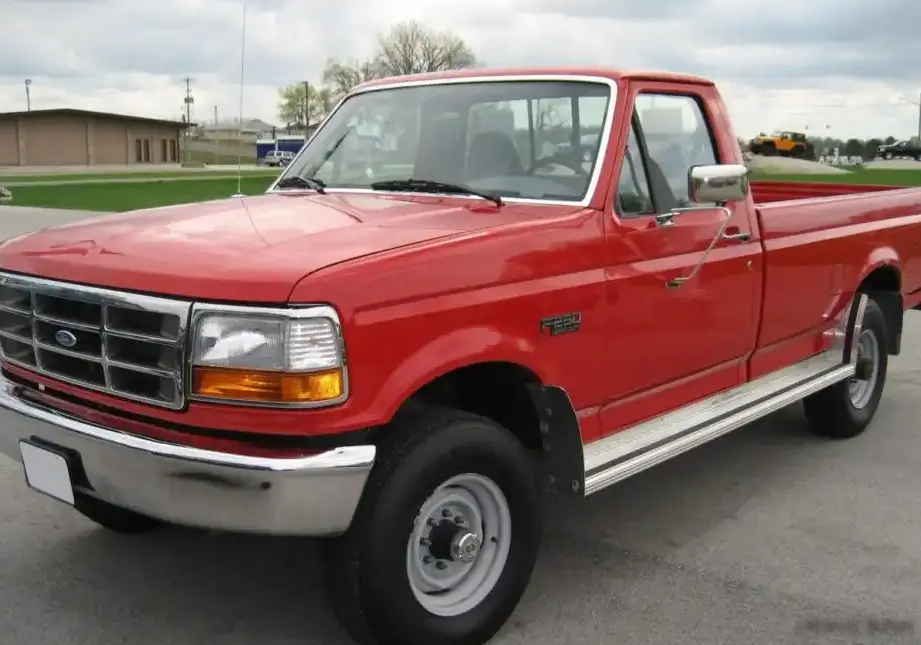
The Ford F-Series F-250 IX Regular Cab, equipped with the 4.9-liter inline-six engine and automatic transmission, represents a work-focused iteration of Ford’s immensely popular F-Series pickup truck. Produced from 1994 through 1997, this configuration occupied the entry-level position within the F-250 range, catering to buyers prioritizing affordability and durability over outright performance. It was part of the ninth generation of the F-Series (1992-1997), known for its modernized styling and improved interior compared to its predecessor. This particular variant served as a mainstay for farmers, ranchers, and tradespeople needing a robust, reliable truck for everyday tasks.
Technical Specifications
| Brand | Ford |
| Model | F-Series F-250 |
| Generation | F-Series F-250 IX Regular Cab |
| Type (Engine) | 4.9 (150 Hp) Automatic |
| Start of production | 1994 |
| End of production | 1997 |
| Powertrain Architecture | Internal Combustion engine |
| Body type | Pick-up |
| Seats | 3 |
| Doors | 2 |
| Fuel Type | Petrol (Gasoline) |
| Power | 150 Hp |
| Power per litre | 30.5 Hp/l |
| Torque | 353 Nm / 260.36 lb.-ft. |
| Engine layout | Front, Longitudinal |
| Engine displacement | 4916 cm3 / 299.99 cu. in. |
| Number of cylinders | 6 |
| Engine configuration | Inline |
| Fuel injection system | Multi-port manifold injection |
| Engine aspiration | Naturally aspirated engine |
| Engine oil capacity | 4.7 l / 4.97 US qt | 4.14 UK qt |
| Coolant | 13 l / 13.74 US qt | 11.44 UK qt |
| Max. weight | 2994 kg / 6600.64 lbs. |
| Fuel tank capacity | 141 l / 37.25 US gal | 31.02 UK gal |
| Length | 5418 mm / 213.31 in. |
| Width | 1778 mm / 70 in. |
| Height | 1864 mm / 73.39 in. |
| Wheelbase | 3378 mm / 132.99 in. |
| Wading depth | 826 mm / 32.52 in. |
| Drivetrain Architecture | Rear wheel drive. Internal Combustion engine (ICE) drives the rear wheels. |
| Drive wheel | Rear wheel drive |
| Number of gears and type of gearbox | 4 gears, automatic transmission |
| Front suspension | Independent coil spring |
| Rear suspension | Leaf spring |
| Front brakes | Disc |
| Rear brakes | Drum |
| Power steering | Electric Steering |
| Tires size | 215/85 R16 |
| Wheel rims size | 16 |
Powertrain & Engine Architecture
The heart of this F-250 variant is Ford’s 4.9-liter (299 cubic inch) inline-six engine, often referred to as the “300 six” due to its historical predecessor. While technically a 4.9L, it’s a descendant of the long-running 4.9L/5.0L family. This engine, designated internally as the 4.9L Windsor, is a robust and simple design known for its longevity and low-end torque. It features a cast iron block and cylinder head, a two-barrel carburetor (later models transitioned to multi-port fuel injection), and a single overhead camshaft. The multi-port fuel injection system, introduced during this generation, improved fuel efficiency and throttle response compared to earlier carbureted versions. The engine produces 150 horsepower and 353 Nm (260 lb-ft) of torque. The automatic transmission is a four-speed unit, the AOD (Automatic Overdrive) or a similar variant, designed to provide comfortable cruising and adequate pulling power. It wasn’t known for being particularly sophisticated, but it was durable and relatively easy to maintain.
Driving Characteristics
The F-250 4.9L automatic offered a decidedly utilitarian driving experience. Acceleration was modest, with a 0-60 mph time likely in the 12-14 second range. The focus was on providing sufficient power for hauling and towing, rather than sporty performance. The automatic transmission’s gear ratios were optimized for low-end torque, making it suitable for work applications. However, this also meant that the engine could feel strained when pushed hard, especially when climbing hills or carrying a heavy load. Compared to the optional 5.8L V8 or the diesel engines available in the F-250 lineup, the 4.9L automatic was significantly less powerful. Manual transmission versions of the 4.9L offered slightly better performance and fuel economy, but the automatic was preferred by many drivers for its convenience.
Equipment & Trim Levels
The F-250 IX Regular Cab 4.9 Automatic typically came with a basic level of equipment. Standard features included a vinyl bench seat, basic instrumentation, and manual windows and locks. Air conditioning and an upgraded stereo were common options. The interior was functional and durable, designed to withstand the rigors of daily use. Trim levels were relatively simple; the “IX” designation generally indicated a mid-range package with some additional convenience features. Optional extras included power windows and locks, a tilt steering wheel, and a sliding rear window. The exterior typically featured black bumpers and side moldings, with a choice of basic paint colors.
Chassis & Braking
The F-250 chassis was built for heavy-duty use. It featured a robust frame and a solid rear axle. The front suspension utilized independent coil springs, providing a reasonably comfortable ride, while the rear suspension employed leaf springs, designed to handle heavy loads. Brakes were disc brakes in the front and drum brakes in the rear. Power steering was standard, making it easier to maneuver the large truck. The tires were typically 215/85 R16 size, chosen for their durability and load-carrying capacity. The rear axle ratio varied depending on the intended use, with lower ratios (numerically higher) providing more pulling power and higher ratios offering better fuel economy.
Market Reception & Comparison
The F-250 4.9L automatic was generally well-received by buyers seeking a dependable and affordable work truck. Critics acknowledged its lack of refinement and modest performance, but praised its durability and low operating costs. Compared to the V8 and diesel options, the 4.9L automatic offered a lower purchase price and simpler maintenance. However, it lacked the power and towing capacity of its more expensive siblings. Fuel economy was reasonable for a truck of its size, averaging around 14-16 mpg in real-world driving. The 4.9L engine was known for its reliability, but the automatic transmission could be prone to wear and tear if not properly maintained.
Legacy
The Ford F-250 4.9L automatic has earned a reputation as a reliable and long-lasting truck. Many examples are still on the road today, testament to the durability of the 4.9L engine and the robust chassis. In the used car market, these trucks are often sought after by buyers looking for an affordable and capable work vehicle. While they may not offer the modern amenities or performance of newer trucks, they provide a simple, dependable, and relatively easy-to-maintain alternative. The 4.9L engine remains a popular choice for engine swaps and restorations, due to its availability and affordability. Its legacy is one of rugged dependability and a work ethic that continues to appeal to truck enthusiasts and tradespeople alike.