Technical Specifications
| Brand | Audi |
| Model | A7 |
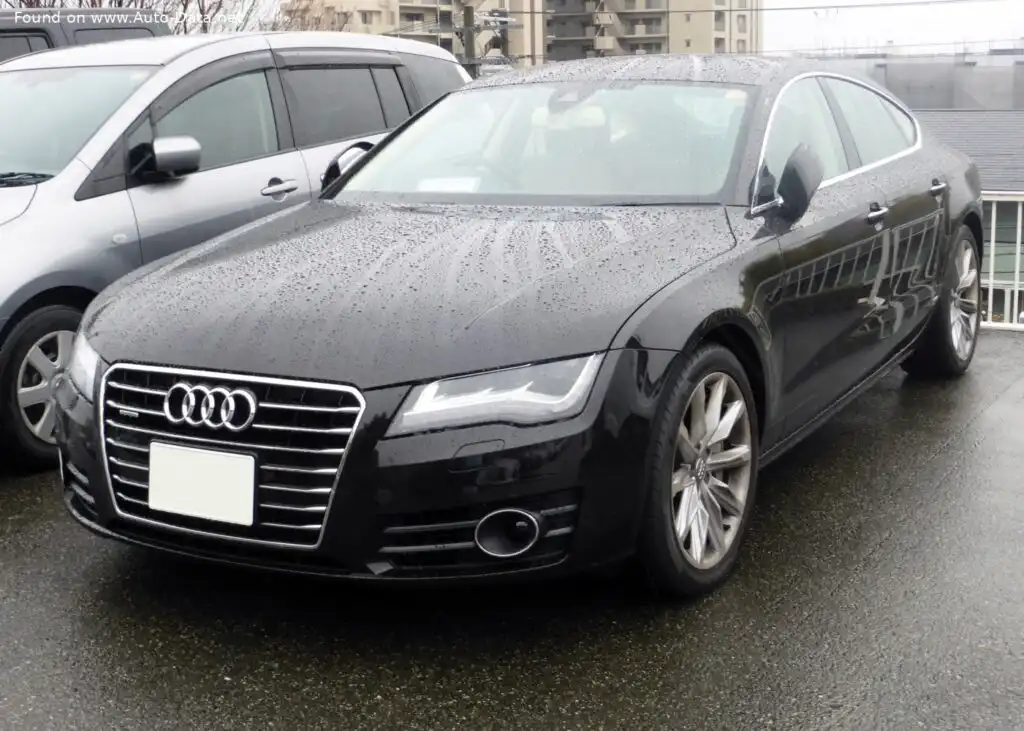
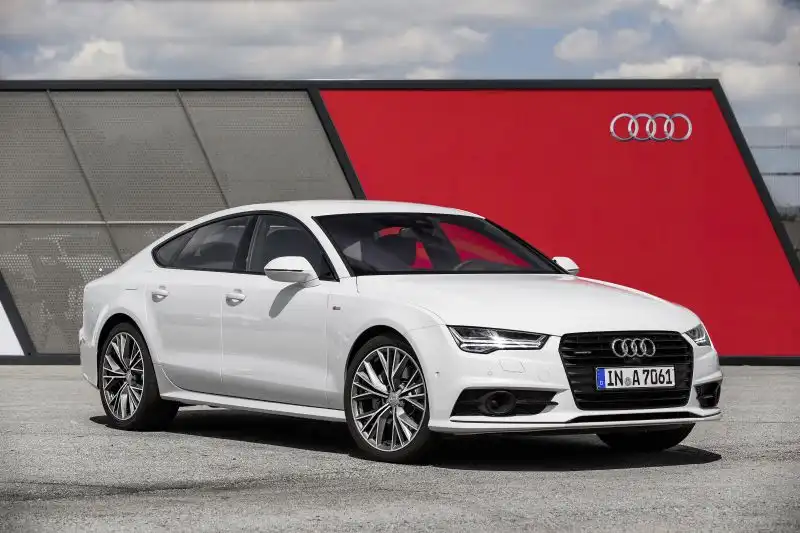
| Generation | A7 Sportback (C7, facelift 2014) |
| Type (Engine) | 3.0 BiTDI V6 clean diesel (320 Hp) quattro Tiptronic |
| Start of production | May, 2014 |
| End of production | 2018 |
| Powertrain Architecture | Internal Combustion engine |
| Body type | Liftback |
| Seats | 5 |
| Doors | 5 |
| Fuel consumption (urban) | 7.4 l/100 km (31.8 US mpg, 38.2 UK mpg, 13.5 km/l) |
| Fuel consumption (extra urban) | 5.4 l/100 km (43.6 US mpg, 52.3 UK mpg, 18.5 km/l) |
| Fuel consumption (combined) | 6.1 l/100 km (38.6 US mpg, 46.3 UK mpg, 16.4 km/l) |
| CO2 emissions | 162 g/km |
| Fuel Type | Diesel |
| Acceleration 0 – 100 km/h | 5.2 sec |
| Acceleration 0 – 62 mph | 5.2 sec |
| Acceleration 0 – 60 mph | 4.9 sec |
| Maximum speed | 250 km/h (155.34 mph) |
| Emission standard | Euro 6 |
| Weight-to-power ratio | 5.9 kg/Hp, 168.9 Hp/tonne |
| Weight-to-torque ratio | 2.9 kg/Nm, 343 Nm/tonne |
| Power | 320 Hp @ 3900-4600 rpm |
| Power per litre | 107.9 Hp/l |
| Torque | 650 Nm @ 1400-2800 rpm (479.42 lb.-ft. @ 1400-2800 rpm) |
| Engine layout | Front, Longitudinal |
| Engine Model/Code | CVUA |
| Engine displacement | 2967 cm3 (181.06 cu. in.) |
| Number of cylinders | 6 |
| Engine configuration | V-engine |
| Cylinder Bore | 83 mm (3.27 in.) |
| Piston Stroke | 91.4 mm (3.6 in.) |
| Compression ratio | 15.5:1 |
| Number of valves per cylinder | 4 |
| Fuel injection system | Diesel Commonrail |
| Engine aspiration | BiTurbo, Intercooler |
| Valvetrain | DOHC |
| Engine oil capacity | 6.4 l (6.76 US qt | 5.63 UK qt) |
| Coolant | 11.5 l (12.15 US qt | 10.12 UK qt) |
| Kerb Weight | 1895 kg (4177.76 lbs.) |
| Max. weight | 2505 kg (5522.58 lbs.) |
| Max load | 610 kg (1344.82 lbs.) |
| Trunk (boot) space – minimum | 535 l (18.89 cu. ft.) |
| Trunk (boot) space – maximum | 1390 l (49.09 cu. ft.) |
| Fuel tank capacity | 73 l (19.28 US gal | 16.06 UK gal) |
| Max. roof load | 100 kg (220.46 lbs.) |
| Permitted trailer load with brakes (8%) | 2100 kg (4629.71 lbs.) |
| Permitted trailer load with brakes (12%) | 2100 kg (4629.71 lbs.) |
| Permitted trailer load without brakes | 750 kg (1653.47 lbs.) |
| Permitted towbar download | 85 kg (187.39 lbs.) |
| Length | 4974 mm (195.83 in.) |
| Width | 1911 mm (75.24 in.) |
| Width including mirrors | 2139 mm (84.21 in.) |
| Height | 1420 mm (55.91 in.) |
| Wheelbase | 2914 mm (114.72 in.) |
| Front track | 1644 mm (64.72 in.) |
| Rear (Back) track | 1635 mm (64.37 in.) |
| Front overhang | 937 mm (36.89 in.) |
| Rear overhang | 1123 mm (44.21 in.) |
| Drag coefficient (Cd) | 0.29 |
| Minimum turning circle (turning diameter) | 11.9 m (39.04 ft.) |
| Drive wheel | All wheel drive (4×4) |
| Number of gears and type of gearbox | 8 gears, automatic transmission Tiptronic |
| Front suspension | Independent multi-link suspension |
| Rear suspension | Independent on trapezoidal lever |
| Front brakes | Ventilated discs |
| Rear brakes | Ventilated discs |
| Assisting systems | ABS (Anti-lock braking system) |
| Steering type | Steering rack and pinion |
| Power steering | Electric Steering |
| Tires size | 255/45 R18 |
| Wheel rims size | 8.5J x 18 |
The Audi A7 Sportback (C7 facelift) 3.0 BiTDI, launched in mid-2014, represented a significant update to the original C7 generation, which debuted in 2010. Built on the Volkswagen Group’s A6/A7 (4H) platform – also known as the 1HX0/A3 platform – the facelift brought revised styling, updated technology, and more efficient engine options. This 320 horsepower diesel variant was positioned as a high-performance, yet fuel-efficient, option within the A7 range, appealing to drivers who desired a luxurious and capable grand tourer. It sat above the lower-powered diesel variants (like the 190 hp 2.0 TDI) and below the performance-oriented S7 models.
Powertrain & Engine Architecture
At the heart of the A7 3.0 BiTDI lies the CVUA engine code, a 3.0-liter V6 turbocharged diesel engine. This engine utilizes a sophisticated common rail direct injection system, delivering fuel at extremely high pressures for optimized combustion. The “BiTDI” designation signifies the use of two turbochargers – a smaller, more responsive turbocharger for low-end torque and a larger turbocharger for high-end power. An intercooler further cools the compressed intake air, increasing density and improving performance. The engine features a Double Overhead Camshaft (DOHC) valvetrain with four valves per cylinder. The eight-speed Tiptronic automatic transmission, a staple of Audi’s premium models, provides smooth and efficient gear changes. This transmission allows for both fully automatic operation and manual gear selection via steering wheel-mounted paddles or the gear selector. The transmission’s gear ratios are tuned to balance acceleration with fuel economy, with a relatively tall final drive ratio for highway cruising.
Driving Characteristics
The 320 hp BiTDI A7 Sportback delivers a compelling driving experience. The twin-turbocharged engine provides a broad torque curve, with peak torque of 650 Nm (479 lb-ft) available from just 1400 rpm. This results in strong acceleration in everyday driving situations, with effortless overtaking capabilities. The 0-60 mph sprint takes approximately 4.9 seconds, making it a genuinely quick vehicle. Compared to the lower-powered diesel variants, the 3.0 BiTDI offers a significantly more responsive and engaging driving experience. While not as overtly sporty as the S7, it provides ample power for spirited driving. The Tiptronic transmission contributes to a refined and comfortable ride, although some drivers may prefer the more direct engagement of a manual gearbox. The quattro all-wheel-drive system provides excellent traction and stability in all weather conditions.
Equipment & Trim Levels
The A7 3.0 BiTDI typically came well-equipped as standard. Features included leather upholstery, tri-zone automatic climate control, a premium sound system, and Audi’s MMI infotainment system with a central display screen. Standard safety features included ABS, electronic stability control, and multiple airbags. Optional extras included features like adaptive cruise control, a head-up display, a panoramic sunroof, and upgraded interior trim materials. Trim levels varied slightly by market, but generally offered options for enhanced interior appointments and exterior styling cues.
Chassis & Braking
The A7 Sportback features an independent multi-link suspension at the front and an independent trapezoidal lever suspension at the rear, providing a comfortable and controlled ride. The suspension is tuned to balance handling with ride comfort, offering a good compromise for long-distance cruising. Braking duties are handled by ventilated discs on all four wheels, providing ample stopping power. The electronic stability control system helps to maintain control during emergency braking maneuvers. Stabilizer bars are fitted to both the front and rear axles to reduce body roll during cornering.
Market Reception & Comparison
The A7 3.0 BiTDI was generally well-received by automotive critics. It was praised for its powerful and efficient engine, luxurious interior, and refined driving experience. Compared to the 2.0 TDI variants, the 3.0 BiTDI offered a significant performance upgrade, albeit at a higher price point. Fuel economy remained impressive for a vehicle of its size and performance, averaging around 38.6 US mpg in combined driving. Compared to the S7, the 3.0 BiTDI offered a more balanced blend of performance and efficiency, appealing to buyers who didn’t necessarily need the ultimate in performance. Reliability was generally good, although, like all modern diesel engines, it was susceptible to issues with the diesel particulate filter (DPF) if not driven on longer journeys regularly.
Legacy
The Audi A7 Sportback (C7) 3.0 BiTDI has proven to be a relatively reliable vehicle in the used car market. The 3.0-liter TDI engine, while complex, is generally robust when properly maintained. Common maintenance items include regular oil changes, filter replacements, and occasional DPF regeneration. The Tiptronic transmission is also generally reliable, but requires regular fluid changes. Today, these vehicles represent a good value for buyers seeking a luxurious and capable grand tourer with strong performance and reasonable running costs. The combination of style, performance, and efficiency has ensured its continued desirability in the used car market.