
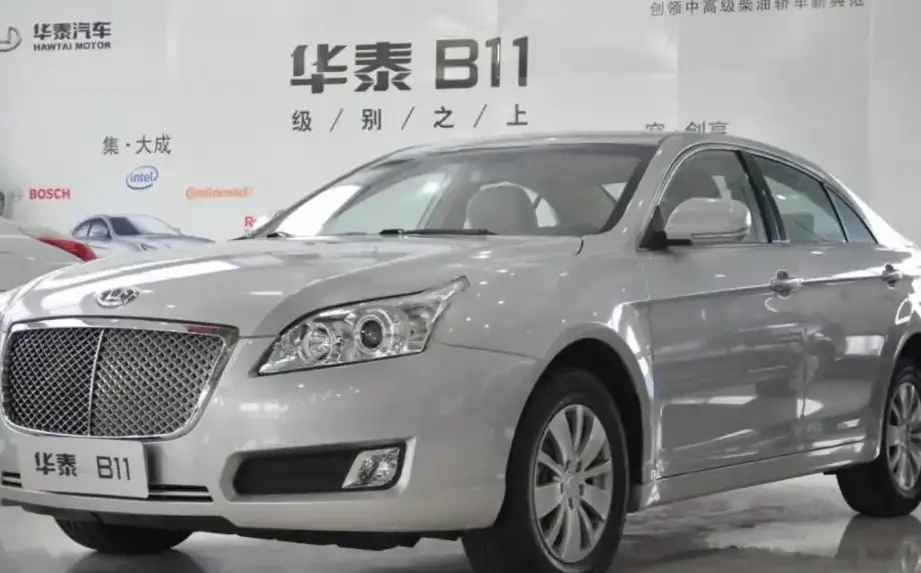
The Hawtai B11 2.0 TD Automatic, produced between 2014 and 2017, represents a significant offering from the Chinese automaker Hawtai Motor Group. Positioned as a mid-range sedan within the B11 lineup, this variant aimed to provide a balance of fuel efficiency, reasonable performance, and comfort for the Chinese domestic market. The B11 itself was Hawtai’s attempt to compete in the increasingly popular mid-size sedan segment, offering a more affordable alternative to established international brands. This particular diesel-powered automatic configuration was designed to appeal to buyers prioritizing economy and ease of driving, particularly in regions where diesel fuel was readily available and cost-effective.
Technical Specifications
| Brand | Hawtai |
| Model | B11 |
| Generation | B11 |
| Type (Engine) | 2.0 TD (150 Hp) Automatic |
| Start of production | 2014 |
| End of production | 2017 |
| Powertrain Architecture | Internal Combustion engine |
| Body type | Sedan |
| Seats | 5 |
| Doors | 4 |
| Fuel Type | Diesel |
| Emission standard | Euro 4 |
| Weight-to-power ratio | 10.8 kg/Hp, 92.3 Hp/tonne |
| Weight-to-torque ratio | 5.2 kg/Nm, 190.8 Nm/tonne |
| Power | 150 Hp @ 4000 rpm |
| Power per litre | 75.3 Hp/l |
| Torque | 310 Nm @ 2000 rpm (228.64 lb.-ft. @ 2000 rpm) |
| Engine layout | Front, Transverse |
| Engine Model/Code | OED |
| Engine displacement | 1991 cm3 (121.5 cu. in.) |
| Number of cylinders | 4 |
| Engine configuration | Inline |
| Cylinder Bore | 83 mm (3.27 in.) |
| Piston Stroke | 92 mm (3.62 in.) |
| Compression ratio | 17.5:1 |
| Number of valves per cylinder | 4 |
| Fuel injection system | Diesel Commonrail |
| Engine aspiration | Turbocharger, Intercooler |
| Valvetrain | DOHC |
| Engine oil capacity | 6.3 l (6.66 US qt | 5.54 UK qt) |
| Coolant | 9 l (9.51 US qt | 7.92 UK qt) |
| Kerb Weight | 1625 kg (3582.51 lbs.) |
| Trunk (boot) space – minimum | 450 l (15.89 cu. ft.) |
| Trunk (boot) space – maximum | 500 l (17.66 cu. ft.) |
| Fuel tank capacity | 70 l (18.49 US gal | 15.4 UK gal) |
| Length | 4943 mm (194.61 in.) |
| Width | 1852 mm (72.91 in.) |
| Height | 1511 mm (59.49 in.) |
| Wheelbase | 2764 mm (108.82 in.) |
| Ride height (ground clearance) | 138 mm (5.43 in.) |
| Drivetrain Architecture | The Internal combustion engine (ICE) drives the front wheels of the vehicle. |
| Drive wheel | Front wheel drive |
| Number of gears and type of gearbox | 4 gears, automatic transmission |
| Front suspension | Independent type McPherson |
| Rear suspension | Independent multi-link suspension |
| Front brakes | Ventilated discs |
| Rear brakes | Disc |
| Assisting systems | ABS (Anti-lock braking system) |
| Steering type | Steering rack and pinion |
| Tires size | 225/60 R16 |
Powertrain & Engine Architecture
The heart of the Hawtai B11 2.0 TD Automatic is the OED engine, a 1.991-liter inline-four cylinder diesel engine. This engine utilizes a turbocharger with an intercooler to boost power output to 150 horsepower at 4000 rpm and 310 Nm (228.64 lb-ft) of torque at 2000 rpm. The high compression ratio of 17.5:1 is typical for diesel engines, contributing to their efficiency. The engine employs a Diesel Commonrail fuel injection system, which allows for precise fuel delivery and improved combustion efficiency. The double overhead camshaft (DOHC) valvetrain further enhances engine breathing and performance. Paired with the engine is a four-speed automatic transmission. While not the most modern transmission technology, it was chosen for its simplicity and cost-effectiveness, providing smooth, if not particularly sporty, gear changes.
Driving Characteristics
The 2.0 TD Automatic offered a comfortable and relaxed driving experience. The 310 Nm of torque available from 2000 rpm provided adequate acceleration for everyday driving situations. However, the four-speed automatic transmission limited the engine’s ability to stay in its optimal power band, especially at higher speeds. Compared to manual transmission versions of the B11, or those equipped with more powerful gasoline engines, the 2.0 TD Automatic felt noticeably slower. The gear ratios were tuned for fuel economy rather than performance, resulting in a somewhat lethargic response during overtaking maneuvers. The front-wheel-drive configuration contributed to predictable handling, but lacked the dynamic capabilities of all-wheel-drive systems.
Equipment & Trim Levels
The B11 2.0 TD Automatic typically came equipped with standard features such as air conditioning, power windows, power door locks, and a basic audio system. Interior upholstery was generally cloth, with options for leather upgrades available at an additional cost. Higher trim levels might have included features like a sunroof, alloy wheels, and a more advanced infotainment system. Safety features included ABS (Anti-lock Braking System) as standard, but other advanced safety technologies were often optional or unavailable.
Chassis & Braking
The B11 utilized an independent McPherson strut suspension in the front and an independent multi-link suspension in the rear, providing a reasonably comfortable ride quality. Ventilated disc brakes were fitted to the front wheels, while the rear wheels used solid discs. The suspension was tuned for comfort rather than sporty handling, prioritizing ride smoothness over precise cornering. The steering system employed a rack and pinion setup, offering adequate steering feel and responsiveness.
Market Reception & Comparison
The Hawtai B11 2.0 TD Automatic was generally well-received in the Chinese market as a practical and affordable mid-size sedan. Critics praised its fuel efficiency and comfortable ride, but noted its lack of performance compared to competitors. Compared to gasoline-powered B11 variants, the diesel model offered superior fuel economy but less overall power. Against established international brands, the B11 2.0 TD Automatic offered a lower price point, but often lacked the refinement and brand recognition of its rivals.
Legacy
The Hawtai B11 2.0 TD Automatic, while not a groundbreaking vehicle, played a role in Hawtai’s efforts to establish itself in the competitive Chinese automotive market. The OED diesel engine proved to be relatively reliable, and examples of this variant are still found on the used car market today. However, due to increasingly stringent emissions regulations and a shift towards gasoline and electric vehicles, the diesel-powered B11 has become less common. Its legacy lies in providing an affordable and fuel-efficient transportation option for Chinese consumers during its production run.
