Technical Specifications
| Brand | Citroen |
| Model | C5 |
| Generation | C5 II (Phase I, 2008) |
| Type (Engine) | 2.0 16V (140 Hp) |
| Start of production | 2008 |
| End of production | 2009 |
| Powertrain Architecture | Internal Combustion engine |
| Body type | Sedan |
| Seats | 5 |
| Doors | 4 |
| Fuel consumption (urban) | 12 l/100 km (19.6 US mpg, 23.5 UK mpg, 8.3 km/l) |
| Fuel consumption (extra urban) | 6.3 l/100 km (37.3 US mpg, 44.8 UK mpg, 15.9 km/l) |
| Fuel consumption (combined) | 8.4 l/100 km (28 US mpg, 33.6 UK mpg, 11.9 km/l) |
| CO2 emissions | 198 g/km |
| Fuel Type | Petrol (Gasoline) |
| Acceleration 0 – 100 km/h | 10.7 sec |
| Acceleration 0 – 62 mph | 10.7 sec |
| Acceleration 0 – 60 mph | 10.2 sec |
| Maximum speed | 210 km/h (130.49 mph) |
| Emission standard | Euro 4 |
| Weight-to-power ratio | 10.9 kg/Hp, 92 Hp/tonne |
| Weight-to-torque ratio | 7.6 kg/Nm, 131.5 Nm/tonne |
| Power | 140 Hp @ 6000 rpm |
| Power per litre | 70.1 Hp/l |
| Torque | 200 Nm @ 4000 rpm (147.51 lb.-ft. @ 4000 rpm) |
| Engine layout | Front, Transverse |
| Engine Model/Code | RFJ EW10A |
| Engine displacement | 1997 cm3 (121.86 cu. in.) |
| Number of cylinders | 4 |
| Engine configuration | Inline |
| Cylinder Bore | 85 mm (3.35 in.) |
| Piston Stroke | 88 mm (3.46 in.) |
| Compression ratio | 10.8:1 |
| Number of valves per cylinder | 4 |
| Fuel injection system | Multi-port manifold injection |
| Engine aspiration | Naturally aspirated engine |
| Engine oil capacity | 5 l (5.28 US qt | 4.4 UK qt) |
| Coolant | 9.4 l (9.93 US qt | 8.27 UK qt) |
| Kerb Weight | 1521 kg (3353.23 lbs.) |
| Max. weight | 2063 kg (4548.14 lbs.) |
| Max load | 542 kg (1194.91 lbs.) |
| Trunk (boot) space – minimum | 439 l (15.5 cu. ft.) |
| Fuel tank capacity | 71 l (18.76 US gal | 15.62 UK gal) |
| Max. roof load | 80 kg (176.37 lbs.) |
| Permitted trailer load with brakes (12%) | 1500 kg (3306.93 lbs.) |
| Permitted trailer load without brakes | 750 kg (1653.47 lbs.) |
| Permitted towbar download | 69 kg (152.12 lbs.) |
| Length | 4779 mm (188.15 in.) |
| Width | 1860 mm (73.23 in.) |
| Width including mirrors | 2096 mm (82.52 in.) |
| Height | 1451-1458 mm (57.13 – 57.4 in.) |
| Wheelbase | 2815 mm (110.83 in.) |
| Front track | 1586 mm (62.44 in.) |
| Rear (Back) track | 1557 mm (61.3 in.) |
| Front overhang | 1054 mm (41.5 in.) |
| Rear overhang | 910 mm (35.83 in.) |
| Minimum turning circle (turning diameter) | 11.7 m (38.39 ft.) |
| Drivetrain Architecture | The Internal combustion engine (ICE) drives the front wheels of the vehicle. |
| Drive wheel | Front wheel drive |
| Number of gears and type of gearbox | 5 gears, manual transmission |
| Front suspension | Double wishbone |
| Rear suspension | Independent multi-link suspension |
| Front brakes | Ventilated discs |
| Rear brakes | Disc |
| Assisting systems | ABS (Anti-lock braking system) |
| Steering type | Steering rack and pinion |
| Power steering | Hydraulic Steering |
| Tires size | 225/55 R17 |
| Wheel rims size | 17 |
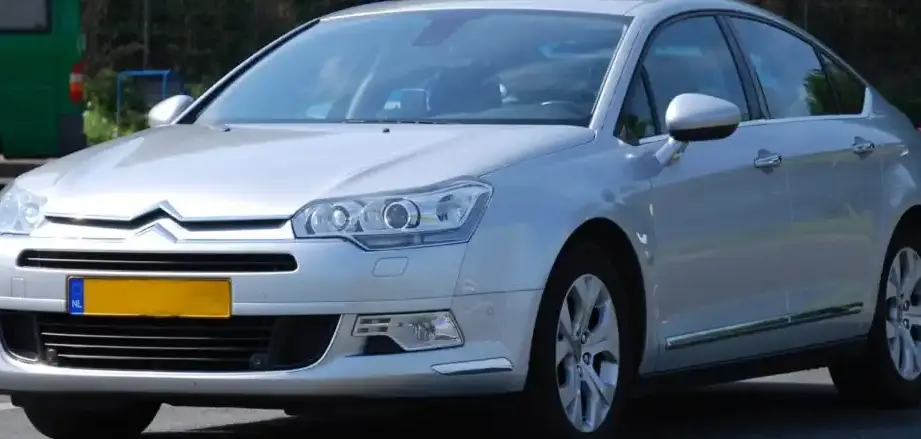
The Citroën C5 II, launched in 2008, marked a significant step forward for Citroën’s large family car, building on the established reputation of its predecessor. The Phase I models, produced from 2008 to 2009, offered a diverse range of engine and trim options. The 2.0 16V variant, producing 140 horsepower, occupied a crucial middle ground in the lineup, appealing to buyers who desired a balance between performance and fuel efficiency. This version was primarily targeted at the European market, where comfort and a refined driving experience were highly valued in the D-segment. It served as a more accessible alternative to the more powerful V6 models, while simultaneously offering a noticeable performance upgrade over the base 1.6L engine.
Powertrain & Engine Architecture
The core of this C5 variant is the EW10A engine, a 2.0-liter inline-four cylinder petrol engine. This engine, frequently identified by the RFJ code, was a cornerstone of the PSA Group’s (Peugeot-Citroën) engine family for many years. It features a cast iron engine block paired with an aluminum cylinder head, incorporating four valves per cylinder and a dual overhead camshaft configuration. Fuel delivery is managed by a multi-point fuel injection system, ensuring precise fuel metering for optimal combustion efficiency. The engine’s 140 horsepower output at 6000 rpm and 200 Nm (147.51 lb-ft) of torque at 4000 rpm were considered sufficient for comfortable cruising and everyday driving needs. The engine is mounted transversely at the front of the vehicle. Typically, this engine was paired with a five-speed manual gearbox, although a four-speed automatic transmission was also available, impacting both performance and fuel economy.
Driving Characteristics
The 2.0 16V C5 equipped with the manual transmission delivered a reasonably engaging driving experience. Acceleration from 0-60 mph took approximately 10.2 seconds, and the vehicle had a top speed of around 130.49 mph. The engine provided adequate power for overtaking on highways, though it wasn’t particularly sporty in nature. The optional automatic transmission, while offering convenience, demonstrably reduced performance, adding roughly 0.5 seconds to the 0-60 mph time. The gear ratios were optimized for fuel efficiency and smooth operation, rather than prioritizing rapid acceleration. The C5’s renowned hydropneumatic suspension system, even in this mid-range trim, provided an exceptionally comfortable ride, effectively absorbing bumps and road imperfections. Steering was light and precise, making it easy to maneuver in urban environments.
Equipment & Trim Levels
The 2.0 16V C5 generally came standard with a respectable array of features. These typically included air conditioning, power windows, central locking, and a basic audio system. Higher trim levels, such as the Exclusive, added features like leather upholstery, automatic climate control, rain-sensing windshield wipers, and parking sensors. Interior upholstery was usually cloth in the base models, with options for partial leather or full leather upgrades. The dashboard layout was functional and ergonomically designed, prioritizing ease of use for the driver. Optional extras included a navigation system, a panoramic sunroof, and upgraded audio systems.
Chassis & Braking
The C5 II featured a robust chassis with a double wishbone front suspension and an independent multi-link rear suspension. This suspension setup provided excellent ride quality and handling characteristics. The braking system consisted of ventilated discs on the front wheels and solid discs on the rear, offering adequate stopping power. An Anti-lock Braking System (ABS) was standard equipment, enhancing safety during emergency braking situations. The C5’s suspension was tuned to prioritize comfort, resulting in a slightly softer ride compared to more performance-focused vehicles. Stabilizer bars were fitted to both the front and rear axles to minimize body roll during cornering.
Market Reception & Comparison
The Citroën C5 II 2.0 16V was generally well-received by automotive critics. It was praised for its comfortable ride, spacious interior, and refined engine. However, some critics pointed out that the engine lacked the power of the V6 models and that the automatic transmission could feel somewhat sluggish. When compared to competitors like the Ford Mondeo and Volkswagen Passat, the C5 offered a unique combination of comfort and distinctive styling. Fuel economy was competitive, averaging around 28 US mpg in combined driving conditions. Reliability was generally considered good, although some owners reported minor issues with the electrical system.
Legacy
The 2.0 16V engine in the C5 II proved to be a relatively reliable powerplant, with many examples still in operation today. While not known for exceptional performance, it offered a good balance of power, fuel economy, and long-term durability. In the used car market, these C5s represent a compelling value proposition for buyers seeking a comfortable and spacious family car. Maintenance costs are generally reasonable, and parts availability remains good. The hydropneumatic suspension, while requiring occasional maintenance, continues to be a defining feature of the C5, providing a unique and exceptionally comfortable driving experience.