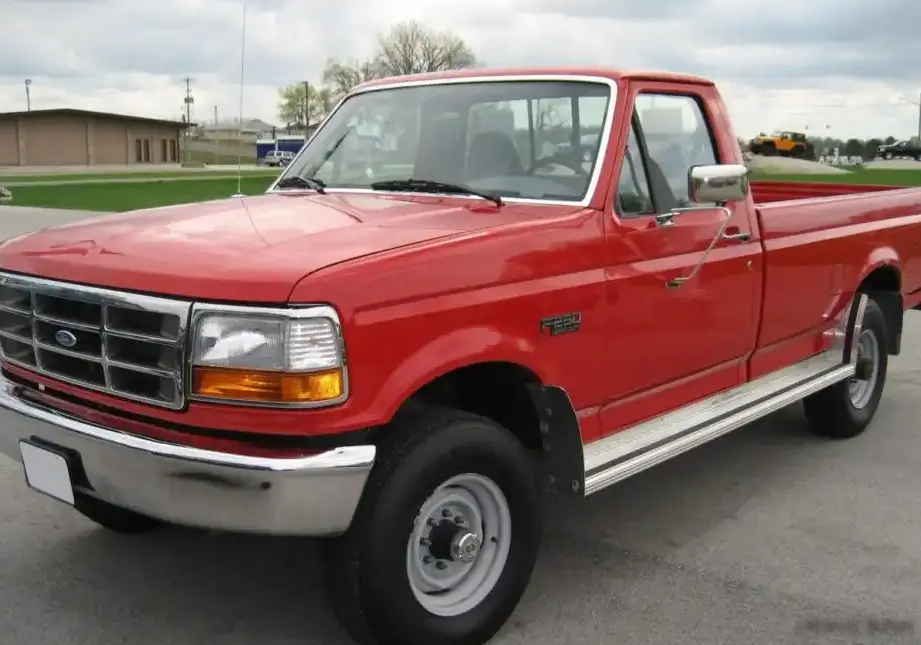
The Ford F-Series F-250 IX Regular Cab, equipped with the 5.8-liter V8 engine producing 210 horsepower, represents a significant workhorse offering from Ford during the early to mid-1990s. Produced from 1991 through 1997, this variant occupied a crucial position in Ford’s heavy-duty truck lineup, bridging the gap between the lighter F-150 and the more robust F-350. It was part of the ninth generation of the F-Series (1992-1997), known for its updated styling and improved interior comfort compared to previous generations. This particular configuration, with the 5.8L V8 and a 5-speed manual transmission, was aimed at buyers needing substantial towing and hauling capacity without the expense of the larger diesel or more powerful gasoline engines.
Technical Specifications
| Brand | Ford |
| Model | F-Series F-250 |
| Generation | F-Series F-250 IX Regular Cab |
| Type (Engine) | 5.8 V8 (210 Hp) |
| Start of production | August, 1991 |
| End of production | 1997 |
| Powertrain Architecture | Internal Combustion engine |
| Body type | Pick-up |
| Seats | 3 |
| Doors | 2 |
| Fuel Type | Petrol (Gasoline) |
| Power | 210 Hp |
| Power per litre | 36.5 Hp/l |
| Torque | 427 Nm / 314.94 lb.-ft. |
| Engine layout | Front, Longitudinal |
| Engine displacement | 5752 cm3 / 351.01 cu. in. |
| Number of cylinders | 8 |
| Engine configuration | V-engine |
| Fuel injection system | Multi-port manifold injection |
| Engine aspiration | Naturally aspirated engine |
| Engine oil capacity | 4.7 l / 4.97 US qt | 4.14 UK qt |
| Coolant | 14.9 l / 15.74 US qt | 13.11 UK qt |
| Max. weight | 2994 kg / 6600.64 lbs. |
| Fuel tank capacity | 141 l / 37.25 US gal | 31.02 UK gal |
| Length | 5418 mm / 213.31 in. |
| Width | 1778 mm / 70 in. |
| Height | 1864 mm / 73.39 in. |
| Wheelbase | 3378 mm / 132.99 in. |
| Wading depth | 826 mm / 32.52 in. |
| Drivetrain Architecture | The Internal combustion engine (ICE) drives the rear wheels of the vehicle. |
| Drive wheel | Rear wheel drive |
| Number of gears and type of gearbox | 5 gears, manual transmission |
| Front suspension | Independent coil spring |
| Rear suspension | Leaf spring |
| Front brakes | Disc |
| Rear brakes | Drum |
| Power steering | Electric Steering |
| Tires size | 215/85 R16 |
| Wheel rims size | 16 |
Powertrain & Engine Architecture
The heart of the F-250 IX was the 5.8-liter (351 cubic inch) Ford Windsor V8 engine. This engine, a staple of Ford trucks for decades, was known for its robust construction and relatively simple design. The 5.8L utilized a cast iron block and cylinder heads, contributing to its durability. It featured a two-valve per cylinder configuration and a hydraulic lifter valvetrain, minimizing maintenance requirements. Fuel delivery was handled by a multi-port fuel injection system, improving efficiency and throttle response compared to earlier carbureted versions. The engine’s 210 horsepower and 315 lb-ft of torque were respectable for the time, providing adequate power for hauling and towing. The 5-speed manual transmission, a New Process Gear 4350, was chosen for its durability and ability to handle the engine’s torque output. Gear ratios were tailored for work applications, prioritizing low-end grunt over high-speed performance.
Driving Characteristics
The F-250 IX with the 5.8L V8 and manual transmission offered a decidedly utilitarian driving experience. Acceleration was modest, but the engine provided a broad torque curve, making it well-suited for towing and hauling heavy loads. The manual transmission allowed for precise control, particularly when navigating challenging terrain or managing loads. Compared to the available diesel engines, the 5.8L was noticeably quieter and smoother, but lacked the diesel’s superior torque and fuel economy. Against the larger 7.5L V8 option, the 5.8L offered a more manageable power delivery and slightly better fuel efficiency, though at the expense of overall capability. The truck’s suspension, designed for heavy-duty use, provided a firm ride, even when unloaded. Steering was relatively slow, typical of trucks of this era, but offered good feedback.
Equipment & Trim Levels
The F-250 IX Regular Cab, in this configuration, typically represented a mid-range trim level. Standard features included a basic vinyl interior, a simple dashboard layout with analog gauges, and manual windows and locks. An AM/FM radio was standard, with an optional cassette player available. Air conditioning was a popular option, as was a rear sliding window. Higher trim levels offered features like cloth upholstery, power windows and locks, and a more comprehensive sound system. The Regular Cab configuration meant a single row of seating, prioritizing functionality over passenger comfort. The bed was typically equipped with a basic drop-in bedliner, and options like a trailer hitch and auxiliary fuel tank were commonly added.
Chassis & Braking
The F-250 IX utilized a body-on-frame construction, providing a robust and durable platform. The front suspension featured independent coil springs, offering a degree of ride comfort, while the rear suspension employed leaf springs, designed to handle heavy loads. Brakes were disc brakes in the front and drum brakes in the rear, providing adequate stopping power for the truck’s weight. Power steering was standard, making maneuvering easier, although the steering feel was somewhat vague. The truck rode on 16-inch steel wheels, typically fitted with 215/85R16 tires, chosen for their durability and load-carrying capacity. A stabilizer bar was included in the front suspension to reduce body roll during cornering.
Market Reception & Comparison
The F-250 IX with the 5.8L V8 was generally well-received by buyers seeking a capable and affordable heavy-duty truck. Critics praised its durability and straightforward design, but noted its lack of refinement compared to some competitors. Fuel economy was considered average for a truck of its size and capability. Compared to the diesel-powered F-250s, the 5.8L offered a lower initial cost but higher operating costs due to its lower fuel efficiency. Against the larger 7.5L V8, the 5.8L provided a better balance of power and fuel economy, making it a popular choice for buyers who didn’t require the ultimate in towing capacity. The manual transmission was favored by those who preferred greater control and didn’t mind the extra effort required to shift gears.
Legacy
The Ford F-250 IX with the 5.8L V8 has proven to be a remarkably durable and reliable truck. Many examples are still on the road today, a testament to the engine’s robust construction and the truck’s overall build quality. While not particularly valuable as collector’s items, well-maintained examples command reasonable prices in the used car market. The 5.8L Windsor V8 is known for its relative simplicity, making it easier and less expensive to repair than more complex engines. However, age and mileage can lead to issues with oil leaks and corrosion. Overall, this F-250 variant remains a popular choice for those seeking a dependable and capable work truck, offering a blend of affordability, durability, and straightforward functionality.