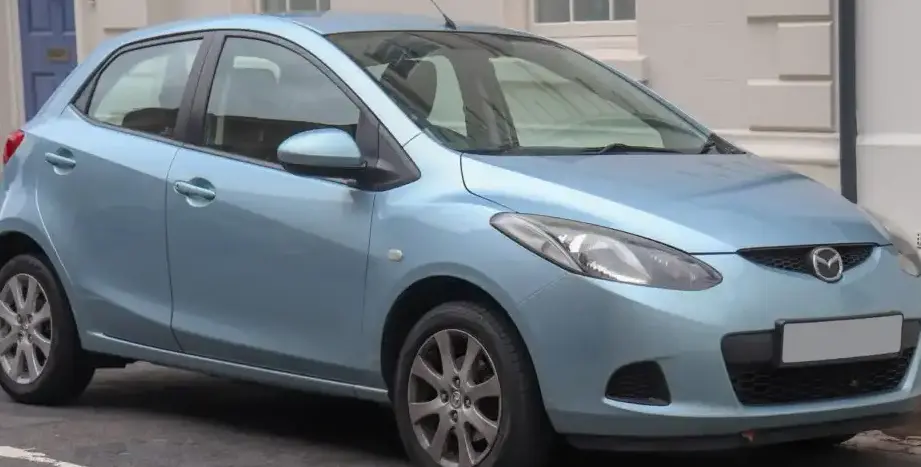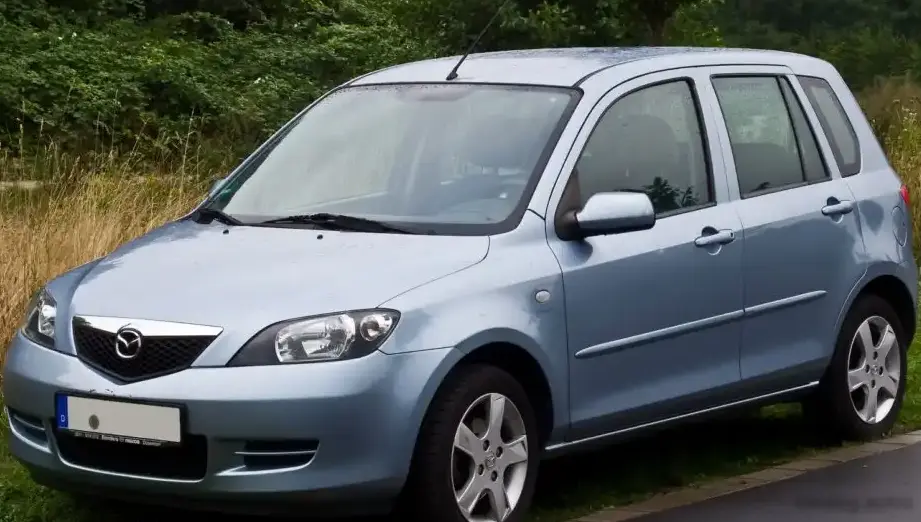
The Mazda2 I (DY) 1.4i 16V 80 hp Automatic, produced between 2003 and 2007, represented an entry-level offering within the first generation (DY) of Mazda’s subcompact hatchback. Positioned as a practical and economical choice, this variant aimed to provide affordable transportation with the convenience of an automatic transmission. It was a key model in Mazda’s European and Asian markets, where small, fuel-efficient cars were highly sought after. The DY series Mazda2 was a significant step forward for Mazda, offering a more refined and modern alternative to its predecessors.
Technical Specifications
| Brand | Mazda |
| Model | 2 |
| Generation | I (DY) |
| Type (Engine) | 1.4i 16V (80 Hp) Automatic |
| Start of production | 2003 |
| End of production | 2007 |
| Powertrain Architecture | Internal Combustion engine |
| Body type | Hatchback |
| Seats | 5 |
| Doors | 5 |
| Fuel consumption (urban) | 8.6 l/100 km (27.4 US mpg, 32.8 UK mpg, 11.6 km/l) |
| Fuel consumption (extra urban) | 5.4 l/100 km (43.6 US mpg, 52.3 UK mpg, 18.5 km/l) |
| Fuel consumption (combined) | 6.5 l/100 km (36.2 US mpg, 43.5 UK mpg, 15.4 km/l) |
| CO2 emissions | 156 g/km |
| Fuel Type | Petrol (Gasoline) |
| Acceleration 0 – 100 km/h | 15 sec |
| Acceleration 0 – 62 mph | 15 sec |
| Acceleration 0 – 60 mph | 14.3 sec |
| Maximum speed | 164 km/h (101.9 mph) |
| Emission standard | Euro 4 |
| Weight-to-power ratio | 13.3 kg/Hp, 75.5 Hp/tonne |
| Weight-to-torque ratio | 8.5 kg/Nm, 117 Nm/tonne |
| Power | 80 Hp @ 5700 rpm |
| Power per litre | 57.6 Hp/l |
| Torque | 124 Nm @ 3500 rpm (91.46 lb.-ft. @ 3500 rpm) |
| Engine layout | Front, Transverse |
| Engine Model/Code | FXJA |
| Engine displacement | 1388 cm3 (84.7 cu. in.) |
| Number of cylinders | 4 |
| Engine configuration | Inline |
| Cylinder Bore | 76 mm (2.99 in.) |
| Piston Stroke | 76.5 mm (3.01 in.) |
| Compression ratio | 11:1 |
| Number of valves per cylinder | 4 |
| Fuel injection system | Multi-port manifold injection |
| Engine aspiration | Naturally aspirated engine |
| Valvetrain | DOHC |
| Engine oil capacity | 3.8 l (4.02 US qt | 3.34 UK qt) |
| Coolant capacity | 5 l (5.28 US qt | 4.4 UK qt) |
| Kerb Weight | 1060 kg (2336.9 lbs.) |
| Max. weight | 1505 kg (3317.96 lbs.) |
| Max load | 445 kg (981.06 lbs.) |
| Trunk (boot) space – minimum | 267 l (9.43 cu. ft.) |
| Trunk (boot) space – maximum | 1044 l (36.87 cu. ft.) |
| Fuel tank capacity | 45 l (11.89 US gal | 9.9 UK gal) |
| Length | 3925 mm (154.53 in.) |
| Width | 1680 mm (66.14 in.) |
| Height | 1545 mm (60.83 in.) |
| Wheelbase | 2490 mm (98.03 in.) |
| Front track | 1470 mm (57.87 in.) |
| Rear track | 1445 mm (56.89 in.) |
| Drag coefficient (Cd) | 0.34 |
| Minimum turning circle | 9.8 m (32.15 ft.) |
| Drivetrain Architecture | Front wheel drive |
| Number of gears | 5 |
| Gearbox type | Automatic transmission |
| Front suspension | Spring Strut |
| Rear suspension | Coil spring |
| Front brakes | Ventilated discs |
| Rear brakes | Drum |
| Assisting systems | ABS (Anti-lock braking system) |
| Steering type | Steering rack and pinion |
| Tires size | 195/50 R15 |
| Wheel rims size | 15 |
INTRODUCTION
The Mazda2 I (DY) 1.4i 16V Automatic, launched in 2003, was a crucial part of Mazda’s strategy to compete in the burgeoning supermini segment. Built on the DY platform, it offered a more spacious and refined interior compared to its predecessor. This particular variant, with its 1.4-liter engine and automatic transmission, was aimed at buyers prioritizing ease of use and fuel efficiency over outright performance. It served as the entry point into the Mazda2 range, appealing to a broad demographic including city dwellers, first-time car buyers, and those seeking a reliable and economical runabout.
Powertrain & Engine Architecture
At the heart of the 1.4i Automatic lies the FXJA engine, a 1.388-liter inline-four cylinder gasoline engine. This engine utilizes a multi-port fuel injection system, delivering fuel directly into the intake ports. The engine features a double overhead camshaft (DOHC) valvetrain, operating with four valves per cylinder, contributing to improved breathing and efficiency. The compression ratio of 11:1 was relatively high for the time, aiding in power output. The automatic transmission was a conventional four-speed unit, chosen for its simplicity and cost-effectiveness. While not offering the responsiveness of a manual gearbox, it provided smooth and effortless gear changes, particularly beneficial in urban driving conditions. The engine’s design prioritized fuel economy and reliability over peak horsepower.
Driving Characteristics
The 80 hp output and 124 Nm of torque delivered by the 1.4i engine, coupled with the four-speed automatic transmission, resulted in a driving experience focused on practicality rather than sportiness. Acceleration from 0-60 mph took around 14.3 seconds, and top speed was limited to 101.9 mph. The automatic transmission’s gear ratios were tuned for fuel efficiency, meaning the engine often felt strained during quick acceleration or when climbing hills. Compared to the more powerful 1.6-liter variants, the 1.4i Automatic felt noticeably slower. However, its smooth gear changes and predictable power delivery made it a comfortable and easy car to drive in everyday situations. The automatic transmission did detract from overall fuel economy compared to the manual version, but the convenience factor was a significant draw for many buyers.
Equipment & Trim Levels
The 1.4i Automatic typically came with a modest level of standard equipment. Features generally included power steering, central locking, electric front windows, and an AM/FM radio. Safety features included ABS (Anti-lock Braking System) and driver and passenger airbags. Interior upholstery was typically cloth, with a functional and durable design. Optional extras included air conditioning, alloy wheels, and a CD player. Higher trim levels, available at an additional cost, added features like upgraded interior trim, a multi-function steering wheel, and improved audio systems. The overall interior design was simple and functional, prioritizing practicality and ease of use.
Chassis & Braking
The Mazda2 I (DY) utilized a front-wheel-drive layout with a MacPherson strut suspension at the front and a coil spring suspension at the rear. This setup provided a comfortable ride quality, absorbing bumps and imperfections in the road surface effectively. The front brakes were ventilated discs, offering good stopping power, while the rear brakes were drums, a cost-saving measure common in this class of vehicle. The chassis was relatively lightweight, contributing to the car’s fuel efficiency and nimble handling. Stabilizer bars were fitted to both the front and rear axles to reduce body roll during cornering, improving stability.
Market Reception & Comparison
The Mazda2 I (DY) 1.4i Automatic was generally well-received by automotive critics as a practical and affordable supermini. It was praised for its comfortable ride, spacious interior, and fuel efficiency. However, the engine’s lack of power and the automatic transmission’s somewhat sluggish performance were often cited as drawbacks. Compared to the 1.6-liter variants, the 1.4i Automatic offered significantly less performance but at a lower price point. The 1.4i manual version provided better fuel economy and a more engaging driving experience, but the automatic appealed to buyers prioritizing convenience. Against competitors like the Ford Fiesta, Volkswagen Polo, and Toyota Yaris, the Mazda2 offered a compelling combination of value, reliability, and style.
Legacy
The FXJA engine, while not known for being particularly high-performance, proved to be remarkably reliable. With regular maintenance, these engines can continue to operate reliably for many years. The four-speed automatic transmission is also generally durable, although it may exhibit some wear and tear over time. In the used car market, the Mazda2 I (DY) 1.4i Automatic remains a popular choice for budget-conscious buyers seeking a dependable and economical vehicle. Its simplicity and relatively low running costs make it an attractive option for first-time car owners or those needing a practical city car. Parts availability is generally good, and maintenance costs are relatively low, contributing to its continued appeal.