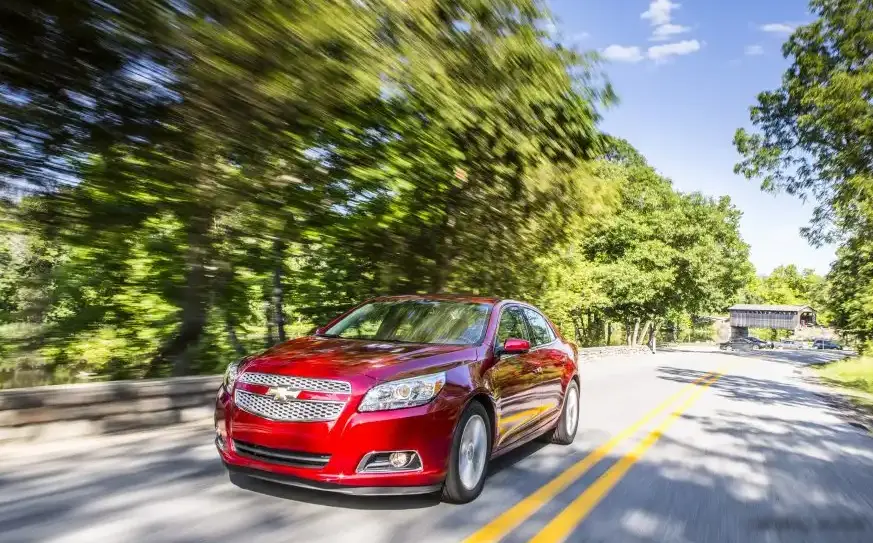
The Chevrolet Malibu VIII 2.0 Turbo (259 Hp) Automatic, produced for the 2013 and 2014 model years, represented a significant step forward for Chevrolet’s mid-size sedan. Part of the eighth generation of the Malibu (introduced for 2013), this variant occupied the upper echelon of the lineup, offering a blend of performance and features aimed at buyers seeking a more engaging driving experience. It was built on the GM’s Epsilon II platform, shared with other global GM products, and positioned itself within a competitive segment against vehicles like the Toyota Camry, Honda Accord, and Ford Fusion. This particular configuration – the 2.0-liter turbocharged engine paired with a six-speed automatic transmission – was designed to appeal to drivers who desired more power than the base 2.5-liter engine offered, without the cost premium of larger displacement options.
Technical Specifications
| Brand | Chevrolet |
| Model | Malibu |
| Generation | Malibu VIII |
| Type (Engine) | 2.0 Turbo (259 Hp) Automatic |
| Start of production | 2013 |
| End of production | 2014 |
| Powertrain Architecture | Internal Combustion engine |
| Body type | Sedan |
| Seats | 5 |
| Doors | 4 |
| Fuel consumption (urban) | 11.2 l/100 km (21 US mpg, 25.2 UK mpg, 8.9 km/l) |
| Fuel consumption (extra urban) | 7.8 l/100 km (30.2 US mpg, 36.2 UK mpg, 12.8 km/l) |
| Fuel Type | Petrol (Gasoline) |
| Weight-to-power ratio | 6.4 kg/Hp, 157.1 Hp/tonne |
| Weight-to-torque ratio | 4.7 kg/Nm, 214.1 Nm/tonne |
| Power | 259 Hp @ 5500 rpm |
| Power per litre | 129.6 Hp/l |
| Torque | 353 Nm @ 1750-5500 rpm (260.36 lb.-ft. @ 1750-5500 rpm) |
| Maximum engine speed | 7000 rpm |
| Engine layout | Front, Transverse |
| Engine Model/Code | LTG |
| Engine displacement | 1998 cm3 (121.93 cu. in.) |
| Number of cylinders | 4 |
| Engine configuration | Inline |
| Cylinder Bore | 86 mm (3.39 in.) |
| Piston Stroke | 86 mm (3.39 in.) |
| Compression ratio | 9.5:1 |
| Number of valves per cylinder | 4 |
| Fuel injection system | Direct injection |
| Engine aspiration | Turbocharger, Intercooler |
| Valvetrain | DOHC, CVVT |
| Engine oil capacity | 4.7 l (4.97 US qt | 4.14 UK qt) |
| Coolant | 7 l (7.4 US qt | 6.16 UK qt) |
| Kerb Weight | 1649 kg (3635.42 lbs.) |
| Trunk (boot) space – minimum | 462 l (16.32 cu. ft.) |
| Fuel tank capacity | 70 l (18.49 US gal | 15.4 UK gal) |
| Length | 4865 mm (191.54 in.) |
| Width | 1854 mm (72.99 in.) |
| Height | 1462 mm (57.56 in.) |
| Wheelbase | 2738 mm (107.8 in.) |
| Front track | 1579 mm (62.17 in.) |
| Rear (Back) track | 1575 mm (62.01 in.) |
| Drag coefficient (Cd) | 0.30 |
| Minimum turning circle (turning diameter) | 11.4 m (37.4 ft.) |
| Drivetrain Architecture | The Internal combustion engine (ICE) drives the front wheels of the vehicle. |
| Drive wheel | Front wheel drive |
| Number of gears and type of gearbox | 6 gears, automatic transmission |
| Front suspension | Independent type McPherson |
| Rear suspension | Independent multi-link suspension |
| Front brakes | Ventilated discs |
| Rear brakes | Disc |
| Assisting systems | ABS (Anti-lock braking system) |
| Steering type | Steering rack and pinion |
| Tires size | 215/60 R16; 225/55 R17; 235/50 R18; 245/45 R19 |
| Wheel rims size | 7.5J x 16; 8.0J x 17; 8.0J x 18; 19J x 19 |
Powertrain & Engine Architecture
The heart of the Malibu VIII 2.0 Turbo was the LUH engine, a 1.998-liter (121.93 cubic inches) inline-four cylinder powerplant. This engine utilized direct fuel injection, a technology that improved fuel efficiency and power output by injecting fuel directly into the combustion chamber. A single twin-scroll turbocharger, coupled with an intercooler, boosted power and torque. The engine featured a double overhead camshaft (DOHC) valvetrain with continuously variable valve timing (CVVT) on both intake and exhaust valves, optimizing engine performance across the rev range. The LTG engine produced 259 horsepower at 5500 rpm and 260 lb-ft of torque between 1750 and 5500 rpm. This power was delivered through a six-speed automatic transmission, designed for smooth and responsive shifting. The transmission was calibrated to balance performance and fuel economy, with gear ratios optimized for both acceleration and highway cruising.
Driving Characteristics
The 2.0-liter turbocharged engine transformed the Malibu’s driving experience compared to the base 2.5-liter naturally aspirated engine. Acceleration was noticeably quicker, making merging onto highways and overtaking maneuvers easier. The six-speed automatic transmission generally provided smooth shifts, although some reviewers noted a slight hesitation during downshifts. The turbocharger provided a broad torque curve, offering ample power throughout the engine’s operating range. While not a sports sedan, the 2.0 Turbo Malibu offered a more engaging driving experience than many of its competitors. The suspension was tuned for comfort, but still provided adequate handling for everyday driving. Compared to the manual transmission equipped models (available in other Malibu trims), the automatic offered convenience but sacrificed some driver involvement.
Equipment & Trim Levels
The 2.0 Turbo trim typically included features such as alloy wheels (sizes ranging from 17 to 19 inches depending on options), a premium audio system, dual-zone automatic climate control, and upgraded interior materials. Standard safety features included ABS, traction control, and multiple airbags. Optional extras included a sunroof, leather upholstery, a navigation system, and advanced safety features like blind-spot monitoring and rear cross-traffic alert. Interior upholstery was typically cloth on the base models, with leather available as an upgrade. The dashboard layout was modern and functional, with a user-friendly infotainment system.
Chassis & Braking
The Malibu VIII utilized an independent McPherson strut suspension in the front and an independent multi-link suspension in the rear. This setup provided a comfortable ride while maintaining reasonable handling characteristics. Front brakes were ventilated discs, while rear brakes were solid discs. ABS (Anti-lock Braking System) was standard, enhancing braking performance and stability. The chassis was designed to provide a balance between rigidity and weight reduction, contributing to the car’s overall handling and fuel efficiency. Stabilizer bars were included both front and rear to reduce body roll during cornering.
Market Reception & Comparison
The 2013-2014 Chevrolet Malibu 2.0 Turbo received generally positive reviews from automotive critics. The engine was praised for its power and responsiveness, and the automatic transmission was considered smooth and efficient. However, some reviewers noted that the interior materials were not as premium as those found in some competing models. Fuel economy was rated at around 21 mpg city and 30 mpg highway, which was competitive for its class. Compared to the base 2.5-liter Malibu, the 2.0 Turbo offered significantly more performance, but at a higher price point. Compared to the Ford Fusion 2.0L EcoBoost, the Malibu offered a similar level of performance, but the Fusion was often praised for its more refined interior and handling.
Legacy
The LTG engine proved to be a relatively reliable powertrain, with few widespread issues reported. The six-speed automatic transmission also demonstrated good durability. In the used car market, the Malibu 2.0 Turbo remains a popular choice for buyers seeking a well-equipped and reasonably priced mid-size sedan. Maintenance costs are generally moderate, and parts availability is good. While not a collector’s item, the Malibu VIII 2.0 Turbo represents a solid and capable family car that offered a compelling combination of performance, features, and value.