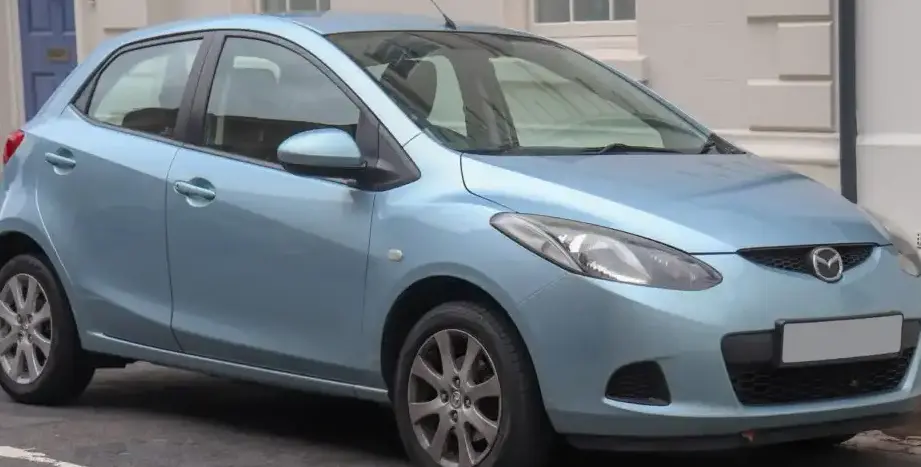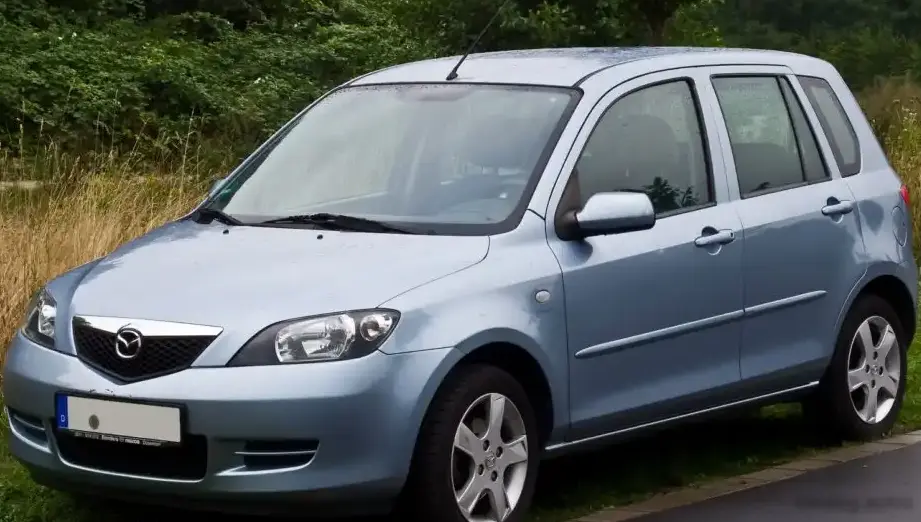
The Mazda2 I (DY) 1.6i 16V, produced between 2003 and 2007, marked a significant evolution for Mazda’s subcompact offering. Positioned as a mid-range trim within the DY generation – the first Mazda2 widely sold in Europe and other global markets – this variant aimed to strike a balance between affordability, performance, and equipment. It played a crucial role in Mazda’s strategy to broaden its appeal to customers seeking a stylish and practical small car. The DY series represented a departure from previous Mazda compacts, embracing a more contemporary design and prioritizing improved fuel efficiency and driving dynamics.
Technical Specifications
| Brand | Mazda |
| Model | 2 |
| Generation | I (DY) |
| Type (Engine) | 1.6 i 16V (101 Hp) |
| Start of production | 2003 |
| End of production | 2007 |
| Powertrain Architecture | Internal Combustion engine |
| Body type | Hatchback |
| Seats | 5 |
| Doors | 5 |
| Fuel consumption (urban) | 9.2 l/100 km (25.6 US mpg) |
| Fuel consumption (extra urban) | 5.5 l/100 km (42.8 US mpg) |
| Fuel consumption (combined) | 6.8 l/100 km (34.6 US mpg) |
| CO2 emissions | 161 g/km |
| Fuel Type | Petrol (Gasoline) |
| Acceleration 0 – 100 km/h | 11.4 sec |
| Acceleration 0 – 62 mph | 11.4 sec |
| Acceleration 0 – 60 mph | 10.8 sec |
| Maximum speed | 181 km/h (112.47 mph) |
| Emission standard | Euro 4 |
| Weight-to-power ratio | 10.7 kg/Hp |
| Weight-to-torque ratio | 7.4 kg/Nm |
| Power | 101 Hp @ 6000 rpm |
| Torque | 146 Nm @ 4000 rpm (107.68 lb.-ft. @ 4000 rpm) |
| Engine layout | Front, Transverse |
| Engine Model/Code | FYJA |
| Engine displacement | 1596 cm3 (97.39 cu. in.) |
| Number of cylinders | 4 |
| Engine configuration | Inline |
| Cylinder Bore | 79 mm (3.11 in.) |
| Piston Stroke | 81.4 mm (3.2 in.) |
| Compression ratio | 11:1 |
| Number of valves per cylinder | 4 |
| Fuel injection system | Multi-port manifold injection |
| Engine aspiration | Naturally aspirated |
| Valvetrain | DOHC |
| Engine oil capacity | 4.25 l (4.49 US qt | 3.74 UK qt) |
| Coolant capacity | 5 l (5.28 US qt | 4.4 UK qt) |
| Kerb Weight | 1080 kg (2380.99 lbs.) |
| Max. weight | 1515 kg (3340 lbs.) |
| Max load | 435 kg (959.01 lbs.) |
| Trunk (boot) space – minimum | 267 l (9.43 cu. ft.) |
| Trunk (boot) space – maximum | 1044 l (36.87 cu. ft.) |
| Fuel tank capacity | 45 l (11.89 US gal | 9.9 UK gal) |
| Length | 3925 mm (154.53 in.) |
| Width | 1680 mm (66.14 in.) |
| Height | 1545 mm (60.83 in.) |
| Wheelbase | 2490 mm (98.03 in.) |
| Front track | 1460 mm (57.48 in.) |
| Rear track | 1435 mm (56.5 in.) |
| Drag coefficient (Cd) | 0.34 |
| Minimum turning circle | 9.8 m (32.15 ft.) |
| Drivetrain | Front wheel drive |
| Number of gears | 5 |
| Gearbox type | Manual transmission |
| Front suspension | Spring Strut |
| Rear suspension | Coil spring |
| Front brakes | Ventilated discs |
| Rear brakes | Drum |
| Assisting systems | ABS (Anti-lock braking system) |
| Steering type | Steering rack and pinion |
| Tires size | 175/65 R14 |
| Wheel rims size | 14 |
Powertrain & Engine Architecture
The Mazda2 1.6i 16V’s powertrain centers around the FYJA engine, a 1.6-liter inline-four cylinder gasoline engine. This engine employs a naturally aspirated design, meaning it doesn’t utilize forced induction. It features a double overhead camshaft (DOHC) valvetrain with 16 valves (four per cylinder), enhancing breathing and high-end power delivery. Fuel is delivered via a multi-port fuel injection system, ensuring precise fuel metering for optimal combustion. The 11:1 compression ratio, relatively high for its time, contributes to both efficiency and power output. The FYJA engine was generally regarded as smooth-running and reasonably reliable. Typically, this engine was paired with a five-speed manual transmission, although a four-speed automatic was also offered, impacting performance and fuel economy.
Driving Characteristics
The 1.6-liter engine produced 101 horsepower and 146 Nm (108 lb-ft) of torque, providing adequate, though not particularly sporty, performance. Acceleration from 0 to 60 mph took approximately 10.8 seconds, with a top speed around 112 mph. Compared to the base 1.4-liter engine, the 1.6i offered a noticeable improvement in responsiveness, especially during overtaking maneuvers or when climbing inclines. However, it lacked the outright punch of higher-performance Mazda2 variants. The five-speed manual transmission provided precise shifts, allowing drivers to effectively utilize the engine’s powerband. The optional four-speed automatic transmission, while convenient, resulted in slightly slower acceleration and reduced fuel economy due to the inherent inefficiencies of a torque converter and the limited number of gear ratios.
Equipment & Trim Levels
The 1.6i trim generally included standard features like power steering, central locking, electric front windows, and an audio system. Air conditioning was frequently offered as an optional upgrade. Interior upholstery was typically cloth, with a straightforward dashboard layout. Higher sub-trims within the 1.6i range might have included alloy wheels, an upgraded audio system, and additional comfort features. The interior design prioritized functionality and durability over luxury, aligning with the car’s positioning as an affordable and practical subcompact.
Chassis & Braking
The Mazda2 DY utilized a front-wheel-drive layout with a MacPherson strut suspension at the front and a coil spring suspension at the rear. The front brakes were ventilated discs, providing good stopping power, while the rear brakes were drums – a cost-saving measure common in this vehicle class. ABS (Anti-lock Braking System) was standard, enhancing safety by preventing wheel lockup during hard braking. The chassis was engineered to deliver a comfortable ride while maintaining reasonable handling characteristics. Stabilizer bars were incorporated to minimize body roll during cornering, improving stability.
Market Reception & Comparison
The Mazda2 1.6i 16V received generally positive reviews from automotive critics. It was praised for its stylish design, comfortable ride quality, and relatively fuel-efficient engine. Compared to competitors like the Ford Fiesta, Volkswagen Polo, and Renault Clio, the Mazda2 offered a compelling blend of features and value. The 1.6-liter engine provided a noticeable performance advantage over the base 1.4-liter option, making it a popular choice for drivers seeking a bit more power. Some critics, however, noted that the interior materials weren’t as refined as those found in some rivals. Fuel economy was competitive for the segment, averaging around 34.6 US mpg in combined driving.
Legacy
The Mazda2 DY 1.6i 16V has proven to be a relatively reliable vehicle, with a significant number still in operation today. The FYJA engine is known for its durability, provided regular maintenance is performed. Common issues include occasional oil leaks and sensor failures. In the used car market, these Mazda2s are often sought after for their affordability, practicality, and appealing design. They represent a good value for buyers looking for a dependable and economical subcompact car. The DY generation Mazda2 established a strong foundation for subsequent generations, solidifying the model’s position as a competitive contender in the subcompact segment.