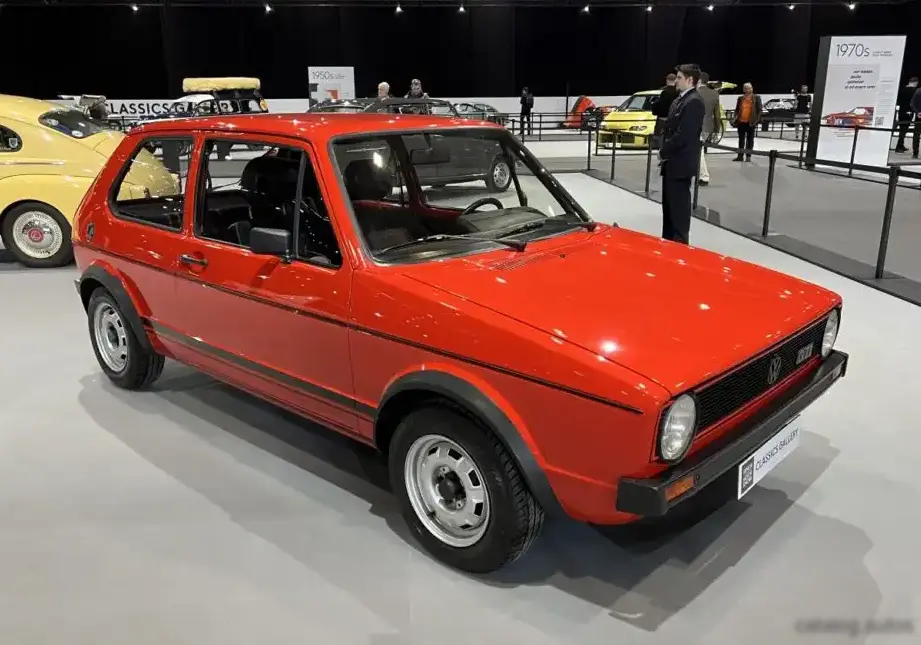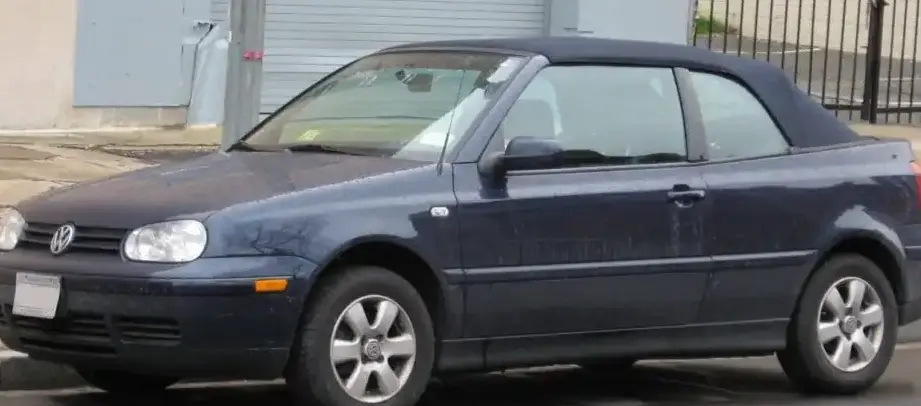
The Volkswagen Golf IV Cabrio 1.8i, produced between April 1998 and October 2000, represented the final iteration of the Mk4 Golf Cabriolet before its discontinuation. Positioned as an entry-level offering within the Golf IV Cabrio range, it provided open-top motoring at a more accessible price point than the higher-performance variants. This model was primarily aimed at the European market, where the convertible Golf held a strong appeal, offering a stylish and practical option for those seeking a fun-to-drive, everyday vehicle. It was built on the Golf IV platform (1HX0/A3) and shared many components with the standard Golf IV hatchback, but with the unique addition of a fully automatic, electrically operated soft top.
Technical Specifications
| Brand | Volkswagen |
| Model | Golf |
| Generation | Golf IV Cabrio |
| Type (Engine) | 1.8i (75 Hp) |
| Start of production | April, 1998 |
| End of production | October, 2000 |
| Powertrain Architecture | Internal Combustion engine |
| Body type | Cabriolet |
| Seats | 4 |
| Doors | 2 |
| Fuel consumption (urban) | 11 l/100 km (21.4 US mpg, 25.7 UK mpg, 9.1 km/l) |
| Fuel consumption (extra urban) | 6.1 l/100 km (38.6 US mpg, 46.3 UK mpg, 16.4 km/l) |
| Fuel Type | Petrol (Gasoline) |
| Acceleration 0 – 100 km/h | 15.5 sec |
| Acceleration 0 – 62 mph | 15.5 sec |
| Acceleration 0 – 60 mph | 14.7 sec |
| Maximum speed | 160 km/h (99.42 mph) |
| Weight-to-power ratio | 15.4 kg/Hp, 64.9 Hp/tonne |
| Weight-to-torque ratio | 8.3 kg/Nm, 121.2 Nm/tonne |
| Power | 75 Hp @ 5000 rpm |
| Power per litre | 42.1 Hp/l |
| Torque | 140 Nm @ 2500 rpm (103.26 lb.-ft. @ 2500 rpm) |
| Engine layout | Front, Transverse |
| Engine Model/Code | ADZ, ANP, AAM, ANN |
| Engine displacement | 1781 cm3 (108.68 cu. in.) |
| Number of cylinders | 4 |
| Engine configuration | Inline |
| Cylinder Bore | 81 mm (3.19 in.) |
| Piston Stroke | 86.4 mm (3.4 in.) |
| Compression ratio | 9:1 |
| Number of valves per cylinder | 2 |
| Fuel injection system | Multi-port manifold injection |
| Engine aspiration | Naturally aspirated engine |
| Valvetrain | OHC |
| Engine oil capacity | 3.8 l (4.02 US qt | 3.34 UK qt) |
| Coolant | 5.5 l (5.81 US qt | 4.84 UK qt) |
| Kerb Weight | 1155 kg (2546.34 lbs.) |
| Max. weight | 1580 kg (3483.3 lbs.) |
| Max load | 425 kg (936.96 lbs.) |
| Trunk (boot) space – minimum | 270 l (9.53 cu. ft.) |
| Trunk (boot) space – maximum | 448 l (15.82 cu. ft.) |
| Fuel tank capacity | 55 l (14.53 US gal | 12.1 UK gal) |
| Length | 4081 mm (160.67 in.) |
| Width | 1695 mm (66.73 in.) |
| Height | 1425 mm (56.1 in.) |
| Wheelbase | 2472 mm (97.32 in.) |
| Front track | 1464 mm (57.64 in.) |
| Rear (Back) track | 1428 mm (56.22 in.) |
| Drivetrain Architecture | The Internal combustion engine (ICE) drives the front wheels of the vehicle. |
| Drive wheel | Front wheel drive |
| Number of gears and type of gearbox | 5 gears, manual transmission |
| Front suspension | Spring Strut |
| Rear suspension | Coil spring |
| Front brakes | Ventilated discs |
| Rear brakes | Disc |
| Assisting systems | ABS (Anti-lock braking system) |
| Steering type | Steering rack and pinion |
| Power steering | Hydraulic Steering |
| Tires size | 185/60 R14 |
| Wheel rims size | 14 |
Introduction
The Golf IV Cabriolet 1.8i (75 hp) was introduced as a more affordable entry point into the Golf IV Cabrio range. Production spanned from 1998 to 2000, and it occupied the base trim level, offering a balance between cost and the open-air experience. It utilized various engine codes including ADZ, ANP, AAM, and ANN, all variations of the 1.8-liter inline-four engine. This variant was particularly popular in Europe, where convertibles were a common sight, and the Golf Cabriolet had a long-standing reputation for reliability and practicality.
Powertrain & Engine Architecture
At the heart of the Golf IV Cabrio 1.8i lies the 1781cc (1.8L) inline-four cylinder engine. The engine codes ADZ, ANP, AAM, and ANN represent minor variations of this engine, primarily relating to emissions control equipment and specific market requirements. The engine features a single overhead camshaft (OHC) valvetrain with two valves per cylinder. Fuel delivery is managed by a multi-port fuel injection system, providing adequate, though not exceptional, performance. The 75 horsepower output is achieved at 5000 rpm, while peak torque of 140 Nm (103.26 lb-ft) is delivered at 2500 rpm. This particular model was typically paired with a 5-speed manual transmission, although a 4-speed automatic transmission was also available, albeit less common. The automatic transmission, while offering convenience, did noticeably impact acceleration and fuel economy.
Driving Characteristics
The 1.8i 75 hp Golf IV Cabriolet offered a relaxed and comfortable driving experience. Acceleration was modest, taking approximately 15.5 seconds to reach 62 mph (100 km/h). The automatic transmission, when equipped, further dulled performance, with slightly slower acceleration times. The engine’s torque curve was relatively flat, providing usable power throughout the rev range, but it lacked the punch of the more powerful 1.9 TDI diesel or the 2.0-liter petrol variants. The suspension, tuned for comfort, provided a compliant ride, but handling was not particularly sporty. The car felt best suited for leisurely cruising with the top down, rather than spirited driving. The gear ratios in the automatic transmission were optimized for fuel efficiency rather than performance.
Equipment & Trim Levels
The base 1.8i trim level included essential features such as power steering, central locking, and an AM/FM radio. Interior upholstery was typically cloth, with a relatively simple dashboard layout. Optional extras included alloy wheels, air conditioning, and a more advanced audio system. Safety features included ABS (Anti-lock Braking System) as standard. The Cabriolet also featured a fully automatic, electrically operated soft top with a glass rear window and a heated rear screen. The interior trim was generally functional and durable, reflecting the car’s position as an entry-level model.
Chassis & Braking
The Golf IV Cabriolet utilized a front-wheel-drive layout with a MacPherson strut front suspension and a coil spring rear suspension. Braking duties were handled by ventilated discs at the front and solid discs at the rear. The braking system was adequate for the car’s weight and performance, but lacked the stopping power of the larger-braked, higher-performance models. The chassis was reinforced compared to the standard Golf IV hatchback to compensate for the lack of a fixed roof, providing acceptable levels of rigidity. Stabilizer bars were fitted front and rear to reduce body roll during cornering.
Market Reception & Comparison
The Golf IV Cabrio 1.8i was generally well-received as an affordable and practical open-top car. Critics noted its comfortable ride and reliable engine, but also pointed out its modest performance. Compared to the 1.9 TDI diesel, the 1.8i offered less torque and slightly worse fuel economy. The more powerful 2.0-liter petrol variants provided significantly better acceleration, but at a higher price point. The 1.8i appealed to buyers who prioritized affordability and comfort over outright performance. Its fuel economy was reasonable for its class, averaging around 38.6 US mpg on the extra-urban cycle.
Legacy
The Golf IV Cabrio 1.8i has proven to be a relatively reliable car, with many examples still on the road today. The 1.8-liter engine is known for its durability, although regular maintenance is essential. Common issues include oil leaks and wear on the timing belt. The automatic transmission, if not serviced regularly, can be prone to failure. In the used car market, the 1.8i Cabriolet represents a relatively affordable entry point into classic Golf ownership. Its simple mechanicals and readily available parts make it a popular choice for enthusiasts and those seeking a classic open-top experience. While not the fastest or most luxurious Golf IV Cabriolet, it remains a charming and practical car that embodies the spirit of affordable motoring.