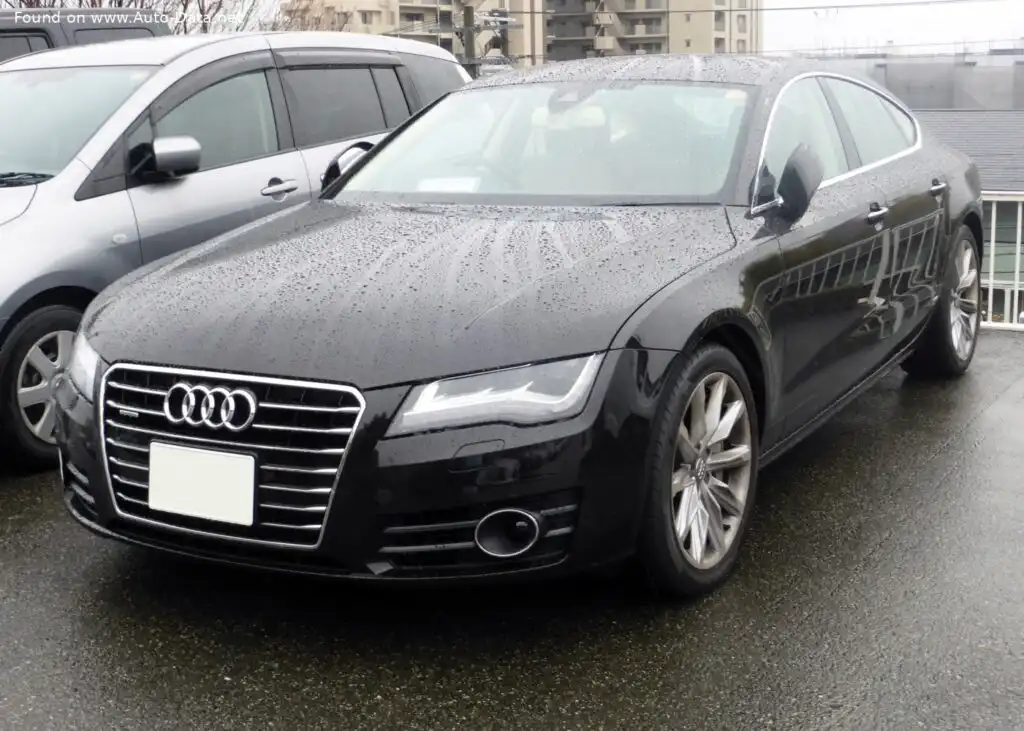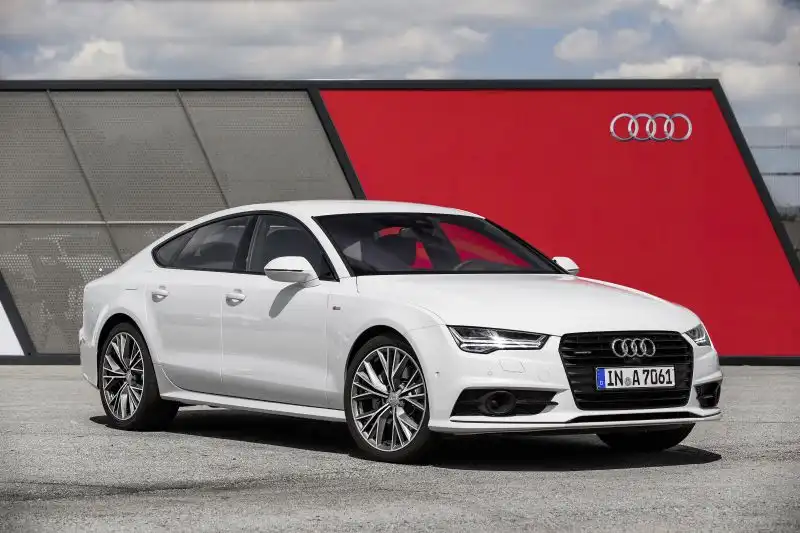
The Audi A7 Sportback (C7) facelift, specifically the 3.0 TDI V6 ultra variant with 190 horsepower and the S tronic dual-clutch transmission, was produced from 2015 to 2017. This model represented a refinement of the C7 generation, introduced in 2010, and aimed to deliver improved fuel efficiency without significantly sacrificing the A7’s luxurious character. Positioned as a mid-range offering within the A7 lineup, it slotted below the more powerful 3.0 TDI variants (272 hp) and above the entry-level 2.0 TDI models. The “ultra” designation signified Audi’s efforts to reduce weight and optimize aerodynamics for enhanced economy.
Technical Specifications
| Brand | Audi |
| Model | A7 |
| Generation | A7 Sportback (C7, facelift 2014) |
| Type (Engine) | 3.0 TDI V6 ultra (190 Hp) S tronic |
| Start of production | 2015 |
| End of production | 2017 |
| Powertrain Architecture | Internal Combustion engine |
| Body type | Liftback |
| Seats | 5 |
| Doors | 5 |
| Fuel consumption (urban) | 5.1-5.2 l/100 km (46.1 – 45.2 US mpg, 55.4 – 54.3 UK mpg, 19.6 – 19.2 km/l) |
| Fuel consumption (extra urban) | 4.5-4.6 l/100 km (52.3 – 51.1 US mpg, 62.8 – 61.4 UK mpg, 22.2 – 21.7 km/l) |
| Fuel consumption (combined) | 4.7-4.8 l/100 km (50 – 49 US mpg, 60.1 – 58.9 UK mpg, 21.3 – 20.8 km/l) |
| CO2 emissions | 122-126 g/km |
| Fuel Type | Diesel |
| Acceleration 0 – 100 km/h | 8.2 sec |
| Acceleration 0 – 62 mph | 8.2 sec |
| Acceleration 0 – 60 mph | 7.8 sec |
| Maximum speed | 230 km/h (142.92 mph) |
| Emission standard | Euro 6 |
| Weight-to-power ratio | 9.2 kg/Hp, 108.3 Hp/tonne |
| Weight-to-torque ratio | 4.4 kg/Nm, 227.9 Nm/tonne |
| Power | 190 Hp @ 2750-5000 rpm |
| Power per litre | 64 Hp/l |
| Torque | 400 Nm @ 1250-3250 rpm (295.02 lb.-ft. @ 1250-3250 rpm) |
| Engine layout | Front, Longitudinal |
| Engine Model/Code | CZVE |
| Engine displacement | 2967 cm3 (181.06 cu. in.) |
| Number of cylinders | 6 |
| Engine configuration | V-engine |
| Fuel injection system | Diesel Commonrail |
| Engine aspiration | Turbocharger, Intercooler |
| Engine oil capacity | 6.1 l (6.45 US qt | 5.37 UK qt) |
| Kerb Weight | 1755 kg (3869.11 lbs.) |
| Max. weight | 2365 kg (5213.93 lbs.) |
| Max load | 610 kg (1344.82 lbs.) |
| Trunk (boot) space – minimum | 535 l (18.89 cu. ft.) |
| Fuel tank capacity | 73 l (19.28 US gal | 16.06 UK gal) |
| Max. roof load | 100 kg (220.46 lbs.) |
| Permitted trailer load with brakes (8%) | 2100 kg (4629.71 lbs.) |
| Permitted trailer load with brakes (12%) | 2000 kg (4409.25 lbs.) |
| Permitted trailer load without brakes | 750 kg (1653.47 lbs.) |
| Permitted towbar download | 85 kg (187.39 lbs.) |
| Length | 4974 mm (195.83 in.) |
| Width | 1911 mm (75.24 in.) |
| Width including mirrors | 2139 mm (84.21 in.) |
| Height | 1420 mm (55.91 in.) |
| Wheelbase | 2914 mm (114.72 in.) |
| Front track | 1644 mm (64.72 in.) |
| Rear (Back) track | 1635 mm (64.37 in.) |
| Minimum turning circle | 11.9 m (39.04 ft.) |
| Drivetrain Architecture | The Internal combustion engine (ICE) drives the front wheels of the vehicle. |
| Drive wheel | Front wheel drive |
| Number of gears and type of gearbox | 7 gears, automatic transmission S tronic |
| Front suspension | Independent multi-link suspension |
| Rear suspension | Independent on trapezoidal lever |
| Front brakes | Ventilated discs |
| Rear brakes | Ventilated discs |
| Assisting systems | ABS (Anti-lock braking system) |
| Steering type | Steering rack and pinion |
| Tires size | 235/55 R 17 |
| Wheel rims size | 8.0J x 17 |
Powertrain & Engine Architecture
The heart of this A7 variant is the 3.0-liter V6 diesel engine, designated CZVE. This engine utilizes a common rail direct injection system, delivering fuel at extremely high pressures for optimized combustion. A single turbocharger, coupled with an intercooler, provides forced induction, boosting power and torque. The engine features four valves per cylinder and a variable geometry turbocharger (VGT) to enhance responsiveness across the rev range. The 190 horsepower output was achieved through engine management recalibration and a slightly detuned power curve compared to higher-output versions of the same engine. The S tronic 7-speed dual-clutch transmission is a key component, offering rapid and smooth gear changes. This transmission features two separate clutches, one for odd and one for even gears, allowing for pre-selection of the next gear and minimizing interruption in power delivery.
Driving Characteristics
The 190 hp 3.0 TDI with the S tronic transmission delivers a comfortable and refined driving experience. While not as overtly sporty as the higher-powered A7 models, it provides ample torque (400 Nm) from low engine speeds, making it well-suited for everyday driving and highway cruising. The S tronic transmission contributes to brisk acceleration, with a 0-60 mph time of around 7.8 seconds. The gear ratios are tuned for fuel efficiency, with higher gears prioritizing economy at cruising speeds. Compared to the manual transmission versions, the S tronic offers greater convenience and smoother shifts, but some enthusiasts might miss the direct engagement of a manual gearbox. The “ultra” designation meant weight reduction measures were implemented, contributing to slightly improved handling and responsiveness compared to standard A7 models.
Equipment & Trim Levels
The 3.0 TDI ultra typically came well-equipped, reflecting Audi’s premium positioning. Standard features included leather upholstery, tri-zone automatic climate control, a multi-function steering wheel, and the Audi MMI infotainment system with a central display screen. Common options included navigation, a Bang & Olufsen sound system, adaptive cruise control, and parking assistance features. Interior trim options varied, with choices in wood or aluminum inlays. Exterior styling was largely consistent across the A7 range, with the “ultra” models often featuring subtle badging to denote their fuel-efficiency focus.
Chassis & Braking
The A7 Sportback utilizes a sophisticated chassis design. The front suspension features independent multi-link setup, while the rear employs an independent trapezoidal link arrangement. This configuration provides a good balance between ride comfort and handling precision. The 190 hp variant typically came equipped with ventilated disc brakes on all four wheels, providing adequate stopping power. ABS (Anti-lock Braking System) and electronic stability control were standard safety features. The suspension tuning was generally geared towards comfort, with a focus on absorbing road imperfections.
Market Reception & Comparison
The A7 3.0 TDI ultra was generally well-received by automotive critics. It was praised for its fuel efficiency, refined driving experience, and luxurious interior. However, some reviewers noted that the 190 hp output felt somewhat underpowered for a vehicle of its size and weight, particularly when compared to the more potent 3.0 TDI variants. In terms of fuel economy, the “ultra” models consistently outperformed their higher-powered counterparts. Reliability was generally good, although, like all modern diesel vehicles, the particulate filter and turbocharger required careful maintenance.
Legacy
The 3.0 TDI V6 ultra engine, in various iterations, proved to be a durable and reliable powertrain. The S tronic transmission, while complex, also demonstrated good longevity with proper servicing. On the used car market, these A7 models represent a good value proposition, offering a blend of luxury, performance, and fuel efficiency. However, potential buyers should be aware of the maintenance requirements associated with diesel engines, including regular servicing of the particulate filter and careful monitoring of oil levels. The C7 A7, including this specific variant, remains a stylish and technologically advanced grand tourer, appreciated for its elegant design and comfortable driving experience.