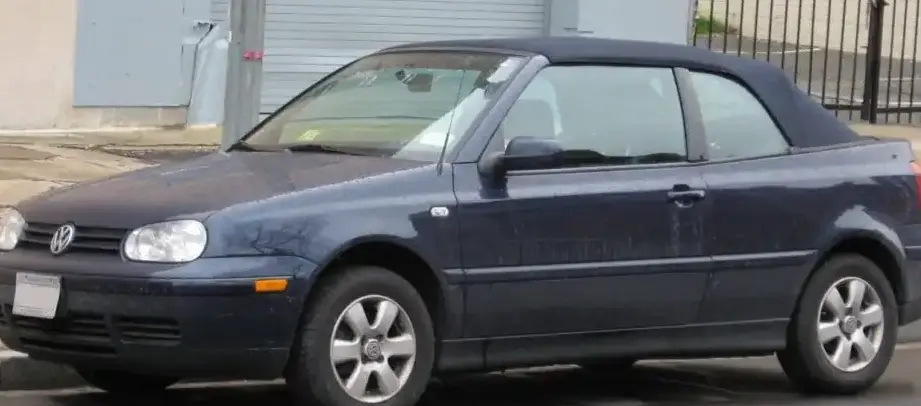
The Volkswagen Golf IV Cabrio 1.8i (90 hp) Automatic, produced between April 1998 and October 2000, represented an entry-level offering within the fourth-generation Golf Cabriolet range. Built on the 1HX0/A3 platform, this variant aimed to provide accessible open-top motoring, blending the Golf’s practicality with the enjoyment of a convertible. It served as a more affordable alternative to the higher-performance and more technologically advanced trims available, such as those equipped with larger engines or manual transmissions. This model was primarily marketed in Europe, where the Golf Cabriolet held a strong position in the compact convertible segment.
Technical Specifications
| Brand | Volkswagen |
| Model | Golf |
| Generation | Golf IV Cabrio |
| Type (Engine) | 1.8i (90 Hp) Automatic |
| Start of production | April, 1998 |
| End of production | October, 2000 |
| Powertrain Architecture | Internal Combustion engine |
| Body type | Cabriolet |
| Seats | 4 |
| Doors | 2 |
| Fuel consumption (urban) | 13.8 l/100 km (17 US mpg, 20.5 UK mpg, 7.2 km/l) |
| Fuel consumption (extra urban) | 7.3 l/100 km (32.2 US mpg, 38.7 UK mpg, 13.7 km/l) |
| Fuel Type | Petrol (Gasoline) |
| Acceleration 0 – 100 km/h | 15 sec |
| Acceleration 0 – 62 mph | 15 sec |
| Acceleration 0 – 60 mph | 14.3 sec |
| Maximum speed | 168 km/h (104.39 mph) |
| Weight-to-power ratio | 12.8 kg/Hp, 77.9 Hp/tonne |
| Weight-to-torque ratio | 8 kg/Nm, 125.5 Nm/tonne |
| Power | 90 Hp @ 5500 rpm |
| Power per litre | 50.5 Hp/l |
| Torque | 145 Nm @ 2500 rpm (106.95 lb.-ft. @ 2500 rpm) |
| Engine layout | Front, Transverse |
| Engine Model/Code | ABS, ADZ, ANP, ACC, ADD |
| Engine displacement | 1781 cm3 (108.68 cu. in.) |
| Number of cylinders | 4 |
| Engine configuration | Inline |
| Cylinder Bore | 81 mm (3.19 in.) |
| Piston Stroke | 86.4 mm (3.4 in.) |
| Compression ratio | 10:1 |
| Number of valves per cylinder | 2 |
| Fuel injection system | Multi-port manifold injection |
| Engine aspiration | Naturally aspirated engine |
| Valvetrain | OHC |
| Engine oil capacity | 4.5 l (4.76 US qt | 3.96 UK qt) |
| Coolant | 5 l (5.28 US qt | 4.4 UK qt) |
| Kerb Weight | 1155 kg (2546.34 lbs.) |
| Max. weight | 1580 kg (3483.3 lbs.) |
| Max load | 425 kg (936.96 lbs.) |
| Trunk (boot) space – minimum | 270 l (9.53 cu. ft.) |
| Trunk (boot) space – maximum | 448 l (15.82 cu. ft.) |
| Fuel tank capacity | 55 l (14.53 US gal | 12.1 UK gal) |
| Length | 4081 mm (160.67 in.) |
| Width | 1695 mm (66.73 in.) |
| Height | 1425 mm (56.1 in.) |
| Wheelbase | 2472 mm (97.32 in.) |
| Front track | 1464 mm (57.64 in.) |
| Rear (Back) track | 1428 mm (56.22 in.) |
| Drivetrain Architecture | The Internal combustion engine (ICE) drives the front wheels of the vehicle. |
| Drive wheel | Front wheel drive |
| Number of gears and type of gearbox | 4 gears, automatic transmission |
| Front suspension | Spring Strut |
| Rear suspension | Coil spring |
| Front brakes | Ventilated discs |
| Rear brakes | Disc |
| Assisting systems | ABS (Anti-lock braking system) |
| Steering type | Steering rack and pinion |
| Power steering | Hydraulic Steering |
| Tires size | 185/60 R14 |
| Wheel rims size | 6J x 14 |
Powertrain & Engine Architecture
The Golf IV Cabrio 1.8i Automatic utilized a 1.8-liter, inline four-cylinder engine, available with various engine codes including ABS, ADZ, ANP, ACC, and ADD depending on the specific market and production year. This engine featured a single overhead camshaft (OHC) valvetrain with two valves per cylinder. Fuel delivery was managed by a multi-port fuel injection system, a common setup for engines of this era. The 90 horsepower output was achieved at 5500 rpm, with a torque figure of 145 Nm (106.95 lb-ft) available at 2500 rpm. The engine’s relatively modest power output was paired with a four-speed automatic transmission. This transmission was chosen to provide ease of use and accessibility, appealing to drivers who prioritized comfort over performance. The automatic gearbox featured standard torque converter technology, offering smooth, if not particularly sporty, gear changes.
Driving Characteristics
The 1.8i Automatic Golf Cabriolet offered a comfortable, but not particularly exhilarating, driving experience. Acceleration from 0 to 100 km/h (0-62 mph) took approximately 15 seconds, and top speed was limited to 168 km/h (104.39 mph). Compared to the more powerful 1.9 TDI diesel or the 2.0-liter gasoline variants, the 1.8i felt noticeably slower, especially when fully loaded or tackling inclines. The four-speed automatic transmission, while convenient, contributed to this lack of urgency. Gear ratios were optimized for fuel efficiency and smooth cruising rather than rapid acceleration. The power delivery was linear, but the engine lacked the punch of its larger counterparts. However, for everyday driving and relaxed open-top motoring, the 1.8i Automatic proved perfectly adequate.
Equipment & Trim Levels
The 1.8i Automatic trim typically included basic features such as power steering, central locking, and electric front windows. Interior upholstery was generally cloth, with a relatively simple dashboard layout. Air conditioning was often an optional extra, as were features like alloy wheels and a radio/cassette player. Safety equipment included an Anti-lock Braking System (ABS) as standard. The trim level was positioned as the entry point into the Golf IV Cabriolet range, making it an attractive option for budget-conscious buyers. Optional extras allowed buyers to personalize their vehicle, but the base specification was fairly spartan.
Chassis & Braking
The Golf IV Cabriolet’s chassis featured a spring strut front suspension and a coil spring rear suspension. The front brakes were ventilated discs, providing adequate stopping power, while the rear brakes were solid discs. The suspension setup was tuned for comfort, prioritizing ride quality over sharp handling. Stabilizer bars were fitted to both the front and rear axles to reduce body roll during cornering. The curb weight of 1155 kg (2546.34 lbs) was relatively light for a convertible, which helped to mitigate the effects of the engine’s modest power output. The steering was rack and pinion, providing reasonably precise control.
Market Reception & Comparison
The Golf IV Cabrio 1.8i Automatic received mixed reviews. Critics generally praised its affordability and ease of use, but criticized its lack of performance compared to other Golf Cabriolet variants. Fuel economy was considered reasonable for a convertible, but not exceptional. The 1.9 TDI diesel offered significantly better fuel efficiency, while the 2.0-liter gasoline engine provided a more engaging driving experience. The 1.8i Automatic appealed to buyers who prioritized comfort and convenience over outright performance, and it proved to be a popular choice for those seeking an affordable entry into open-top motoring.
Legacy
The Golf IV Cabrio 1.8i Automatic, while not the most powerful or technologically advanced variant, remains a relatively reliable and affordable classic car. The 1.8-liter engine is known for its durability, and the four-speed automatic transmission, while not particularly sophisticated, is generally robust. Today, these cars can be found on the used car market at relatively low prices. They represent a good value for those seeking a classic convertible that is easy to maintain and enjoyable to drive. However, potential buyers should be aware of the typical issues associated with older vehicles, such as rust and wear and tear on suspension components. The Golf IV Cabrio 1.8i Automatic continues to be a popular choice for enthusiasts and those looking for a stylish and affordable open-top car.