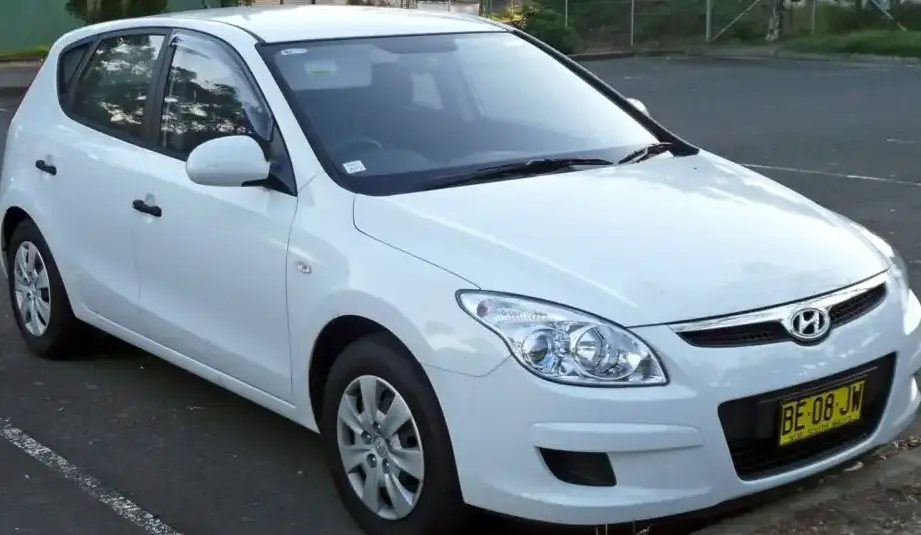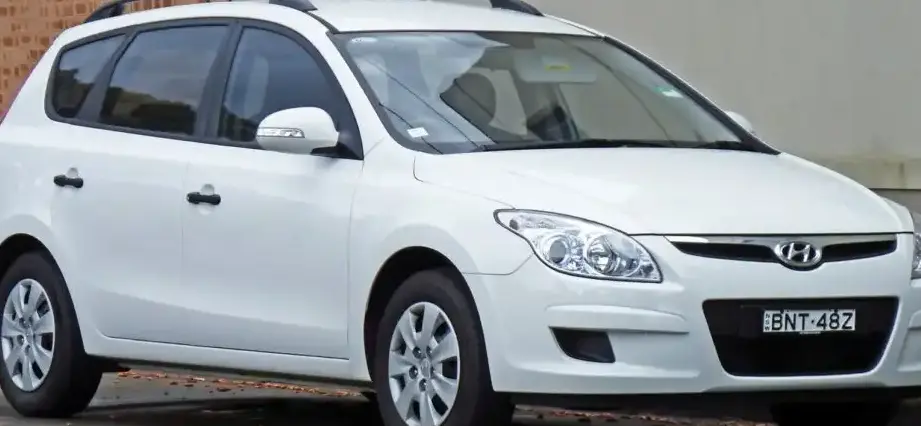
The Hyundai i30 I CW 2.0 CRDi, produced from 2008 to 2010, represents a significant offering in the compact wagon (estate) segment for the Korean automaker. Positioned as a practical and fuel-efficient option, the i30 CW (CW denoting ‘Combined Wagon’) aimed to broaden the appeal of the i30 range beyond the standard hatchback. This variant, equipped with the 2.0-liter CRDi diesel engine producing 140 horsepower, was targeted towards buyers prioritizing economy, space, and a comfortable driving experience. It was part of the first generation i30 (internal code FD), which shared its platform with the Kia Cee’d and Hyundai Elantra.
Technical Specifications
| Brand | Hyundai |
| Model | i30 |
| Generation | i30 I CW |
| Type (Engine) | 2.0 CRDi (140 Hp) |
| Start of production | 2008 |
| End of production | 2010 |
| Powertrain Architecture | Internal Combustion engine |
| Body type | Station wagon (estate) |
| Seats | 5 |
| Doors | 5 |
| Fuel consumption (urban) | 7.2 l/100 km (32.7 US mpg) |
| Fuel consumption (extra urban) | 4.4 l/100 km (53.5 US mpg) |
| Fuel consumption (combined) | 5.5 l/100 km (42.8 US mpg) |
| Fuel Type | Diesel |
| Acceleration 0 – 100 km/h | 10.7 sec |
| Acceleration 0 – 62 mph | 10.7 sec |
| Acceleration 0 – 60 mph | 10.2 sec |
| Maximum speed | 205 km/h (127.38 mph) |
| Emission standard | Euro 4 |
| Weight-to-power ratio | 9.9 kg/Hp |
| Weight-to-torque ratio | 4.5 kg/Nm |
| Power | 140 Hp @ 3800 rpm |
| Torque | 305 Nm @ 1800-2500 rpm (224.96 lb.-ft.) |
| Engine layout | Front, Transverse |
| Engine Model/Code | D4EA |
| Engine displacement | 1991 cm3 (121.5 cu. in.) |
| Number of cylinders | 4 |
| Engine configuration | Inline |
| Cylinder Bore | 83 mm (3.27 in.) |
| Piston Stroke | 92 mm (3.62 in.) |
| Compression ratio | 17.3:1 |
| Number of valves per cylinder | 4 |
| Fuel injection system | Diesel Commonrail |
| Engine aspiration | Turbocharger, Intercooler |
| Valvetrain | SOHC |
| Engine oil capacity | 6.7 l (7.08 US qt | 5.9 UK qt) |
| Coolant capacity | 7.3 l (7.71 US qt | 6.42 UK qt) |
| Kerb Weight | 1381 kg (3044.58 lbs.) |
| Max. weight | 1970 kg (4343.11 lbs.) |
| Max load | 589 kg (1298.52 lbs.) |
| Trunk (boot) space – minimum | 415 l (14.66 cu. ft.) |
| Trunk (boot) space – maximum | 1395 l (49.26 cu. ft.) |
| Fuel tank capacity | 53 l (14 US gal | 11.66 UK gal) |
| Length | 4475 mm (176.18 in.) |
| Width | 1775 mm (69.88 in.) |
| Height | 1565 mm (61.61 in.) |
| Wheelbase | 2700 mm (106.3 in.) |
| Front track | 1538 mm (60.55 in.) |
| Rear track | 1536 mm (60.47 in.) |
| Drag coefficient (Cd) | 0.31 |
| Minimum turning circle | 10.4 m (34.12 ft.) |
| Drivetrain | Front wheel drive |
| Number of gears | 6 |
| Gearbox type | Manual transmission |
| Front suspension | Independent, McPherson with coil spring and anti-roll bar |
| Rear suspension | Independent multi-link with stabilizer |
| Front brakes | Ventilated discs |
| Rear brakes | Disc |
| Assisting systems | ABS |
| Steering type | Steering rack and pinion |
| Tires size | 205/55 R16 H |
| Wheel rims size | 16 |
Powertrain & Engine Architecture
The heart of the i30 CW 2.0 CRDi is the Hyundai D4EA engine, a 1991cc inline-four cylinder diesel. This engine utilizes a second-generation common-rail direct injection system, delivering fuel at extremely high pressure for optimized combustion. The D4EA features a single overhead camshaft (SOHC) valvetrain operating four valves per cylinder. A turbocharger with an intercooler is employed to boost power and torque, providing 140 horsepower at 3800 rpm and a substantial 305 Nm (224.96 lb-ft) of torque between 1800 and 2500 rpm. This broad torque curve is a hallmark of modern diesel engines, providing strong pulling power at lower engine speeds. The engine’s high compression ratio of 17.3:1 contributes to its efficiency. The 6-speed manual transmission was standard, offering well-spaced gear ratios designed to maximize fuel economy and performance.
Driving Characteristics
The 2.0 CRDi engine in the i30 CW delivers a composed and efficient driving experience. While not a performance-oriented variant, the 140 hp output and generous torque provide adequate acceleration for everyday driving and highway cruising. The 0-60 mph time of around 10.2 seconds is respectable for a diesel wagon. The six-speed manual transmission allows drivers to keep the engine in its optimal torque band, resulting in effortless overtaking and hill climbing. Compared to lower-powered i30 variants (like the 1.6 gasoline), the 2.0 CRDi offers significantly more pulling power, making it a better choice for those who frequently carry passengers or cargo. Compared to the higher-output 173 hp version of the same engine, this variant prioritizes fuel economy over outright performance.
Equipment & Trim Levels
The i30 CW 2.0 CRDi typically came with a reasonable level of standard equipment. Features included air conditioning, power windows, central locking, and a basic audio system with CD player. Safety features such as ABS (Anti-lock Braking System) and front airbags were standard. Higher trim levels, often denoted by suffixes like ‘Comfort’ or ‘Style’, added features like alloy wheels, fog lights, a multi-function steering wheel, and upgraded interior trim. Interior upholstery was typically cloth, with options for leather available on higher-spec models. Optional extras included a sunroof, parking sensors, and a more advanced audio system.
Chassis & Braking
The i30 CW utilizes a McPherson strut front suspension and a multi-link rear suspension, providing a comfortable and controlled ride. The suspension setup is tuned for everyday usability rather than sporty handling. Front brakes are ventilated discs, while rear brakes are solid discs, providing adequate stopping power for the vehicle’s weight. The steering is a rack and pinion system, offering precise and responsive control. The i30 CW’s chassis is designed to balance ride comfort with handling stability, making it a pleasant vehicle to drive on a variety of road surfaces.
Market Reception & Comparison
The Hyundai i30 CW 2.0 CRDi was generally well-received by automotive critics as a practical and economical wagon. Its fuel efficiency – achieving around 42.8 US mpg in combined driving – was a major selling point. Critics praised the spacious interior and large cargo area, making it a suitable choice for families. Compared to rivals like the Ford Focus Estate and Volkswagen Golf Estate, the i30 CW offered a competitive price point and a generous warranty. However, some reviewers noted that the interior materials weren’t as premium as those found in some European competitors. Reliability was generally considered good, although some early common-rail diesel engines experienced issues with injector failure.
Legacy
The Hyundai i30 I CW 2.0 CRDi has proven to be a relatively reliable vehicle in the used car market. The D4EA engine, while requiring regular maintenance (including oil changes and fuel filter replacements), is generally durable. Common issues include potential problems with the diesel particulate filter (DPF) if the vehicle is primarily used for short journeys, and occasional injector issues. Today, these i30 CWs represent an affordable and practical option for buyers seeking a fuel-efficient and spacious wagon. Their relatively low running costs and readily available parts contribute to their continued appeal in the used car market.