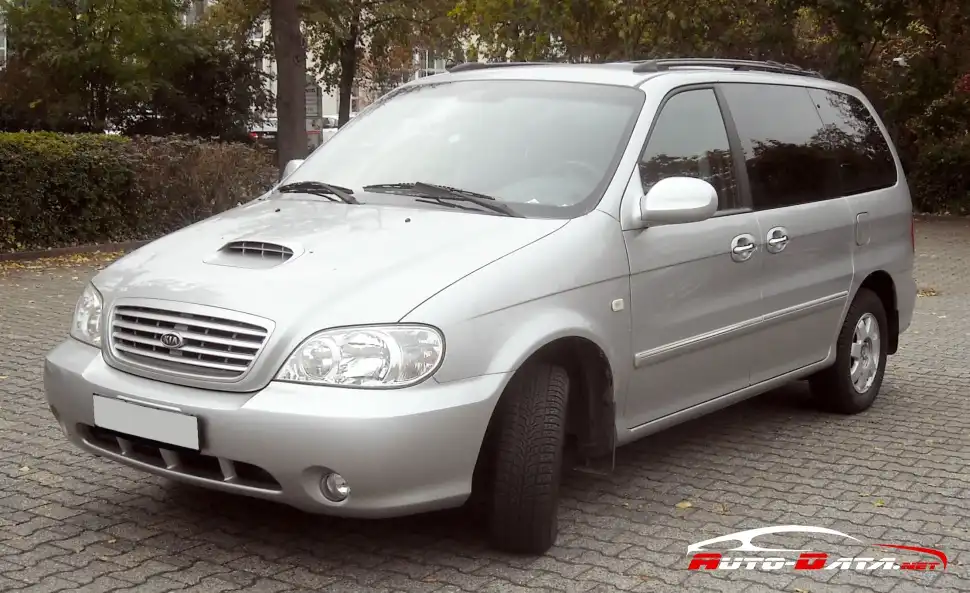
Technical Specifications
| Brand | Kia |
| Model | Carnival |
| Generation | Carnival I (UP/GQ) |
| Type (Engine) | 2.5i V6 24V (165 Hp) Automatic |
| Start of production | 1999 |
| End of production | 2001 |
| Powertrain Architecture | Internal Combustion engine |
| Body type | Minivan |
| Seats | 7 |
| Doors | 5 |
| Fuel consumption (combined) | 11.3 l/100 km (20.8 US mpg, 25 UK mpg, 8.8 km/l) |
| Fuel Type | Petrol (Gasoline) |
| Acceleration 0 – 100 km/h | 13.8 sec |
| Acceleration 0 – 62 mph | 13.8 sec |
| Acceleration 0 – 60 mph | 13.1 sec |
| Maximum speed | 185 km/h (114.95 mph) |
| Weight-to-power ratio | 10.8 kg/Hp, 92.4 Hp/tonne |
| Weight-to-torque ratio | 8 kg/Nm, 124.4 Nm/tonne |
| Power | 165 Hp @ 6500 rpm |
| Power per litre | 66.1 Hp/l |
| Torque | 222 Nm @ 4100 rpm (163.74 lb.-ft. @ 4100 rpm) |
| Engine layout | Front, Transverse |
| Engine Model/Code | KV6 |
| Engine displacement | 2497 cm3 (152.38 cu. in.) |
| Number of cylinders | 6 |
| Engine configuration | V-engine |
| Cylinder Bore | 80 mm (3.15 in.) |
| Piston Stroke | 82.8 mm (3.26 in.) |
| Compression ratio | 10.4:1 |
| Number of valves per cylinder | 4 |
| Fuel injection system | Multi-port manifold injection |
| Engine aspiration | Naturally aspirated engine |
| Valvetrain | DOHC |
| Engine oil capacity | 5.8 l (6.13 US qt | 5.1 UK qt) |
| Coolant | 9.4 l (9.93 US qt | 8.27 UK qt) |
| Kerb Weight | 1785 kg (3935.25 lbs.) |
| Max. weight | 2425 kg (5346.21 lbs.) |
| Max load | 640 kg (1410.96 lbs.) |
| Trunk (boot) space – minimum | 344 l (12.15 cu. ft.) |
| Trunk (boot) space – maximum | 1159 l (40.93 cu. ft.) |
| Fuel tank capacity | 75 l (19.81 US gal | 16.5 UK gal) |
| Length | 4890 mm (192.52 in.) |
| Width | 1900 mm (74.8 in.) |
| Height | 1730 mm (68.11 in.) |
| Wheelbase | 2910 mm (114.57 in.) |
| Front track | 1625 mm (63.98 in.) |
| Rear (Back) track | 1600 mm (62.99 in.) |
| Minimum turning circle | 13 m (42.65 ft.) |
| Drivetrain Architecture | The Internal combustion engine (ICE) drives the front wheels of the vehicle. |
| Drive wheel | Front wheel drive |
| Number of gears and type of gearbox | 4 gears, automatic transmission |
| Front suspension | Wishbone |
| Rear suspension | Coil spring |
| Front brakes | Ventilated discs |
| Rear brakes | Drum |
| Assisting systems | ABS (Anti-lock braking system) |
| Steering type | Steering rack and pinion |
| Power steering | Hydraulic Steering |
| Tires size | 215/65 R15 |
| Wheel rims size | 15 |
The Kia Carnival, marketed as the Sedona in North America, marked Kia’s ambitious entry into the minivan market in 1999. The first generation (internally designated UP/GQ) aimed to offer a more affordable and well-equipped alternative to established competitors like the Dodge Caravan and Toyota Sienna. The 2.5i V6 24V Automatic variant, produced from 1999 to 2001, occupied a mid-range position in the Carnival lineup, balancing performance and practicality for family transportation. This model was particularly important as it demonstrated Kia’s growing engineering prowess and its desire to gain a stronger foothold in the global automotive landscape.
Powertrain & Engine Architecture
The 2.5i V6 Carnival was powered by the KV6 engine, a 2.5-liter, 60-degree V6 developed in-house by Kia. This engine featured a double overhead camshaft (DOHC) valvetrain with four valves per cylinder, resulting in its 24-valve configuration. The KV6 employed multi-port fuel injection, delivering fuel directly to each intake port to optimize combustion efficiency. Producing 165 horsepower at 6,500 rpm and 222 Nm (163.74 lb-ft) of torque at 4,100 rpm, the engine provided adequate power for the minivan, though it wasn’t designed for sporty performance. It was paired with a four-speed automatic transmission, prioritizing smooth operation and ease of use. This transmission was a conventional hydraulic unit, known for its relatively simple and reliable design.
Driving Characteristics
The 2.5i V6 Automatic Carnival delivered a comfortable, but not particularly exciting, driving experience. Acceleration was modest, requiring approximately 13.8 seconds to reach 62 mph. The four-speed automatic transmission, while smooth, lacked the responsiveness found in more modern transmissions. Gear ratios were optimized for fuel economy and relaxed cruising rather than quick acceleration. Compared to the available manual transmission or potential future higher-output engine options, this variant felt noticeably less energetic. However, the automatic transmission made it an ideal choice for drivers who valued convenience and ease of driving, especially in urban settings. The front-wheel-drive configuration provided predictable handling, though it wasn’t particularly engaging for driving enthusiasts.
Equipment & Trim Levels
The 2.5i V6 Automatic trim typically included standard features such as air conditioning, power windows and locks, and an AM/FM stereo. Optional upgrades included alloy wheels, a sunroof, and enhanced interior upholstery. The interior materials were durable and family-friendly. Seating accommodated seven passengers in a 2-3-2 configuration. Additional options included rear air conditioning and a CD player. The dashboard layout was functional and straightforward, emphasizing usability over elaborate design.
Chassis & Braking
The Carnival I utilized a front-wheel-drive chassis with an independent wishbone suspension at the front and a coil spring suspension at the rear. This setup provided a reasonably comfortable ride, although it wasn’t geared towards sporty handling. Braking was handled by ventilated discs at the front and drum brakes at the rear. An anti-lock braking system (ABS) was standard, enhancing safety. Steering was rack-and-pinion with hydraulic power assistance, offering light and easy steering feel. The suspension was tuned to prioritize comfort and load-carrying capacity, reflecting the vehicle’s intended role as a family vehicle.
Market Reception & Comparison
The 2.5i V6 Automatic Carnival received mixed reviews. Critics generally praised its spacious interior, comfortable ride, and competitive price point. However, the engine was often criticized for being underpowered, especially when the vehicle was fully loaded with passengers and cargo. Fuel economy, averaging around 20.8 US mpg combined, was typical for the segment. Compared to the base 2.4L four-cylinder models, the V6 offered a noticeable performance improvement, but at a higher cost. Against competitors like the Dodge Caravan and Toyota Sienna, the Carnival offered a compelling value proposition, but lacked the established reputation and refinement of those more established models.
Legacy
The KV6 engine, while not renowned for exceptional longevity, proved to be reasonably reliable with consistent maintenance. Common issues included oil leaks and occasional sensor failures. The four-speed automatic transmission was generally durable. Today, the 1999-2001 Kia Carnival 2.5i V6 Automatic is a relatively affordable used car option. Its simplicity and relatively low running costs make it appealing to budget-conscious buyers. However, potential buyers should be aware of the engine’s potential for oil consumption and the limited availability of replacement parts compared to more popular models. The Carnival I was a crucial step for Kia, demonstrating the brand’s ability to produce a competitive and practical minivan and paving the way for future success in the segment.