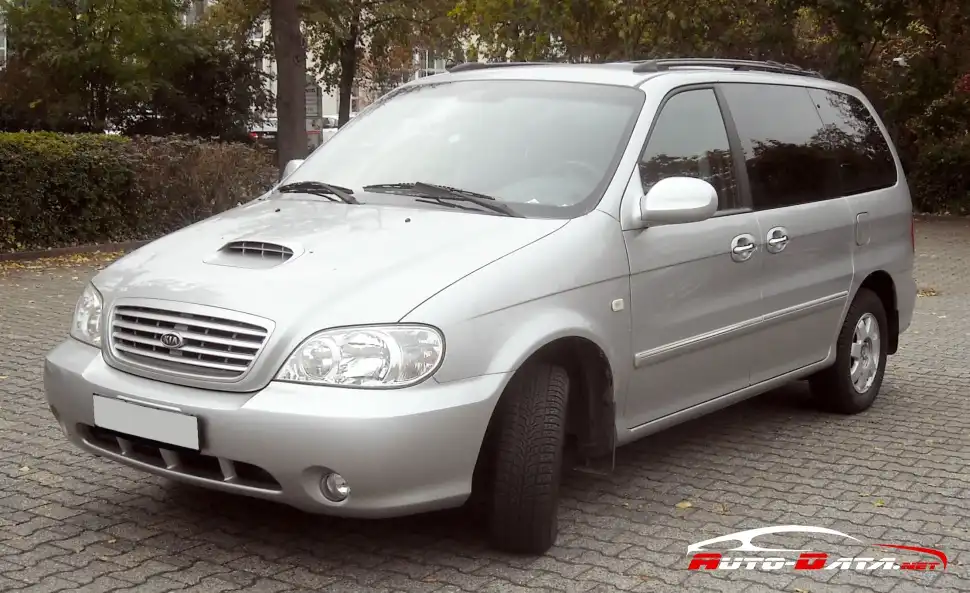
The Kia Carnival, known as the Kia Sedona in North American markets, represented Kia’s entry into the competitive minivan segment. Introduced in 1999 as a 2000 model year vehicle (under the UP/GQ chassis code), the first generation Carnival aimed to provide a practical and affordable alternative to established players like the Dodge Caravan and Toyota Sienna. The 2.9 TD variant, powered by a turbocharged diesel engine producing 126 horsepower, was primarily aimed at markets outside of North America where diesel fuel was more prevalent and cost-effective. Production of this specific configuration ran from 1999 to 2001.
Technical Specifications
| Brand | Kia |
| Model | Carnival |
| Generation | Carnival I (UP/GQ) |
| Type (Engine) | 2.9 TD (126 Hp) |
| Start of production | 1999 |
| End of production | 2001 |
| Powertrain Architecture | Internal Combustion engine |
| Body type | Minivan |
| Seats | 7 |
| Doors | 5 |
| Fuel consumption (urban) | 12 l/100 km (19.6 US mpg) |
| Fuel consumption (extra urban) | 7 l/100 km (33.6 US mpg) |
| Fuel consumption (combined) | 8.3 l/100 km (28.3 US mpg) |
| Fuel Type | Diesel |
| Acceleration 0 – 100 km/h | 17.3 sec |
| Acceleration 0 – 62 mph | 17.3 sec |
| Acceleration 0 – 60 mph | 16.4 sec |
| Maximum speed | 168 km/h (104.39 mph) |
| Weight-to-power ratio | 14.9 kg/Hp |
| Weight-to-torque ratio | 5.6 kg/Nm |
| Power | 126 Hp @ 3600 rpm |
| Torque | 338 Nm @ 1950 rpm (249.3 lb.-ft. @ 1950 rpm) |
| Engine layout | Front, Transverse |
| Engine Model/Code | J3 |
| Engine displacement | 2902 cm3 (177.09 cu. in.) |
| Number of cylinders | 4 |
| Engine configuration | Inline |
| Cylinder Bore | 97.1 mm (3.82 in.) |
| Piston Stroke | 98 mm (3.86 in.) |
| Compression ratio | 19:1 |
| Number of valves per cylinder | 4 |
| Fuel injection system | Precombustion chamber injection |
| Engine aspiration | Turbocharger |
| Valvetrain | DOHC |
| Engine oil capacity | 6.6 l (6.97 US qt | 5.81 UK qt) |
| Coolant capacity | 9.4 l (9.93 US qt | 8.27 UK qt) |
| Kerb Weight | 1880 kg (4144.69 lbs.) |
| Max. weight | 2545 kg (5610.76 lbs.) |
| Max load | 665 kg (1466.07 lbs.) |
| Trunk (boot) space – minimum | 344 l (12.15 cu. ft.) |
| Trunk (boot) space – maximum | 1159 l (40.93 cu. ft.) |
| Fuel tank capacity | 75 l (19.81 US gal | 16.5 UK gal) |
| Length | 4890 mm (192.52 in.) |
| Width | 1900 mm (74.8 in.) |
| Height | 1730 mm (68.11 in.) |
| Wheelbase | 2910 mm (114.57 in.) |
| Front track | 1625 mm (63.98 in.) |
| Rear (Back) track | 1600 mm (62.99 in.) |
| Minimum turning circle | 13 m (42.65 ft.) |
| Drivetrain | Front wheel drive |
| Number of gears | 5 |
| Gearbox type | Manual transmission |
| Front suspension | Wishbone |
| Rear suspension | Coil spring |
| Front brakes | Ventilated discs |
| Rear brakes | Drum |
| Assisting systems | ABS (Anti-lock braking system) |
| Steering type | Steering rack and pinion |
| Power steering | Hydraulic |
| Tires size | 215/65 R15 |
| Wheel rims size | 15 |
Powertrain & Engine Architecture
The heart of the 2.9 TD Carnival was the Kia J3 engine, a 2.9-liter inline-four cylinder diesel. This engine utilized precombustion chamber injection, a system common in older diesel designs, where fuel is injected into a small pre-chamber before entering the main combustion chamber. This aids in more complete combustion, particularly at lower engine speeds. The engine was turbocharged, boosting power output to 126 horsepower and 338 Nm (249.3 lb-ft) of torque. The turbocharger helped to overcome the inherent limitations of a naturally aspirated diesel engine, providing improved acceleration and highway cruising ability. The engine featured a double overhead camshaft (DOHC) valvetrain, operating four valves per cylinder. The 2.9 TD was paired with a five-speed manual transmission, the only gearbox option available for this configuration. This transmission was chosen for its durability and efficiency, aligning with the intended use case of the diesel engine.
Driving Characteristics
The 2.9 TD Carnival, with its 126 horsepower and relatively high torque output, offered a different driving experience compared to gasoline-powered versions. Acceleration was modest, taking around 17.3 seconds to reach 62 mph (100 km/h), and 16.4 seconds to 60 mph. However, the engine’s torque peak at 1950 rpm provided decent pulling power for everyday driving and hauling passengers or cargo. The five-speed manual transmission allowed drivers to keep the engine in its optimal power band. Compared to potential higher-output gasoline engines (which weren’t widely available in the Carnival initially), the diesel offered better fuel economy, but at the expense of outright speed. The manual transmission also provided more driver engagement than an automatic, though it required more effort in stop-and-go traffic.
Equipment & Trim Levels
The 2.9 TD Carnival typically came with a fairly basic level of equipment, reflecting its position as a value-oriented offering. Standard features generally included power steering, air conditioning, and basic cloth upholstery. Depending on the market, features like power windows and central locking might have been standard or optional. Interior trim was functional and durable, prioritizing practicality over luxury. Optional extras could include alloy wheels, upgraded audio systems, and a sunroof. The trim level was generally considered entry-level to mid-range, focusing on providing essential features for family transportation.
Chassis & Braking
The Carnival’s chassis featured a front-engine, front-wheel-drive layout. Suspension consisted of a wishbone setup at the front and a coil spring arrangement at the rear. The front brakes were ventilated discs, providing adequate stopping power, while the rear brakes were drums, a cost-saving measure common in this class of vehicle. Anti-lock Braking System (ABS) was included as a standard safety feature. The suspension was tuned for comfort, prioritizing a smooth ride over sporty handling. The relatively heavy weight of the vehicle, around 1880 kg (4144.69 lbs), contributed to its stable but not particularly agile handling characteristics.
Market Reception & Comparison
The 2.9 TD Carnival received mixed reviews. Critics praised its spacious interior, practicality, and affordability, particularly in markets where diesel fuel was cheaper. However, the engine’s performance was often criticized as being underpowered, especially when fully loaded with passengers and luggage. Fuel economy was a strong point, offering a significant advantage over gasoline-powered rivals. Compared to other trims in the Carnival lineup, the 2.9 TD was the most economical option, but it lacked the punch of potential gasoline engines. Its reliability was generally considered good, but maintenance costs for the diesel engine and its associated components could be higher than those for a gasoline engine.
Legacy
The Kia Carnival 2.9 TD, while not a performance standout, played a significant role in establishing Kia as a viable competitor in the minivan segment. The J3 diesel engine proved to be reasonably durable, and many examples remain on the road today. In the used car market, these Carnivals are often sought after by buyers looking for an affordable and practical family vehicle with good fuel economy. However, potential buyers should be aware of the age-related issues common to older diesel engines, such as turbocharger wear and potential fuel injection system problems. The 2.9 TD Carnival represents a pivotal moment in Kia’s history, demonstrating the brand’s commitment to providing value and practicality to consumers.