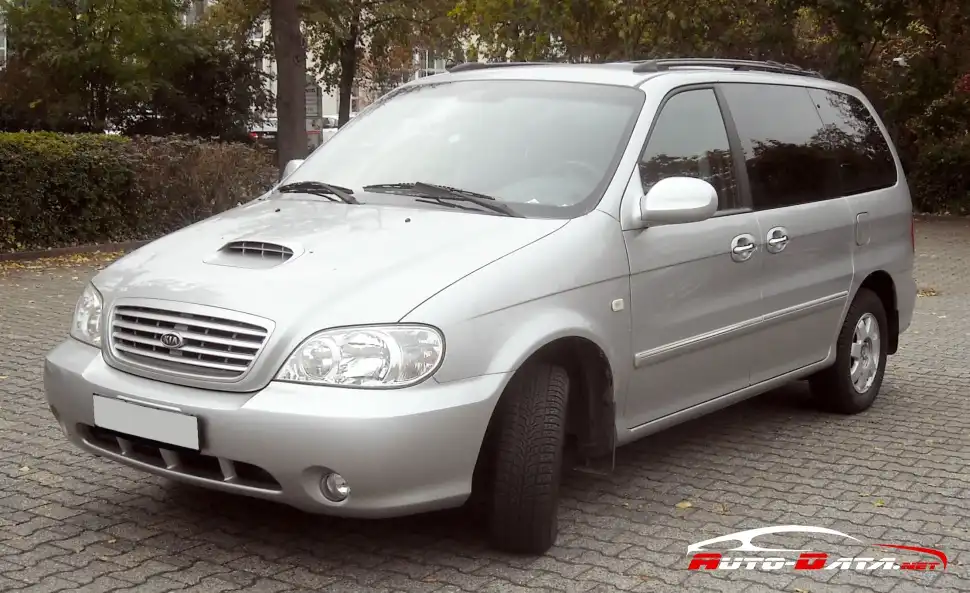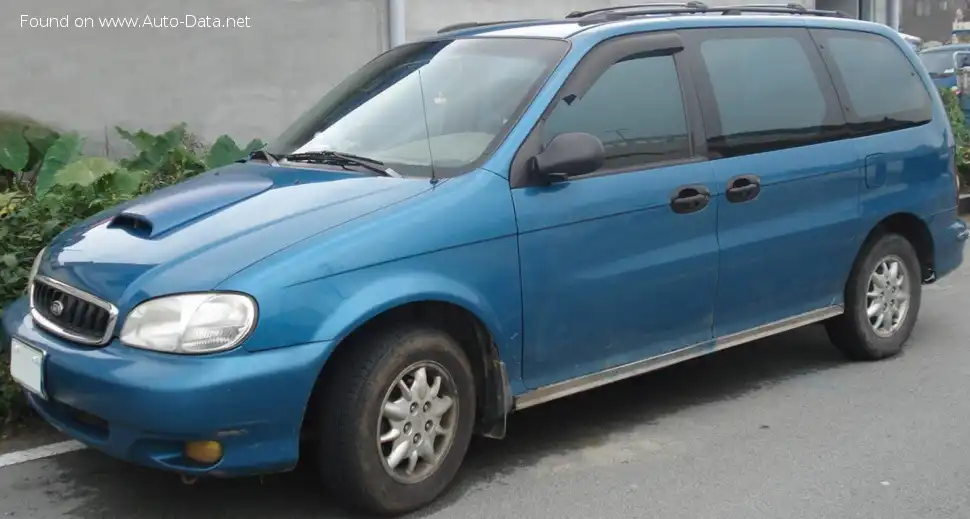
The Kia Carnival, known as the Sedona in North American markets, represented Kia’s entry into the competitive minivan segment. Introduced in 1999 as a 2000 model year vehicle (under the UP/GQ chassis code), the first generation Carnival aimed to provide a spacious and affordable alternative to established players like the Dodge Caravan and Toyota Sienna. The 2.9 TD Automatic variant, produced from 1999 to 2001, was a key offering in many international markets, particularly in Europe and Asia, where diesel engines were favored for their fuel efficiency and torque. This model positioned itself as a mid-range option, offering a balance between affordability and practicality for families.
Technical Specifications
| Brand | Kia |
| Model | Carnival |
| Generation | Carnival I (UP/GQ) |
| Type (Engine) | 2.9 TD (126 Hp) Automatic |
| Start of production | 1999 |
| End of production | 2001 |
| Powertrain Architecture | Internal Combustion engine |
| Body type | Minivan |
| Seats | 7 |
| Doors | 5 |
| Fuel consumption (urban) | 12 l/100 km (19.6 US mpg) |
| Fuel consumption (extra urban) | 7 l/100 km (33.6 US mpg) |
| Fuel consumption (combined) | 8.3 l/100 km (28.3 US mpg) |
| Fuel Type | Diesel |
| Acceleration 0 – 100 km/h | 17.3 sec |
| Acceleration 0 – 62 mph | 17.3 sec |
| Acceleration 0 – 60 mph | 16.4 sec |
| Maximum speed | 168 km/h (104.39 mph) |
| Weight-to-power ratio | 15 kg/Hp |
| Weight-to-torque ratio | 5.6 kg/Nm |
| Power | 126 Hp @ 3600 rpm |
| Power per litre | 43.4 Hp/l |
| Torque | 338 Nm @ 1950 rpm (249.3 lb.-ft. @ 1950 rpm) |
| Engine layout | Front, Transverse |
| Engine Model/Code | J3 |
| Engine displacement | 2902 cm3 (177.09 cu. in.) |
| Number of cylinders | 4 |
| Engine configuration | Inline |
| Cylinder Bore | 97.1 mm (3.82 in.) |
| Piston Stroke | 98 mm (3.86 in.) |
| Compression ratio | 19:1 |
| Number of valves per cylinder | 4 |
| Fuel injection system | Precombustion chamber injection |
| Engine aspiration | Turbocharger |
| Valvetrain | DOHC |
| Engine oil capacity | 6.6 l (6.97 US qt | 5.81 UK qt) |
| Coolant capacity | 9.4 l (9.93 US qt | 8.27 UK qt) |
| Kerb Weight | 1890 kg (4166.74 lbs.) |
| Max. weight | 2545 kg (5610.76 lbs.) |
| Max load | 655 kg (1444.03 lbs.) |
| Trunk (boot) space – minimum | 344 l (12.15 cu. ft.) |
| Trunk (boot) space – maximum | 1159 l (40.93 cu. ft.) |
| Fuel tank capacity | 75 l (19.81 US gal | 16.5 UK gal) |
| Length | 4890 mm (192.52 in.) |
| Width | 1900 mm (74.8 in.) |
| Height | 1730 mm (68.11 in.) |
| Wheelbase | 2910 mm (114.57 in.) |
| Front track | 1625 mm (63.98 in.) |
| Rear track | 1600 mm (62.99 in.) |
| Minimum turning circle | 13 m (42.65 ft.) |
| Drivetrain | Front wheel drive |
| Number of gears | 4 |
| Gearbox type | Automatic transmission |
| Front suspension | Wishbone |
| Rear suspension | Coil spring |
| Front brakes | Ventilated discs |
| Rear brakes | Drum |
| Assisting systems | ABS (Anti-lock braking system) |
| Steering type | Steering rack and pinion |
| Power steering | Hydraulic |
| Tires size | 215/65 R15 |
| Wheel rims size | 15 |
INTRODUCTION
The Kia Carnival I (UP/GQ) 2.9 TD Automatic, launched in 1999, was a significant vehicle for Kia as it expanded its global presence. Built on the 1HX0/A3 platform, this minivan aimed to offer a compelling package of space, practicality, and affordability. The 2.9-liter turbodiesel engine paired with a four-speed automatic transmission was specifically targeted towards markets where fuel economy and low-end torque were highly valued. It served as a workhorse for families and businesses alike, offering a seven-seat configuration and ample cargo space. This variant occupied a middle ground in the Carnival lineup, positioned above the base gasoline models but below any potential higher-trim level diesel options.
Powertrain & Engine Architecture
The heart of the 2.9 TD Automatic Carnival is the J3 engine, a 2.9-liter inline-four cylinder diesel. This engine utilized a precombustion chamber injection system, a common technology for diesel engines of the era, designed to improve combustion efficiency and reduce noise. The turbocharger significantly boosted power output, bringing it to 126 horsepower at 3600 rpm and a respectable 338 Nm (249.3 lb.-ft.) of torque at a low 1950 rpm. The four-speed automatic transmission was a conventional hydraulic unit, chosen for its simplicity and reliability. While not offering the smoothness or efficiency of modern transmissions, it provided convenient operation for a wide range of drivers. The engine’s DOHC valvetrain contributed to improved breathing and overall performance.
Driving Characteristics
The 2.9 TD Automatic Carnival prioritized usability over outright performance. Acceleration was modest, with a 0-60 mph time of around 16.4 seconds. However, the engine’s strong low-end torque made it well-suited for carrying passengers and cargo. The automatic transmission, while functional, wasn’t particularly quick to shift, and the gear ratios were optimized for fuel economy rather than spirited driving. Compared to the gasoline-powered Carnivals, the diesel offered significantly better fuel economy and more pulling power. Against higher-output diesel variants (if available in certain markets), this 126 hp version felt less powerful, particularly when fully loaded. The focus was on providing a comfortable and relaxed driving experience, ideal for long journeys.
Equipment & Trim Levels
The 2.9 TD Automatic Carnival typically came equipped with a reasonable level of standard features. These generally included power windows and locks, air conditioning, and a basic audio system. Interior upholstery was typically cloth, with a durable and practical design. Optional extras could include alloy wheels, a sunroof, and upgraded audio systems. Trim levels varied by market, but the 2.9 TD Automatic generally represented a mid-range offering, bridging the gap between basic and luxury configurations. The dashboard layout was functional and straightforward, prioritizing ease of use over aesthetic flair.
Chassis & Braking
The Carnival’s chassis was designed to provide a comfortable ride and stable handling. Front suspension utilized a wishbone setup, while the rear employed a coil spring arrangement. The front brakes were ventilated discs, providing adequate stopping power, while the rear brakes were drums, a cost-saving measure common in this class of vehicle. ABS (Anti-lock Braking System) was a standard safety feature. The steering was rack and pinion with hydraulic assistance, offering reasonable precision and ease of maneuvering. The relatively heavy weight of the vehicle, around 1890 kg (4166.74 lbs), contributed to its planted feel on the road.
Market Reception & Comparison
The Kia Carnival 2.9 TD Automatic was generally well-received in markets where diesel minivans were popular. Critics praised its spacious interior, comfortable ride, and fuel efficiency. However, some noted the engine’s lack of refinement compared to some competitors and the somewhat sluggish performance of the automatic transmission. Compared to gasoline-powered Carnivals, the diesel offered superior fuel economy and torque, making it a more practical choice for long-distance travel and towing. Against rivals like the Renault Espace or Volkswagen Sharan, the Carnival offered a competitive price point and a generous warranty, contributing to its appeal.
Legacy
The Kia Carnival I (UP/GQ) 2.9 TD Automatic, while not a performance icon, proved to be a reliable and practical family vehicle. The J3 diesel engine, while not without its quirks, was generally durable and capable of high mileage with proper maintenance. Today, these vehicles are increasingly rare, but well-maintained examples can still be found. The 2.9 TD Automatic powertrain is known for its longevity, although finding parts can become challenging as the vehicle ages. It represents a significant step forward for Kia, demonstrating the brand’s ability to compete in the global minivan market and establish a reputation for value and reliability.