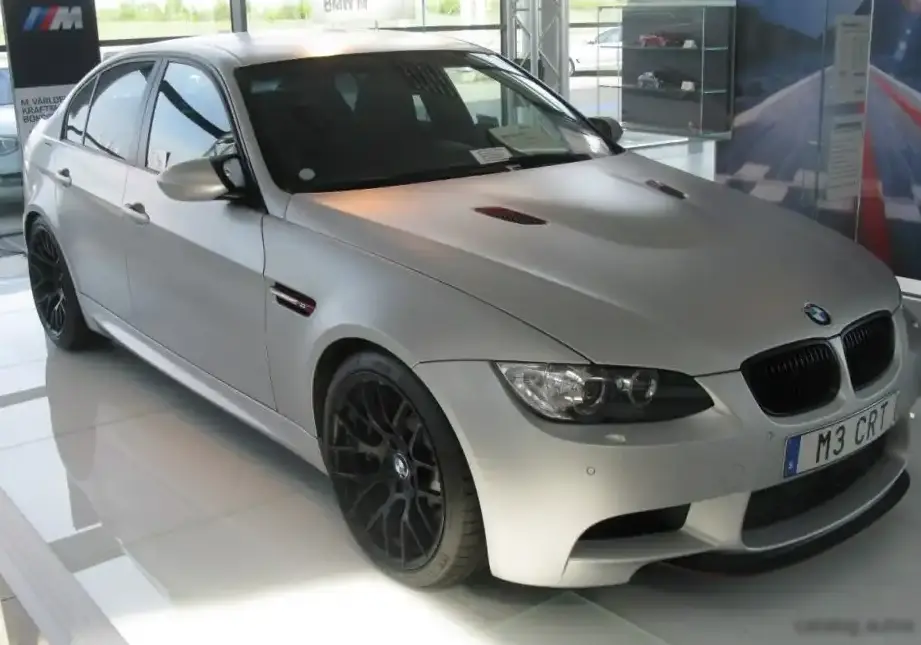
The BMW M3 CRT (Carbon Track Technology) was a limited-edition, high-performance variant of the E90 M3, produced for a very short period between June and November 2011. Built as a send-off to the E90 generation before the introduction of the F80 M3, the CRT aimed to deliver a more focused driving experience through significant weight reduction and enhanced track capability. Only 68 examples were ever produced, making it one of the rarest E90 M3 variants. It represents the pinnacle of development for the E90 platform, combining the naturally aspirated 4.4-liter V8 engine with BMW’s M DCT dual-clutch transmission.
Technical Specifications
| Brand | BMW |
| Model | M3 |
| Generation | M3 (E90 LCI, facelift 2008) |
| Type (Engine) | CRT 4.4 V8 (450 Hp) M DCT |
| Start of production | June, 2011 |
| End of production | November, 2011 |
| Powertrain Architecture | Internal Combustion engine |
| Body type | Sedan |
| Seats | 4 |
| Doors | 4 |
| Fuel consumption (economy) – urban (NEDC) | 18.4 l/100 km (12.8 US mpg, 15.4 UK mpg, 5.4 km/l) |
| Fuel consumption (economy) – extra urban (NEDC) | 9.3 l/100 km (25.3 US mpg, 30.4 UK mpg, 10.8 km/l) |
| Fuel consumption (economy) – combined (NEDC) | 12.7 l/100 km (18.5 US mpg, 22.2 UK mpg, 7.9 km/l) |
| CO2 emissions (NEDC) | 295 g/km |
| Fuel Type | Petrol (Gasoline) |
| Acceleration 0 – 100 km/h | 4.4 sec |
| Acceleration 0 – 62 mph | 4.4 sec |
| Acceleration 0 – 60 mph | 4.2 sec |
| Maximum speed | 290 km/h (180.2 mph) |
| Emission standard | Euro 5 |
| Weight-to-power ratio | 3.5 kg/Hp, 284.8 Hp/tonne |
| Weight-to-torque ratio | 3.6 kg/Nm, 278.5 Nm/tonne |
| Power | 450 Hp @ 8300 rpm |
| Power per litre | 103.2 Hp/l |
| Torque | 440 Nm @ 3750 rpm (324.53 lb.-ft. @ 3750 rpm) |
| Engine layout | Front, Longitudinal |
| Engine Model/Code | S65B44A |
| Engine displacement | 4361 cm3 (266.12 cu. in.) |
| Number of cylinders | 8 |
| Engine configuration | V-engine |
| Cylinder Bore | 92 mm (3.62 in.) |
| Piston Stroke | 82 mm (3.23 in.) |
| Compression ratio | 12:1 |
| Number of valves per cylinder | 4 |
| Fuel injection system | Multi-port manifold injection |
| Engine aspiration | Naturally aspirated engine |
| Valvetrain | Double-Vanos |
| Engine oil capacity | 8.8 l (9.3 US qt, 7.74 UK qt) |
| Coolant | 11.4 l (12.05 US qt, 10.03 UK qt) |
| Kerb Weight | 1580 kg (3483.3 lbs.) |
| Max. weight | 1970 kg (4343.11 lbs.) |
| Max load | 390 kg (859.8 lbs.) |
| Trunk (boot) space – minimum | 450 l (15.89 cu. ft.) |
| Fuel tank capacity | 63 l (16.64 US gal, 13.86 UK gal) |
| Length | 4614 mm (181.65 in.) |
| Width | 1817 mm (71.54 in.) |
| Height | 1416 mm (55.75 in.) |
| Wheelbase | 2761 mm (108.7 in.) |
| Front track | 1540 mm (60.63 in.) |
| Rear (Back) track | 1540 mm (60.63 in.) |
| Drag coefficient (Cd) | 0.31 |
| Minimum turning circle | 11.7 m (38.39 ft.) |
| Drivetrain Architecture | Rear wheel drive |
| Number of gears and type of gearbox | 7 gears, automatic transmission M DCT |
| Front suspension | Spring Strut, Transverse stabilizer |
| Rear suspension | Independent multi-link spring suspension with stabilizer |
| Front brakes | Ventilated discs, 378×32 mm |
| Rear brakes | Ventilated discs, 380×28 mm |
| Assisting systems | ABS (Anti-lock braking system) |
| Steering type | Steering rack and pinion |
| Power steering | Hydraulic Steering |
| Tires size | Front wheel tires: 245/35 R19 Rear wheel tires: 265/35 R19 |
| Wheel rims size | Front wheel rims: 9J x 19 Rear wheel rims: 10J x 19 |
INTRODUCTION
The BMW M3 CRT, produced for a fleeting six months in 2011, represents a unique chapter in the E90 M3’s history. Positioned as the ultimate expression of the E90 M3, it was designed to bridge the gap between the standard car and the upcoming F80 M3, which would feature a turbocharged engine. The CRT was exclusively available as a sedan and built on the E90 LCI (Life Cycle Impulse) platform, which included cosmetic and technological updates to the original E90. Its limited production run and focus on track performance have made it a highly sought-after collector’s item.
Powertrain & Engine Architecture
At the heart of the M3 CRT lies the S65B44A 4.4-liter naturally aspirated V8 engine, producing 450 horsepower at 8,300 rpm and 440 Nm (324.53 lb-ft) of torque at 3,750 rpm. This engine, already renowned for its high-revving character and linear power delivery, benefits from minor revisions to optimize performance. The engine utilizes individual throttle bodies, a high compression ratio of 12:1, and BMW’s Double-Vanos variable valve timing system for both intake and exhaust valves. Fuel is delivered via multi-port fuel injection. The CRT exclusively paired this engine with the 7-speed M DCT (Dual Clutch Transmission), a single-clutch automated manual transmission known for its rapid shifts and driver engagement. The M DCT features Drivelogic, allowing drivers to select from various shift programs to tailor the transmission’s behavior to their driving style.
Driving Characteristics
The M3 CRT’s driving experience is defined by its responsiveness and agility. The weight reduction, achieved through the extensive use of carbon fiber reinforced plastic (CFRP) in the roof, contributes significantly to its nimble handling. The M DCT transmission provides incredibly quick gear changes, enhancing acceleration and allowing for precise control during track driving. While the 450 hp output is similar to other high-performance E90 M3 variants, the CRT’s lighter weight results in a noticeable improvement in acceleration and braking performance. The gear ratios of the M DCT are optimized for both road and track use, providing strong acceleration in all gears. Compared to the standard E90 M3, the CRT feels more focused and direct, with a greater emphasis on driver involvement.
Equipment & Trim Levels
The M3 CRT came standard with a comprehensive list of features, reflecting its position as the top-of-the-line E90 M3. Interior appointments included unique carbon fiber trim, sport seats upholstered in black Merino leather with contrasting stitching, and an M steering wheel. Standard equipment also included navigation, premium sound system, and automatic climate control. Optional extras were limited, given the car’s already high level of specification. The most notable visual cue was the CFRP roof, which not only reduced weight but also gave the car a distinctive appearance. Exterior styling was otherwise similar to the E90 LCI M3, with the exception of unique badging.
Chassis & Braking
The M3 CRT’s chassis was optimized for track performance. The suspension features a spring-strut front axle and an independent multi-link rear axle, both with transverse stabilizers. The suspension settings were tuned to provide a balance between comfort and handling precision. Braking duties are handled by ventilated discs on all four wheels, measuring 378x32mm at the front and 380x28mm at the rear. The braking system is equipped with ABS (Anti-lock Braking System) for enhanced safety. The car’s weight distribution is nearly perfect, contributing to its balanced handling characteristics.
Market Reception & Comparison
The M3 CRT was met with widespread acclaim from automotive journalists and enthusiasts. Critics praised its exceptional handling, powerful engine, and exclusive nature. Compared to other E90 M3 variants, such as the Competition Package edition, the CRT offered a more focused and track-oriented driving experience. While the fuel economy figures (12.7 l/100 km combined) were not particularly impressive, they were typical for a high-performance V8 engine. Reliability was generally good, although the complexity of the S65 engine and M DCT transmission required regular maintenance. The CRT’s limited production run and desirability have resulted in significant appreciation in value on the used car market.
Legacy
The M3 CRT stands as a testament to BMW’s engineering prowess and its commitment to delivering exceptional driving experiences. Its innovative use of carbon fiber and its focus on track performance set it apart from other E90 M3 variants. Today, the M3 CRT is highly sought after by collectors and enthusiasts, and its value continues to rise. The car represents the last of the naturally aspirated V8-powered M3s, making it a particularly significant model in BMW’s history. The technologies and engineering principles employed in the CRT paved the way for future high-performance BMW models.