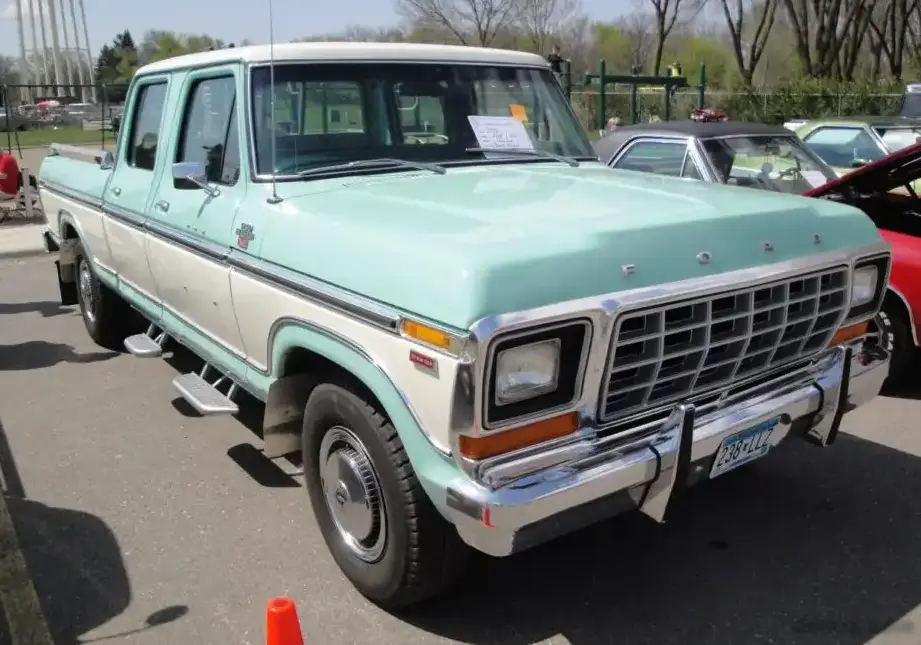
The Ford F-Series F-250 VI Crew Cab, equipped with the 5.9-liter (360 cubic inch) V8 engine producing 145 horsepower, represents a specific configuration within the sixth generation of Ford’s heavy-duty pickup truck line. Produced for a limited time between 1975 and 1976, this variant occupied a unique position in the F-250 range, offering a balance between capability and affordability. It was a transitional model, bridging the gap between the earlier, more utilitarian F-Series trucks and the later, more refined offerings. The Crew Cab body style, while not new to Ford, was still relatively uncommon, catering to buyers needing substantial passenger space alongside truck functionality.
Technical Specifications
| Brand | Ford |
| Model | F-Series F-250 |
| Generation | F-Series F-250 VI Crew Cab |
| Type (Engine) | 5.9 360 V8 (145 Hp) |
| Start of production | 1975 |
| End of production | 1976 |
| Powertrain Architecture | Internal Combustion engine |
| Body type | Pick-up |
| Seats | 6 |
| Doors | 4 |
| Fuel Type | Petrol (Gasoline) |
| Power | 145 Hp |
| Power per litre | 24.6 Hp/l |
| Engine displacement | 5899 cm3 |
| Engine displacement (cu. in.) | 359.98 cu. in. |
| Number of cylinders | 8 |
| Engine configuration | V-engine |
| Cylinder Bore | 102.87 mm |
| Cylinder Bore (in.) | 4.05 in. |
| Piston Stroke | 88.9 mm |
| Piston Stroke (in.) | 3.5 in. |
| Number of valves per cylinder | 2 |
| Fuel injection system | Carburettor |
| Engine aspiration | Naturally aspirated engine |
| Max. weight | 3402 kg |
| Max. weight (lbs.) | 7500.13 lbs. |
| Trunk (boot) space – minimum | 1727 l |
| Trunk (boot) space – minimum (cu. ft.) | 60.99 cu. ft. |
| Length | 5652 mm |
| Length (in.) | 222.52 in. |
| Wheelbase | 3810 mm |
| Wheelbase (in.) | 150 in. |
| Wading depth | 673 mm |
| Wading depth (in.) | 26.5 in. |
| Drivetrain Architecture | The Internal combustion engine (ICE) drives the rear wheels of the vehicle. |
| Drive wheel | Rear wheel drive |
| Number of gears and type of gearbox | 3 gears, manual transmission |
| Front suspension | Independent coil spring |
| Rear suspension | Leaf spring |
| Front brakes | Disc |
| Rear brakes | Drum |
| Power steering | Electric Steering |
| Tires size | 215/85 R16.5 |
| Wheel rims size | 6J x 16.5 |
Powertrain & Engine Architecture
The heart of this F-250 variant is the 5.9-liter (360 cubic inch) Ford Windsor V8 engine. This engine, designated within Ford’s engine family as the 351W, is a robust and relatively simple design. It features a cast iron block and cylinder heads, with a two-barrel carburetor handling fuel delivery. The engine utilizes a traditional pushrod valvetrain with two valves per cylinder. While 145 horsepower might seem modest by modern standards, it was considered adequate for the intended purpose of hauling and towing in the mid-1970s. The 351W was known for its durability and relatively easy maintenance. The three-speed manual transmission was the standard offering for this configuration, providing a direct mechanical linkage to the rear wheels. The transmission’s gear ratios were optimized for torque multiplication, prioritizing hauling capacity over outright acceleration.
Driving Characteristics
The 145 hp F-250 Crew Cab with a manual transmission delivered a driving experience focused on utility rather than performance. Acceleration was leisurely, and the truck felt most comfortable when operating within a narrow RPM range. The manual transmission required deliberate shifting, and the lack of overdrive meant higher engine speeds at highway cruising. Compared to the available larger engines (like the 390 cubic inch V8), this variant offered significantly less power, making it less suitable for heavy-duty towing or navigating steep terrain. However, it did offer a more economical option for those who didn’t require the full capabilities of the larger engines. The leaf spring rear suspension provided a firm ride, especially when unladen, but it was well-suited to carrying heavy loads.
Equipment & Trim Levels
The F-250 Crew Cab, even in this base configuration, offered a relatively comfortable interior for the time. Standard features included a vinyl bench seat (capable of seating six passengers), a basic instrument cluster, and a heater. Air conditioning, power steering, and upgraded interior trim were available as optional extras. The trim level was fairly basic, reflecting the truck’s positioning as a work-oriented vehicle. The dashboard was typically constructed of durable plastic, and the interior door panels were similarly functional. The Crew Cab body style itself was the primary luxury, providing significantly more passenger space than the standard cab models.
Chassis & Braking
The F-250 chassis was a traditional body-on-frame construction, providing a robust and durable platform. The front suspension utilized independent coil springs, offering a degree of ride comfort, while the rear suspension employed leaf springs, designed to handle heavy loads. Braking duties were handled by disc brakes at the front and drum brakes at the rear. Power steering was often an optional extra, making maneuvering the large truck easier, particularly in tight spaces. The 16.5-inch wheels were fitted with 215/85 R16.5 tires, providing a balance between load-carrying capacity and ride quality.
Market Reception & Comparison
The 1975-1976 F-250 Crew Cab with the 360 V8 and manual transmission was a niche offering. Critics generally acknowledged its practicality and spaciousness, but noted its lack of power compared to other F-250 configurations. It was often seen as a compromise – offering the passenger capacity of the Crew Cab with a more affordable engine option. Fuel economy, even for the 1970s, was relatively poor. Compared to the larger engine options, this variant was favored by those who prioritized cost savings and didn’t require maximum towing or hauling capacity. The 300 cubic inch inline-six was another popular choice for those seeking fuel efficiency, but it lacked the V8’s torque.
Legacy
The 360 Windsor V8, while not the most powerful engine offered in the F-Series, proved to be remarkably durable. Many examples are still running today, a testament to its robust design. The F-250 Crew Cab from this era has gained a following among collectors and enthusiasts, particularly those seeking a classic American pickup truck with a unique configuration. Parts availability remains relatively good, making maintenance and restoration feasible. In the used car market, these trucks command a moderate price, depending on condition and originality. The combination of the 360 V8 and manual transmission is considered a desirable configuration by some, offering a more engaging driving experience than the automatic transmission options.