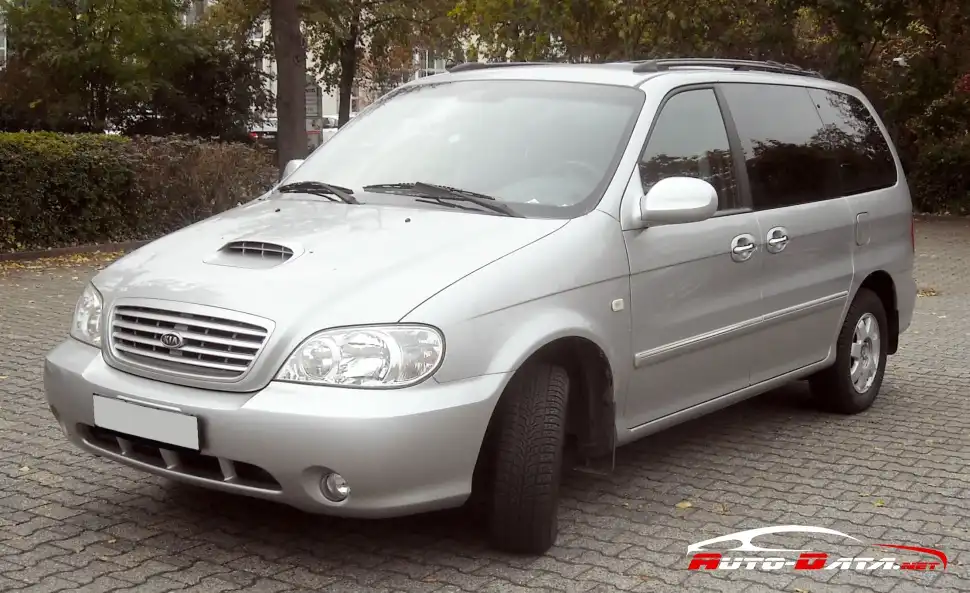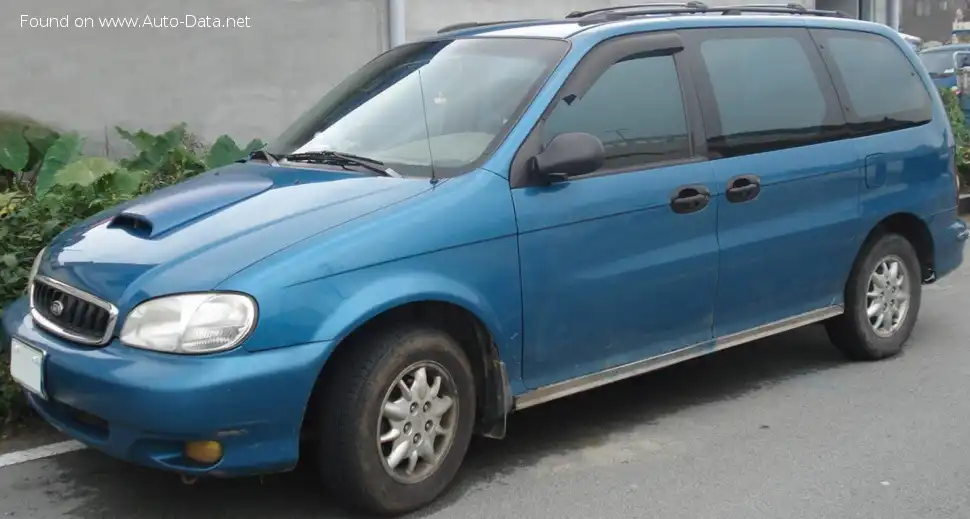
The Kia Carnival, known as the Kia Joice in some markets, represented Kia’s entry into the increasingly popular minivan segment. Introduced in 1998 and continuing through 2001 for the first generation (UP/GQ chassis code), the Carnival aimed to provide a practical and affordable family vehicle. The 2.9 TD Automatic variant, powered by Kia’s J3 diesel engine, was positioned as a mid-range offering, balancing fuel efficiency with the convenience of an automatic transmission. This model was primarily sold in Asia and Europe, where diesel engines were favored for their economy, and represented a significant step for Kia in offering a more refined and feature-rich vehicle compared to its earlier offerings.
Technical Specifications
| Brand | Kia |
| Model | Carnival |
| Generation | Carnival I (UP/GQ) |
| Type (Engine) | 2.9 TD (135 Hp) Automatic |
| Start of production | 1998 |
| End of production | 2001 |
| Powertrain Architecture | Internal Combustion engine |
| Body type | Minivan |
| Seats | 7 |
| Doors | 5 |
| Fuel consumption (urban) | 12 l/100 km (19.6 US mpg) |
| Fuel consumption (extra urban) | 7 l/100 km (33.6 US mpg) |
| Fuel Type | Diesel |
| Weight-to-power ratio | 13.8 kg/Hp |
| Weight-to-torque ratio | 6 kg/Nm |
| Power | 135 Hp @ 3800 rpm |
| Power per litre | 46.5 Hp/l |
| Torque | 309 Nm @ 2000 rpm (227.91 lb.-ft. @ 2000 rpm) |
| Engine layout | Front, Transverse |
| Engine Model/Code | J3 |
| Engine displacement | 2903 cm3 (177.15 cu. in.) |
| Number of cylinders | 4 |
| Engine configuration | Inline |
| Cylinder Bore | 97.1 mm (3.82 in.) |
| Piston Stroke | 98 mm (3.86 in.) |
| Compression ratio | 19:1 |
| Number of valves per cylinder | 4 |
| Fuel injection system | Diesel Commonrail |
| Engine aspiration | Turbocharger |
| Valvetrain | DOHC |
| Engine oil capacity | 6.6 l (6.97 US qt | 5.81 UK qt) |
| Coolant capacity | 9.4 l (9.93 US qt | 8.27 UK qt) |
| Kerb Weight | 1865 kg (4111.62 lbs.) |
| Trunk (boot) space – minimum | 344 l (12.15 cu. ft.) |
| Trunk (boot) space – maximum | 1159 l (40.93 cu. ft.) |
| Fuel tank capacity | 75 l (19.81 US gal | 16.5 UK gal) |
| Length | 4890 mm (192.52 in.) |
| Width | 1900 mm (74.8 in.) |
| Height | 1730 mm (68.11 in.) |
| Wheelbase | 2910 mm (114.57 in.) |
| Front track | 1635 mm (64.37 in.) |
| Rear track | 1600 mm (62.99 in.) |
| Minimum turning circle | 13 m (42.65 ft.) |
| Drivetrain Architecture | Front wheel drive |
| Number of gears | 4 |
| Gearbox type | Automatic transmission |
| Front suspension | Wishbone |
| Rear suspension | Coil spring |
| Front brakes | Ventilated discs |
| Rear brakes | Drum |
| Assisting systems | ABS (Anti-lock braking system) |
| Steering type | Steering rack and pinion |
| Power steering | Hydraulic |
| Tires size | 205/70 R15 |
| Wheel rims size | 15 |
Powertrain & Engine Architecture
The heart of the 2.9 TD Carnival was Kia’s J3 engine, a 2.9-liter inline-four cylinder diesel. This engine utilized a turbocharger and a diesel common rail fuel injection system to produce 135 horsepower at 3800 rpm and 309 Nm (227.91 lb-ft) of torque at 2000 rpm. The common rail system, a relatively new technology at the time, allowed for more precise fuel delivery, resulting in improved fuel efficiency and reduced emissions compared to older diesel injection systems. The engine featured a double overhead camshaft (DOHC) valvetrain with four valves per cylinder, contributing to its relatively high power output for a naturally aspirated diesel of its size. The automatic transmission was a conventional four-speed unit, chosen for its ease of use and suitability for family transport. While not known for its sporty performance, the transmission was generally reliable.
Driving Characteristics
The 2.9 TD Automatic Carnival offered a comfortable, if not particularly exciting, driving experience. The automatic transmission, while convenient, did detract from the engine’s available torque. Acceleration was adequate for everyday driving and highway merging, but the vehicle felt somewhat sluggish when fully loaded. The four-speed automatic’s gear ratios were spaced to prioritize fuel economy over performance. Compared to the manual transmission versions of the Carnival, the automatic suffered a noticeable performance penalty. The higher-output gasoline engines, while less fuel-efficient, offered significantly more responsive acceleration. The suspension was tuned for comfort, providing a reasonably smooth ride even on uneven surfaces.
Equipment & Trim Levels
The 2.9 TD Automatic trim typically included features such as air conditioning, power windows, power door locks, and a basic audio system. Interior upholstery was usually cloth, with options for upgraded materials available. Depending on the market, features like alloy wheels, a sunroof, and upgraded audio systems could be added as optional extras. The Carnival aimed to provide a good level of standard equipment for its price point, making it an attractive option for families seeking a practical and well-equipped minivan. Safety features were relatively basic for the time, typically including ABS brakes and driver and passenger airbags.
Chassis & Braking
The Carnival utilized a front-wheel-drive layout with an independent wishbone suspension at the front and a coil spring suspension at the rear. The front brakes were ventilated discs, providing adequate stopping power, while the rear brakes were drums. This configuration was typical for minivans of this era, balancing cost and performance. The steering was rack and pinion with hydraulic power assistance, offering reasonably precise steering feel. The vehicle’s relatively high weight (1865 kg / 4111.62 lbs) contributed to its stable handling characteristics, but also limited its agility.
Market Reception & Comparison
The Kia Carnival 2.9 TD Automatic received mixed reviews. Critics praised its spacious interior, comfortable ride, and relatively affordable price. However, the engine’s performance with the automatic transmission was often criticized as being underwhelming. Fuel economy was generally considered good for a vehicle of its size, particularly compared to gasoline-powered alternatives. Compared to other minivans available at the time, such as the Honda Odyssey or Toyota Sienna, the Carnival offered a more budget-friendly option, but lacked the refinement and performance of its Japanese competitors. The diesel engine, while economical, was also perceived as being noisier and less refined than gasoline engines.
Legacy
The Kia Carnival I (UP/GQ) 2.9 TD Automatic, while not a groundbreaking vehicle, played an important role in establishing Kia as a viable competitor in the global automotive market. The J3 diesel engine proved to be reasonably reliable, and many examples are still on the road today. However, finding parts can be increasingly challenging as the vehicle ages. The automatic transmission, while generally durable, is susceptible to wear and tear with high mileage. In the used car market, these Carnivals are typically valued for their affordability and practicality, making them a popular choice for budget-conscious buyers seeking a spacious family vehicle. The model paved the way for subsequent generations of the Carnival, which have continued to improve in terms of refinement, performance, and features.