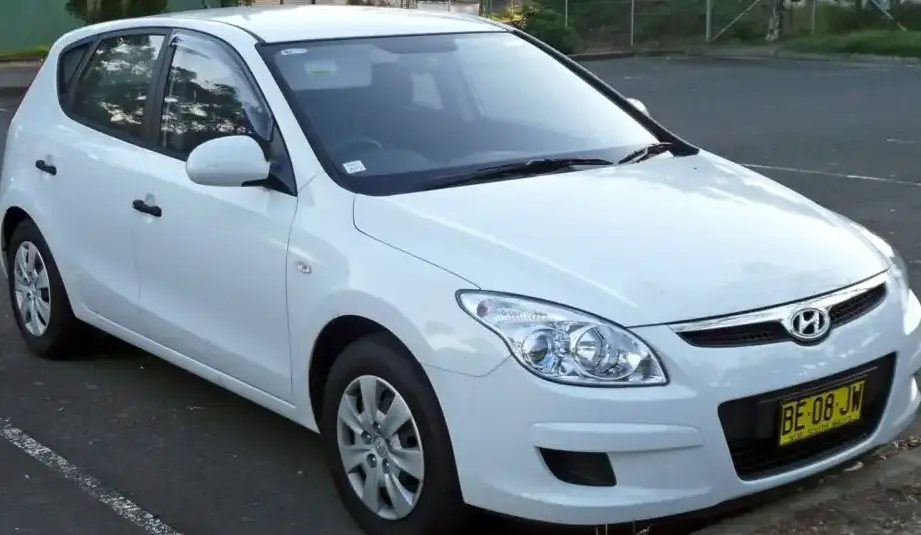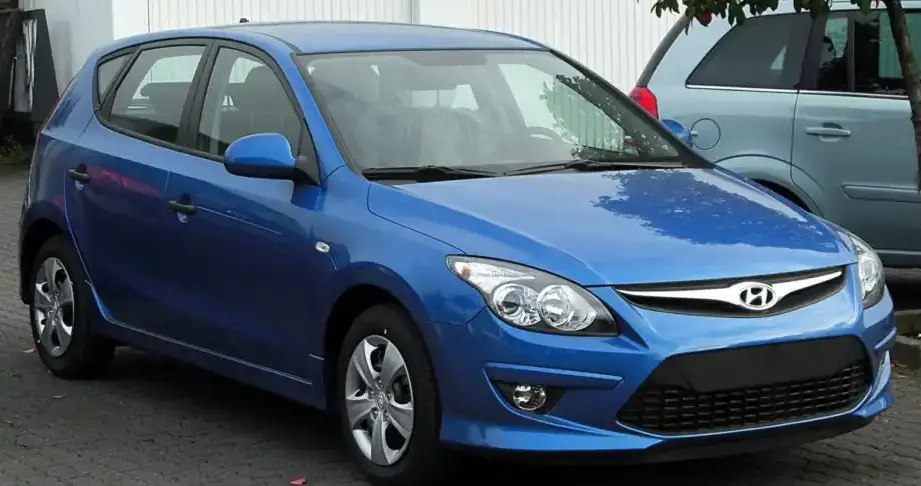
The Hyundai i30 (first generation, facelifted in 2010) 1.6-liter (126 horsepower) automatic variant was a key offering in Hyundai’s expanding European lineup. Introduced as part of the i30’s mid-cycle refresh, this model aimed to provide a comfortable and economical entry point into the compact hatchback segment. Production for this specific configuration ran from 2010 to 2012, positioned as a mainstream option within the broader i30 range, which also included lower-powered base models and higher-performance variants. The i30, in general, represented Hyundai’s ambition to challenge established European manufacturers with a vehicle offering a compelling blend of value, features, and a five-year warranty – a significant differentiator at the time.
Technical Specifications
| Brand | Hyundai |
| Model | i30 |
| Generation | i30 I (facelift 2010) |
| Type (Engine) | 1.6 (126 Hp) Automatic |
| Start of production | 2010 |
| End of production | 2012 |
| Powertrain Architecture | Internal Combustion engine |
| Body type | Hatchback |
| Seats | 5 |
| Doors | 5 |
| Fuel consumption (urban) | 8.8 l/100 km (26.7 US mpg) |
| Fuel consumption (extra urban) | 5.9 l/100 km (39.9 US mpg) |
| Fuel consumption (combined) | 6.9 l/100 km (34.1 US mpg) |
| CO2 emissions | 162 g/km |
| Fuel Type | Petrol (Gasoline) |
| Acceleration 0 – 100 km/h | 12.1 sec |
| Acceleration 0 – 62 mph | 12.1 sec |
| Acceleration 0 – 60 mph | 11.5 sec |
| Maximum speed | 183 km/h (113.71 mph) |
| Emission standard | Euro 5 |
| Weight-to-power ratio | 9.6 kg/Hp |
| Weight-to-torque ratio | 7.9 kg/Nm |
| Power | 126 Hp @ 6200 rpm |
| Torque | 154 Nm @ 4200 rpm (113.58 lb.-ft. @ 4200 rpm) |
| Engine layout | Front, Transverse |
| Engine Model/Code | G4FC |
| Engine displacement | 1591 cm3 (97.09 cu. in.) |
| Number of cylinders | 4 |
| Engine configuration | Inline |
| Cylinder Bore | 77 mm (3.03 in.) |
| Piston Stroke | 85.4 mm (3.36 in.) |
| Compression ratio | 10.5:1 |
| Number of valves per cylinder | 4 |
| Fuel injection system | Multi-port manifold injection |
| Engine aspiration | Naturally aspirated engine |
| Valvetrain | DOHC |
| Engine oil capacity | 3.3 l (3.49 US qt | 2.9 UK qt) |
| Coolant capacity | 6 l (6.34 US qt | 5.28 UK qt) |
| Kerb Weight | 1214 kg (2676.41 lbs.) |
| Max. weight | 1740 kg (3836.04 lbs.) |
| Max load | 526 kg (1159.63 lbs.) |
| Trunk (boot) space – minimum | 340 l (12.01 cu. ft.) |
| Trunk (boot) space – maximum | 1250 l (44.14 cu. ft.) |
| Fuel tank capacity | 53 l (14 US gal | 11.66 UK gal) |
| Permitted trailer load with brakes (12%) | 1200 kg (2645.55 lbs.) |
| Permitted trailer load without brakes | 550 kg (1212.54 lbs.) |
| Length | 4280 mm (168.5 in.) |
| Width | 1775 mm (69.88 in.) |
| Height | 1480 mm (58.27 in.) |
| Wheelbase | 2650 mm (104.33 in.) |
| Front track | 1546 mm (60.87 in.) |
| Rear track | 1544 mm (60.79 in.) |
| Drag coefficient (Cd) | 0.33 |
| Minimum turning circle | 10.2 m (33.46 ft.) |
| Drivetrain | Front wheel drive |
| Number of gears | 4 |
| Gearbox type | Automatic transmission |
| Front brakes | Ventilated discs |
| Rear brakes | Disc |
| Assisting systems | ABS (Anti-lock braking system) |
| Steering type | Steering rack and pinion |
| Tires size | 185/65 R15 H |
| Wheel rims size | 15 |
Powertrain & Engine Architecture
The heart of this i30 variant was the Hyundai G4FC 1.6-liter inline-four cylinder engine. This engine, a mainstay in several Hyundai and Kia models of the period, featured a dual overhead camshaft (DOHC) valvetrain with four valves per cylinder. Fuel delivery was handled by a multi-point fuel injection system. The G4FC was known for its relatively simple design and focus on fuel efficiency rather than outright performance. Paired with this engine was a four-speed automatic transmission. While not the most modern transmission available at the time (many competitors were moving to five or six-speed automatics), it was chosen for its cost-effectiveness and smooth operation. The transmission’s gear ratios were tuned for comfortable cruising and acceptable acceleration, prioritizing fuel economy over sporty driving dynamics.
Driving Characteristics
The 1.6-liter automatic i30 offered a comfortable, if not particularly exciting, driving experience. Acceleration from 0-60 mph took around 11.5 to 12.1 seconds, making it adequate for everyday driving but not ideal for quick overtaking maneuvers. The automatic transmission, while smooth, could feel somewhat sluggish, especially when downshifting. The gear ratios were spaced to maximize fuel efficiency, resulting in a noticeable lack of urgency when requesting more power. Compared to the manual transmission version of the same engine, the automatic suffered a slight performance penalty. Higher-trim i30s equipped with larger engines, such as the 1.8L or diesel variants, offered significantly more power and a more engaging driving experience. However, the 1.6 automatic prioritized ease of use and fuel economy, making it a popular choice for urban commuters.
Equipment & Trim Levels
The 1.6-liter automatic i30 typically came equipped with a reasonable level of standard features. These generally included air conditioning, power windows, central locking, a basic audio system with CD player, and ABS brakes. Interior upholstery was typically cloth, and the dashboard featured a functional, if somewhat plain, design. Optional extras included alloy wheels, a sunroof, upgraded audio systems, and parking sensors. Trim levels varied slightly depending on the market, but the 1.6 automatic generally occupied a mid-range position in the i30 lineup, offering a good balance of features and affordability.
Chassis & Braking
The i30’s chassis featured a MacPherson strut front suspension and a coupled torsion beam rear suspension. This setup provided a comfortable ride quality, although it wasn’t particularly sporty. The front brakes were ventilated discs, while the rear brakes were solid discs. ABS (Anti-lock Braking System) was standard, providing enhanced safety during emergency braking. The suspension tuning was geared towards comfort and stability, prioritizing ride quality over sharp handling. The 1.6-liter models typically featured smaller wheels and tires compared to the higher-performance variants, further contributing to the comfortable ride.
Market Reception & Comparison
The Hyundai i30 1.6 automatic was generally well-received by critics as a practical and affordable hatchback. It was praised for its comfortable ride, spacious interior, and generous warranty. However, it was also criticized for its relatively uninspiring performance and somewhat dated automatic transmission. Compared to rivals like the Volkswagen Golf, Ford Focus, and Opel Astra, the i30 offered a more competitive price point and a longer warranty, but lacked the same level of refinement and driving dynamics. Fuel economy was competitive for its class, and reliability proved to be generally good.
Legacy
The Hyundai i30 1.6 automatic has proven to be a relatively reliable vehicle in the used car market. The G4FC engine is known for its durability, and the four-speed automatic transmission, while not cutting-edge, is generally robust. Common issues are typically limited to routine maintenance items such as timing belt replacement and sensor failures. Today, these i30s represent an affordable and practical option for budget-conscious buyers seeking a dependable compact hatchback. While not a performance icon, the 1.6 automatic i30 played a significant role in establishing Hyundai as a credible competitor in the European automotive market.