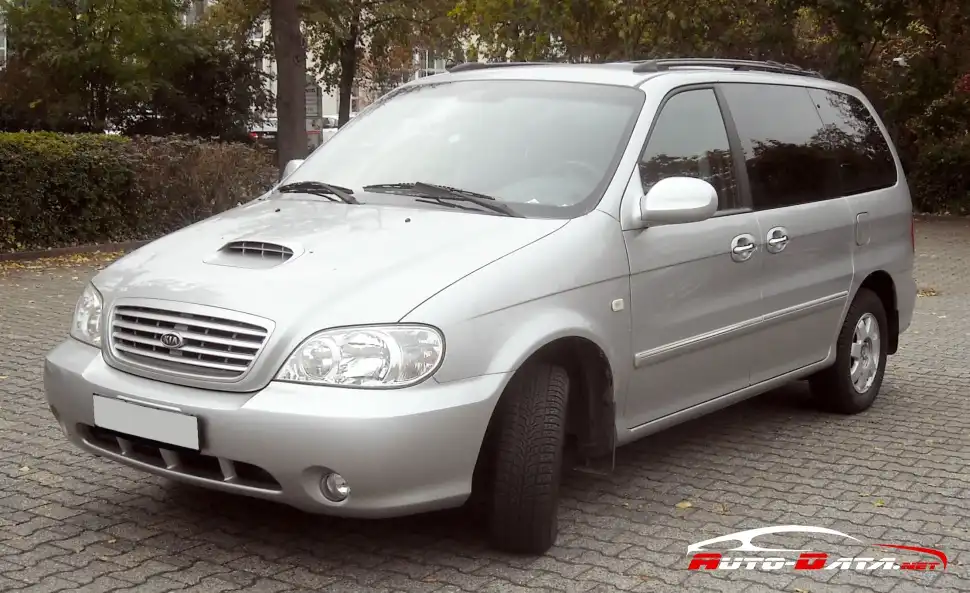
The Kia Carnival, known as the Sedona in North American markets, represented Kia’s initial foray into the competitive minivan segment. Introduced in 1998, the first generation (UP/GQ) aimed to provide a more affordable and feature-rich alternative to established players like the Dodge Caravan and Toyota Sienna. The facelifted version, launched in 2001 and produced through 2006, brought revised styling and mechanical refinements. This article focuses on the 2.5i V6 variant with the automatic transmission, a configuration primarily sold in select international markets, and its position within the Carnival lineup.
Technical Specifications
| Brand | Kia |
| Model | Carnival |
| Generation | Carnival I (UP/GQ, facelift 2001) |
| Type (Engine) | 2.5i V6 (150 Hp) Automatic |
| Start of production | 2001 |
| End of production | 2006 |
| Powertrain Architecture | Internal Combustion engine |
| Body type | Minivan |
| Seats | 7 |
| Doors | 5 |
| Fuel consumption (urban) | 16.4 l/100 km (14.3 US mpg, 17.2 UK mpg, 6.1 km/l) |
| Fuel consumption (extra urban) | 10 l/100 km (23.5 US mpg, 28.2 UK mpg, 10 km/l) |
| Fuel consumption (combined) | 12.4 l/100 km (19 US mpg, 22.8 UK mpg, 8.1 km/l) |
| Fuel Type | Petrol (Gasoline) |
| Weight-to-power ratio | 13.4 kg/Hp (74.5 Hp/tonne) |
| Weight-to-torque ratio | 9 kg/Nm (111.3 Nm/tonne) |
| Power | 150 Hp @ 5600 rpm |
| Power per litre | 60.1 Hp/l |
| Torque | 224 Nm @ 4000 rpm (165.21 lb.-ft. @ 4000 rpm) |
| Engine layout | Front, Transverse |
| Engine Model/Code | KV6 |
| Engine displacement | 2497 cm3 (152.38 cu. in.) |
| Number of cylinders | 6 |
| Engine configuration | V-engine |
| Cylinder Bore | 80 mm (3.15 in.) |
| Piston Stroke | 82.8 mm (3.26 in.) |
| Compression ratio | 10.4:1 |
| Number of valves per cylinder | 4 |
| Fuel injection system | Multi-port manifold injection |
| Engine aspiration | Naturally aspirated engine |
| Valvetrain | DOHC |
| Engine oil capacity | 5.8 l (6.13 US qt, 5.1 UK qt) |
| Coolant capacity | 9.4 l (9.93 US qt, 8.27 UK qt) |
| Kerb Weight | 2013 kg (4437.91 lbs.) |
| Max. weight | 2580 kg (5687.93 lbs.) |
| Max load | 567 kg (1250.02 lbs.) |
| Fuel tank capacity | 75 l (19.81 US gal, 16.5 UK gal) |
| Length | 4925 mm (193.9 in.) |
| Width | 1900 mm (74.8 in.) |
| Height | 1730 mm (68.11 in.) |
| Wheelbase | 2905 mm (114.37 in.) |
| Front track | 1625 mm (63.98 in.) |
| Rear track | 1600 mm (62.99 in.) |
| Ride height (ground clearance) | 170 mm (6.69 in.) |
| Minimum turning circle | 13 m (42.65 ft.) |
| Drivetrain Architecture | Front wheel drive |
| Number of gears | 4 |
| Gearbox type | Automatic transmission |
| Front suspension | Wishbone |
| Rear suspension | Coil spring |
| Front brakes | Ventilated discs |
| Rear brakes | Drum |
| Assisting systems | ABS (Anti-lock braking system) |
| Steering type | Steering rack and pinion |
| Power steering | Hydraulic |
| Tires size | 215/65 R15 |
| Wheel rims size | 15 |
INTRODUCTION
The 2001-2006 Kia Carnival, following the facelift, offered a compelling package for families seeking a spacious and relatively affordable minivan. The 2.5i V6 Automatic variant was positioned as a mid-range option in many markets, offering a balance between performance and fuel economy. It sat below the more powerful 2.7L V6 models and above the diesel options (where available). Built on the UP/GQ platform, the Carnival aimed to challenge established competitors with its generous standard features and competitive pricing. This version was particularly popular in regions where larger displacement engines faced higher taxation or where fuel efficiency was a primary concern.
Powertrain & Engine Architecture
The heart of this Carnival variant is the KV6 engine, a 2.5-liter, 60-degree V6. This engine utilizes a naturally aspirated configuration with multi-port fuel injection, delivering 150 horsepower at 5600 rpm and 224 Nm (165.21 lb-ft) of torque at 4000 rpm. The engine features a double overhead camshaft (DOHC) valvetrain with four valves per cylinder, contributing to its relatively smooth operation. The KV6 engine, while not known for groundbreaking performance, was considered reasonably durable and reliable. The automatic transmission is a conventional four-speed unit, designed to provide comfortable and effortless cruising. While not offering the responsiveness of a manual transmission, it suited the minivan’s intended purpose of family transportation. The transmission’s gear ratios were optimized for fuel efficiency and smooth acceleration, prioritizing usability over outright speed.
Driving Characteristics
The 2.5i V6 Automatic Carnival delivers adequate, but not exhilarating, performance. Acceleration is sufficient for everyday driving and highway merging, but the minivan’s weight (2013 kg / 4437.91 lbs) is noticeable. Compared to the more powerful 2.7L V6 models, the 2.5L feels less responsive, particularly when fully loaded with passengers and cargo. The four-speed automatic transmission, while smooth, lacks the gear ratios found in more modern transmissions, resulting in slightly higher engine speeds at highway cruising speeds. The focus is on providing a comfortable and relaxed driving experience, rather than sporty handling. Steering is light and easy, making maneuvering in tight spaces straightforward. The suspension is tuned for comfort, absorbing bumps and imperfections in the road reasonably well.
Equipment & Trim Levels
The 2.5i V6 Automatic Carnival typically came equipped with a respectable array of standard features. These generally included air conditioning, power windows and locks, a basic audio system, and cloth upholstery. Higher trim levels, often denoted by specific package names depending on the market, added features such as alloy wheels, upgraded audio systems, a sunroof, and woodgrain interior trim. Safety features typically included ABS (Anti-lock Braking System) and airbags for the driver and front passenger. Optional extras often included rear air conditioning, a CD changer, and power-adjustable front seats.
Chassis & Braking
The Carnival’s chassis utilizes a front-engine, front-wheel-drive layout. The front suspension employs a wishbone configuration, while the rear suspension utilizes a coil spring setup. This combination provides a comfortable ride, although it doesn’t offer the handling precision of more sophisticated suspension systems. The braking system features ventilated discs on the front wheels and drum brakes on the rear. While adequate for normal driving conditions, the rear drum brakes can feel less effective under heavy braking. The steering system is a rack and pinion setup with hydraulic power assistance, providing light and easy steering feel.
Market Reception & Comparison
The 2.5i V6 Automatic Carnival received mixed reviews. Critics generally praised its spacious interior, comfortable ride, and competitive pricing. However, the engine’s performance was often criticized as being underwhelming, particularly when compared to rivals with larger displacement engines. Fuel economy was considered average for its class. Compared to the 2.7L V6 models, the 2.5L offered better fuel efficiency but sacrificed performance. The diesel variants, where available, provided superior fuel economy and torque but often came with a higher price tag. The Carnival’s value proposition was strong, offering a lot of space and features for the money.
Legacy
The 2.5i V6 Automatic Kia Carnival has proven to be a relatively reliable powertrain combination. While not without its quirks, the KV6 engine is generally considered durable, and the four-speed automatic transmission is known for its robustness. In the used car market, these Carnivals are often sought after by budget-conscious buyers looking for a spacious and practical family vehicle. Maintenance costs are generally reasonable, although sourcing parts for older models can sometimes be challenging. The Carnival helped establish Kia as a viable competitor in the minivan segment and paved the way for future generations of the vehicle.