
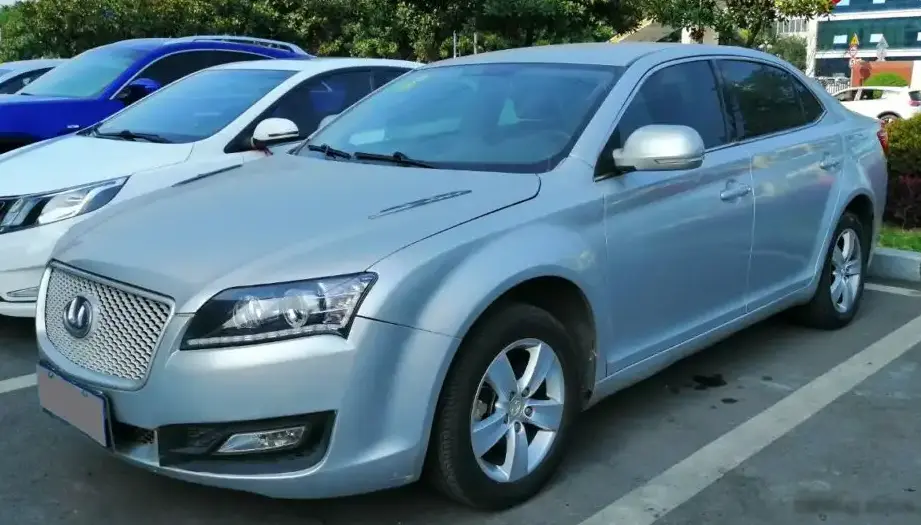
The Hawtai E70 2.0 (136 Hp) was a mid-size sedan produced by the Chinese manufacturer Hawtai Motor Group between 2013 and 2016. Positioned as a relatively affordable and spacious option within the burgeoning Chinese automotive market, the E70 aimed to provide a comfortable and practical vehicle for families and commuters. It represented Hawtai’s attempt to establish itself as a credible player in the sedan segment, leveraging a design that borrowed heavily from established Japanese and European models. The 2.0-liter variant, producing 136 horsepower, occupied a middle ground in the E70 lineup, offering a balance between performance and fuel economy.
Technical Specifications
| Brand | Hawtai |
| Model | E70 |
| Generation | E70 |
| Type (Engine) | 2.0 (136 Hp) |
| Start of production | 2013 |
| End of production | 2016 |
| Powertrain Architecture | Internal Combustion engine |
| Body type | Sedan |
| Seats | 5 |
| Doors | 4 |
| Fuel Type | Petrol (Gasoline) |
| Emission standard | Euro 4 |
| Power | 136 Hp @ 6000 rpm |
| Power per litre | 68.1 Hp/l |
| Torque | 180 Nm @ 4000 rpm / 132.76 lb.-ft. @ 4000 rpm |
| Engine layout | Rear, Transverse |
| Engine Model/Code | 4G63 |
| Engine displacement | 1997 cm3 / 121.86 cu. in. |
| Number of cylinders | 4 |
| Engine configuration | Inline |
| Compression ratio | 9.5:1 |
| Number of valves per cylinder | 4 |
| Fuel injection system | Multi-port manifold injection |
| Engine aspiration | Naturally aspirated engine |
| Trunk (boot) space – minimum | 527 l / 18.61 cu. ft. |
| Fuel tank capacity | 55 l / 14.53 US gal | 12.1 UK gal |
| Length | 4777 mm / 188.07 in. |
| Width | 1794 mm / 70.63 in. |
| Height | 1481 mm / 58.31 in. |
| Wheelbase | 2678 mm / 105.43 in. |
| Ride height (ground clearance) | 126 mm / 4.96 in. |
| Drivetrain Architecture | The Internal combustion engine (ICE) drives the front wheels of the vehicle. |
| Drive wheel | Front wheel drive |
| Number of gears and type of gearbox | 5 gears, manual transmission |
| Front suspension | Independent type McPherson |
| Rear suspension | Independent multi-link suspension |
| Front brakes | Disc |
| Rear brakes | Disc |
| Assisting systems | ABS (Anti-lock braking system) |
| Steering type | Steering rack and pinion |
| Tires size | 205/55 R16 |
Powertrain & Engine Architecture
The Hawtai E70 2.0 was powered by a 1.997-liter inline-four cylinder engine, designated the 4G63. This engine, while sharing a designation with the Mitsubishi 4G63 known for its performance applications, was a significantly detuned version. It utilized a multi-port fuel injection system and a naturally aspirated configuration, producing 136 horsepower at 6000 rpm and 180 Nm (132.76 lb-ft) of torque at 4000 rpm. The engine featured a compression ratio of 9.5:1 and four valves per cylinder. The engine was transversely mounted in the front of the vehicle, driving the front wheels. The E70 2.0 was exclusively offered with a 5-speed manual transmission. While an automatic transmission was available on other E70 variants, it was not paired with the 2.0-liter engine. This decision likely aimed to keep the cost of the 2.0L model down, positioning it as the more economical option.
Driving Characteristics
The driving experience of the Hawtai E70 2.0 was characterized by adequate, but not particularly exciting, performance. The 136 horsepower engine provided sufficient power for everyday driving and highway cruising, but acceleration was modest. The 5-speed manual transmission offered a reasonable level of control, although the shift quality was often criticized as being somewhat vague. The gear ratios were tuned for fuel efficiency rather than outright performance. Compared to the higher-output engine options available in the E70 range, the 2.0-liter variant felt noticeably less responsive. However, it offered a more economical driving experience, making it a popular choice for drivers prioritizing fuel costs. The engine’s torque curve was relatively flat, providing usable power across a reasonable rev range, but lacking the punch of more powerful alternatives. The steering was light, making it easy to maneuver in urban environments, but lacked significant feedback.
Equipment & Trim Levels
The Hawtai E70 2.0 typically came equipped with a standard set of features aimed at providing comfort and convenience. These included air conditioning, power windows, power door locks, and a basic audio system. Interior upholstery was generally cloth, with plastic trim accents. Higher trim levels offered optional extras such as alloy wheels, a sunroof, and a more advanced audio system with Bluetooth connectivity. Safety features were relatively basic, with ABS being the primary safety system offered as standard. The overall interior design was functional but lacked the refinement of more established brands. The focus was on providing a practical and affordable vehicle rather than a luxurious experience. The dashboard layout was straightforward, with easily accessible controls.
Chassis & Braking
The Hawtai E70 2.0 featured an independent McPherson strut suspension system at the front and an independent multi-link suspension system at the rear. This suspension setup aimed to provide a comfortable ride quality and reasonable handling characteristics. The vehicle was equipped with disc brakes on all four wheels, providing adequate stopping power. The steering system utilized a rack and pinion setup, offering a decent level of steering feel. The E70 2.0 rode on 205/55 R16 tires, which contributed to a balanced ride and handling compromise. The suspension was tuned for comfort, absorbing bumps and imperfections in the road reasonably well. However, it wasn’t designed for spirited driving, exhibiting noticeable body roll in corners.
Market Reception & Comparison
The Hawtai E70 2.0 received mixed reviews from automotive critics in China. While the vehicle was praised for its spacious interior and relatively affordable price point, it was often criticized for its lack of refinement, uninspired styling, and the somewhat underwhelming performance of the 2.0-liter engine. Compared to other sedans in its class, such as the Geely Emgrand and the Chery Arrizo, the E70 2.0 offered a comparable level of equipment and performance, but often lacked the brand recognition and perceived quality of its competitors. Fuel economy was generally considered to be average for its class. The E70 2.0 targeted budget-conscious buyers who prioritized space and practicality over performance and prestige. It competed directly with other domestic Chinese brands offering similar value propositions.
Legacy
The Hawtai E70 2.0, while not a groundbreaking vehicle, played a role in Hawtai’s efforts to gain a foothold in the competitive Chinese automotive market. The 2.0-liter engine, while not known for its longevity or performance, proved to be reasonably reliable in normal driving conditions. Today, the E70 2.0 can be found on the used car market in China, typically at very affordable prices. Its appeal lies primarily in its practicality and low cost of ownership. However, potential buyers should be aware of the vehicle’s age and the potential for maintenance issues associated with older Chinese-made vehicles. The E70 represents a snapshot of the early stages of the Chinese automotive industry’s development, showcasing the ambition and challenges faced by domestic manufacturers. It serves as a reminder of the rapid evolution of the Chinese automotive landscape and the increasing quality and sophistication of vehicles produced by Chinese automakers.
