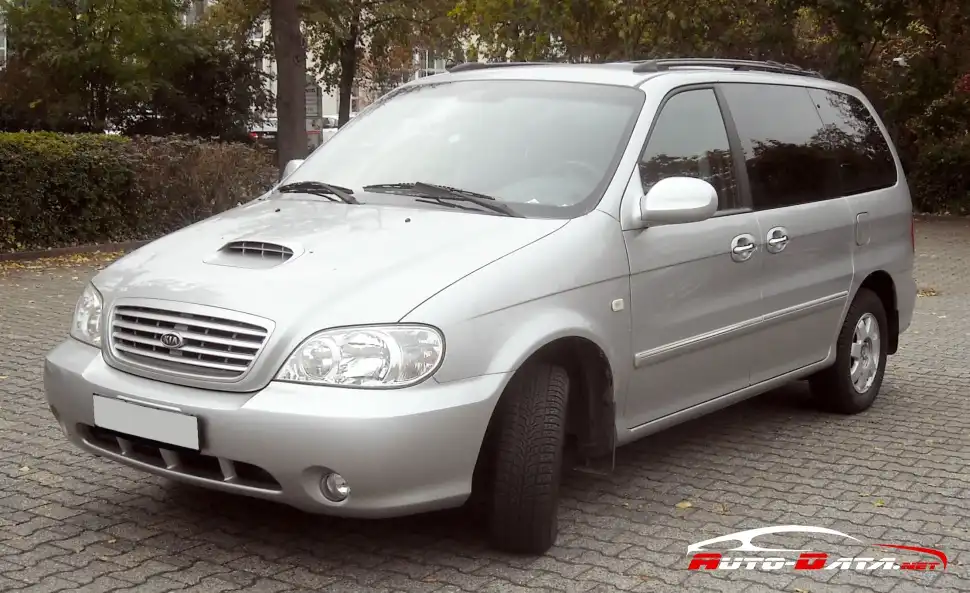
The Kia Carnival, known as the Sedona in North American markets, represented Kia’s initial foray into the competitive minivan segment. Introduced in 1998, the first generation (UP/GQ) aimed to provide a more affordable and feature-rich alternative to established players like the Dodge Caravan and Toyota Sienna. The facelifted version, launched in 2001 and produced through 2006, brought styling updates and refinements. This article focuses on the 2.5i V6 24V variant with the automatic transmission, a configuration primarily sold in select international markets, and its position within the Carnival lineup.
Technical Specifications
| Brand | Kia |
| Model | Carnival |
| Generation | Carnival I (UP/GQ, facelift 2001) |
| Type (Engine) | 2.5i V6 24V (175 Hp) Automatic |
| Start of production | 2001 |
| End of production | 2006 |
| Powertrain Architecture | Internal Combustion engine |
| Body type | Minivan |
| Seats | 7 |
| Doors | 5 |
| Fuel consumption (urban) | 16.4 l/100 km (14.3 US mpg, 17.2 UK mpg, 6.1 km/l) |
| Fuel consumption (extra urban) | 10 l/100 km (23.5 US mpg, 28.2 UK mpg, 10 km/l) |
| Fuel consumption (combined) | 12.4 l/100 km (19 US mpg, 22.8 UK mpg, 8.1 km/l) |
| Fuel Type | Petrol (Gasoline) |
| Weight-to-power ratio | 11.4 kg/Hp, 87.5 Hp/tonne |
| Weight-to-torque ratio | 9.1 kg/Nm, 110 Nm/tonne |
| Power | 175 Hp @ 6000 rpm |
| Power per litre | 70.1 Hp/l |
| Torque | 220 Nm @ 4000 rpm (162.26 lb.-ft. @ 4000 rpm) |
| Engine layout | Front, Transverse |
| Engine Model/Code | KV6 |
| Engine displacement | 2497 cm3 (152.38 cu. in.) |
| Number of cylinders | 6 |
| Engine configuration | V-engine |
| Cylinder Bore | 80 mm (3.15 in.) |
| Piston Stroke | 82.8 mm (3.26 in.) |
| Compression ratio | 10.4:1 |
| Number of valves per cylinder | 4 |
| Fuel injection system | Multi-port manifold injection |
| Engine aspiration | Naturally aspirated engine |
| Valvetrain | DOHC |
| Engine oil capacity | 5.8 l (6.13 US qt | 5.1 UK qt) |
| Coolant capacity | 9.4 l (9.93 US qt | 8.27 UK qt) |
| Kerb Weight | 2000 kg (4409.25 lbs.) |
| Max. weight | 2555 kg (5632.81 lbs.) |
| Max load | 555 kg (1223.57 lbs.) |
| Fuel tank capacity | 75 l (19.81 US gal | 16.5 UK gal) |
| Length | 4925 mm (193.9 in.) |
| Width | 1900 mm (74.8 in.) |
| Height | 1735 mm (68.31 in.) |
| Wheelbase | 2905 mm (114.37 in.) |
| Front track | 1625 mm (63.98 in.) |
| Rear track | 1600 mm (62.99 in.) |
| Minimum turning circle | 13 m (42.65 ft.) |
| Drivetrain Architecture | Front wheel drive, Internal Combustion engine |
| Number of gears | 4 |
| Gearbox type | Automatic transmission |
| Front suspension | Coil spring |
| Rear suspension | Coil spring |
| Front brakes | Ventilated discs |
| Rear brakes | Drum |
| Assisting systems | ABS (Anti-lock braking system) |
| Steering type | Steering rack and pinion |
| Power steering | Hydraulic Steering |
| Tires size | 215/70 R15 |
| Wheel rims size | 15 |
INTRODUCTION
The 2001-2006 Kia Carnival, following the facelift, offered a compelling package for families seeking a spacious and relatively affordable minivan. The 2.5i V6 Automatic variant was positioned as a mid-range option in many markets, offering a balance between performance and fuel economy. It sat below the more powerful 2.7L V6 models, and above the base engine options available in some regions. Built on the UP/GQ platform, the Carnival aimed to challenge established competitors with its generous standard features and competitive pricing. This version was particularly popular in regions where larger displacement engines faced higher taxation or where fuel efficiency was a greater concern.
Powertrain & Engine Architecture
The heart of this Carnival variant is the KV6 engine, a 2.5-liter DOHC 24-valve V6. This engine, developed in collaboration with Mitsubishi, utilizes a multi-port fuel injection system for precise fuel delivery. The engine’s architecture features a 60-degree V-angle, contributing to a relatively compact engine bay footprint. The 175 horsepower output is achieved at 6000 rpm, while peak torque of 220 Nm (162 lb-ft) arrives at 4000 rpm. The engine’s compression ratio is 10.4:1. Paired with the KV6 is a four-speed automatic transmission. This transmission, while not offering the sophistication of more modern gearboxes, provided smooth and adequate shifting for everyday driving. The transmission’s gear ratios were tuned for comfortable cruising and acceptable acceleration, prioritizing usability over outright performance.
Driving Characteristics
The 2.5i V6 Automatic Carnival delivered a comfortable, if not particularly sporty, driving experience. Acceleration was adequate for merging onto highways and overtaking, but it wasn’t a particularly quick vehicle. The four-speed automatic transmission, while smooth, lacked the responsiveness of more modern transmissions or manual gearboxes. Compared to the higher-output 2.7L V6 models, the 2.5L felt noticeably less powerful, especially when fully loaded with passengers and cargo. The front-wheel-drive configuration provided predictable handling, but the Carnival wasn’t designed for aggressive cornering. The suspension, tuned for comfort, absorbed bumps and road imperfections well, making it a pleasant vehicle for long journeys.
Equipment & Trim Levels
The 2.5i V6 Automatic Carnival typically came equipped with a reasonable level of standard features. These generally included air conditioning, power windows and locks, a basic audio system, and dual front airbags. Higher trim levels, often denoted by specific package names depending on the market, added features such as alloy wheels, upgraded audio systems, a sunroof, and woodgrain interior trim. Interior upholstery was typically cloth, with leather options available on higher-end trims. The dashboard layout was functional and straightforward, prioritizing ease of use over aesthetic flair. Optional extras often included rear air conditioning, a CD changer, and upgraded seat materials.
Chassis & Braking
The Carnival’s chassis utilized a coil spring suspension system at both the front and rear, tuned for ride comfort. The front suspension incorporated a stabilizer bar to reduce body roll during cornering. The rear brakes were typically drum brakes, while the front brakes were ventilated discs. This configuration was common for vehicles in this weight class during the early 2000s. The steering system employed a rack and pinion setup with hydraulic power assistance, providing reasonably precise steering feel. The 215/70 R15 tires offered a good balance between ride comfort and handling, although they weren’t particularly sporty.
Market Reception & Comparison
The 2.5i V6 Automatic Carnival received mixed reviews from automotive critics. While praised for its spacious interior, competitive pricing, and generous standard features, it was often criticized for its lack of refinement and relatively modest performance. Compared to the more powerful V6 models, the 2.5L version was seen as a more sensible choice for budget-conscious buyers who prioritized fuel economy and practicality. Fuel economy figures were respectable for a minivan of its size, averaging around 19 US mpg in combined driving. Reliability was generally good, although some owners reported minor issues with the automatic transmission and electrical components.
Legacy
The Kia Carnival I (UP/GQ) played a significant role in establishing Kia as a credible player in the minivan segment. The 2.5i V6 Automatic variant, while not the most powerful or refined option, offered a compelling value proposition for families seeking a spacious and affordable vehicle. Today, these Carnivals are relatively common in the used car market, often available at very affordable prices. The KV6 engine, while generally reliable, requires regular maintenance to prevent oil leaks and ensure optimal performance. The four-speed automatic transmission, while durable, may exhibit some wear and tear with high mileage. Despite its age, the Carnival remains a practical and versatile vehicle for those seeking a budget-friendly minivan.