Technical Specifications
| Brand | BMW |
| Model | M3 |
| Generation | M3 (G80) |
| Type (Engine) | 3.0 (480 Hp) |
| Start of production | 2020 year |
| End of production | 2024 year |
| Powertrain Architecture | Internal Combustion engine |
| Body type | Sedan |
| Seats | 5 |
| Doors | 4 |
| Combined fuel consumption (WLTP) | 10.3-10.6 l/100 km |
| Combined fuel consumption (US mpg) | 22.8 – 22.2 |
| Combined fuel consumption (UK mpg) | 27.4 – 26.6 |
| Combined fuel consumption (km/l) | 9.7 – 9.4 |
| CO2 emissions (WLTP) | 236-241 g/km |
| Fuel consumption (urban – NEDC) | 15.6 l/100 km |
| Fuel consumption (urban – US mpg) | 15.1 |
| Fuel consumption (urban – UK mpg) | 18.1 |
| Fuel consumption (urban – km/l) | 6.4 |
| Fuel consumption (extra urban – NEDC) | 8 l/100 km |
| Fuel consumption (extra urban – US mpg) | 29.4 |
| Fuel consumption (extra urban – UK mpg) | 35.3 |
| Fuel consumption (extra urban – km/l) | 12.5 |
| Fuel consumption (combined – NEDC) | 10.8 l/100 km |
| Fuel consumption (combined – US mpg) | 21.8 |
| Fuel consumption (combined – UK mpg) | 26.2 |
| Fuel consumption (combined – km/l) | 9.3 |
| CO2 emissions (NEDC) | 248 g/km |
| Fuel Type | Petrol (Gasoline) |
| Acceleration 0 – 100 km/h | 4.2 sec |
| Acceleration 0 – 62 mph | 4.2 sec |
| Acceleration 0 – 60 mph | 4 sec |
| Maximum speed | 250 km/h (155.34 mph), Electronically limited |
| Emission standard | Euro 6d |
| Weight-to-power ratio | 3.6 kg/Hp, 281.5 Hp/tonne |
| Weight-to-torque ratio | 3.1 kg/Nm, 322.6 Nm/tonne |
| Power | 480 Hp @ 6250 rpm |
| Power per litre | 160.4 Hp/l |
| Torque | 550 Nm @ 2650-6130 rpm (405.66 lb.-ft. @ 2650-6130 rpm) |
| Engine layout | Front, Longitudinal |
| Engine Model/Code | S58B30B |
| Engine displacement | 2993 cm3 (182.64 cu. in.) |
| Number of cylinders | 6 |
| Engine configuration | Inline |
| Cylinder Bore | 84 mm (3.31 in.) |
| Piston Stroke | 90 mm (3.54 in.) |
| Compression ratio | 9.3:1 |
| Number of valves per cylinder | 4 |
| Fuel injection system | Direct injection |
| Engine aspiration | Twin-power turbo, Intercooler |
| Valvetrain | DOHC |
| Engine oil capacity | 7 l (7.4 US qt | 6.16 UK qt) |
| Kerb Weight | 1705 kg (3758.88 lbs.) |
| Max. weight | 2210 kg (4872.22 lbs.) |
| Max load | 505 kg (1113.33 lbs.) |
| Trunk (boot) space – minimum | 480 l (16.95 cu. ft.) |
| Fuel tank capacity | 59 l (15.59 US gal | 12.98 UK gal) |
| Max. roof load | 75 kg (165.35 lbs.) |
| Length | 4794 mm (188.74 in.) |
| Width | 1903 mm (74.92 in.) |
| Width including mirrors | 2068 mm (81.42 in.) |
| Height | 1433 mm (56.42 in.) |
| Wheelbase | 2857 mm (112.48 in.) |
| Front track | 1617 mm (63.66 in.) |
| Rear track | 1605 mm (63.19 in.) |
| Front overhang | 860 mm (33.86 in.) |
| Rear overhang | 1077 mm (42.4 in.) |
| Ride height (ground clearance) | 120 mm (4.72 in.) |
| Drag coefficient (Cd) | 0.33 |
| Minimum turning circle | 12.2 m (40.03 ft.) |
| Drivetrain Architecture | Rear wheel drive |
| Number of gears | 6 |
| Type of gearbox | Manual transmission |
| Front suspension | Coil spring, Double wishbone |
| Rear suspension | Independent multi-link suspension |
| Front brakes | Ventilated discs |
| Rear brakes | Ventilated discs |
| Assisting systems | ABS (Anti-lock braking system) |
| Steering type | Steering rack and pinion |
| Power steering | Electric Steering |
| Front tire size | 275/40 ZR18 103Y XL |
| Rear tire size | 285/35 ZR19 103Y XL |
| Front wheel rim size | 9.5J x 18 |
| Rear wheel rim size | 10.5J x 19 |
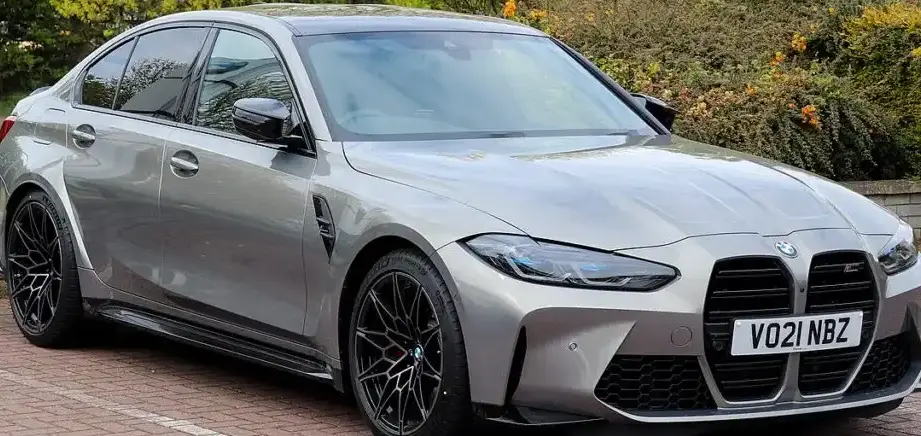
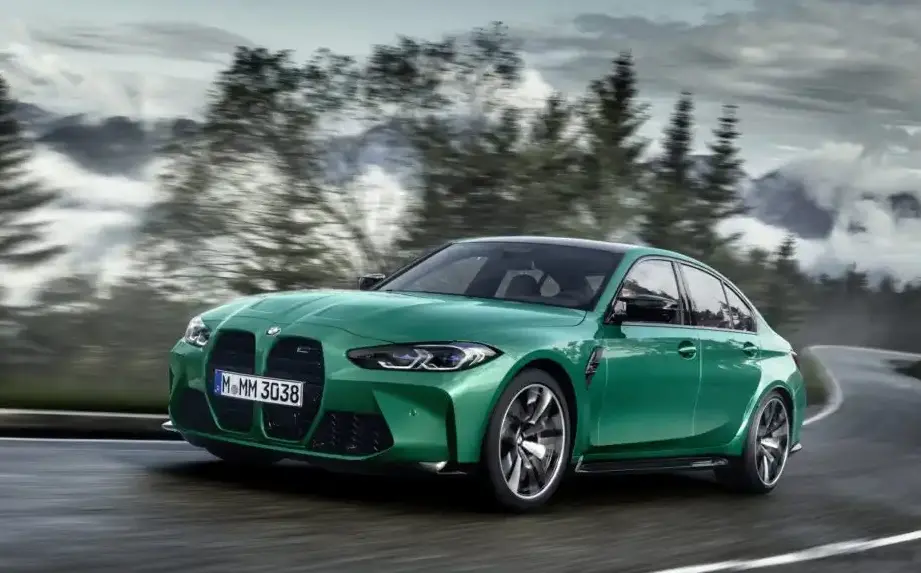
The G80 generation BMW M3, launched in 2020, represented a bold new direction for the iconic sports sedan. The 3.0 variant, equipped with the S58B30B inline-six engine producing 480 horsepower, quickly became a popular choice for enthusiasts. Built on the CLAR platform (Cluster Architecture), the G80 M3 aimed to deliver a more focused and engaging driving experience than its predecessor, the F80. This particular configuration, with its rear-wheel drive layout and available manual transmission, harkens back to the M3’s roots, offering a purist’s driving experience in a modern package. It sits at the base of the G80 M3 range, with the Competition models offering more power and all-wheel drive.
Powertrain & Engine Architecture
At the heart of the M3 3.0 lies the S58B30B, a 3.0-liter inline-six engine. This engine is a significant departure from the previous generation’s turbocharged inline-six, featuring a closed-deck block for increased strength and rigidity. It utilizes direct fuel injection operating at a maximum of 350 bar, ensuring precise fuel delivery for optimal combustion. The engine employs twin-scroll turbochargers, one for each bank of three cylinders, minimizing turbo lag and maximizing responsiveness. The valvetrain utilizes BMW’s VANOS variable valve timing and Valvetronic variable valve lift systems, allowing for precise control over airflow and optimizing engine performance across the rev range. The standard transmission is a six-speed manual, while an eight-speed M Steptronic automatic transmission with Drivelogic is available as an option. The automatic transmission features quicker shift times and more aggressive programming compared to the standard 3 Series automatic.
Driving Characteristics
The 480 hp and 405 lb-ft of torque delivered by the S58B30B engine, combined with the rear-wheel drive configuration, provide a thrilling driving experience. Acceleration from 0 to 60 mph takes approximately 4 seconds. The manual transmission offers precise and engaging shifts, while the automatic provides smooth and rapid gear changes. The rear-wheel drive setup allows for a more playful and dynamic driving experience, particularly on track. Compared to the higher-output Competition models, the 3.0 feels more balanced and predictable, making it more approachable for drivers of all skill levels. The gear ratios are tuned for a balance of acceleration and fuel efficiency, with a relatively short final drive to maximize responsiveness.
Equipment & Trim Levels
The M3 3.0 came standard with a comprehensive list of features, including M Sport seats, a leather-wrapped steering wheel, and a 12.3-inch digital instrument cluster. Interior trim options included aluminum, carbon fiber, and wood accents. Optional extras included M Sport seats with integrated headrests, a head-up display, and a premium Harman Kardon sound system. Exterior features included M-specific aerodynamic enhancements, such as a front splitter, side skirts, and a rear diffuser. Available paint colors included a range of metallic and non-metallic options, as well as several exclusive M colors.
Chassis & Braking
The G80 M3 features a sophisticated chassis designed for optimal handling and stability. The front suspension utilizes a double-wishbone design with adaptive dampers, while the rear suspension employs a multi-link setup. The chassis incorporates extensive use of aluminum to reduce weight and improve rigidity. Braking duties are handled by large, ventilated discs at all four corners, with six-piston calipers at the front and single-piston calipers at the rear. The M Compound braking system is standard, while the optional M Carbon Ceramic brakes offer even greater stopping power and fade resistance. The M3 3.0 features an electronically controlled limited-slip differential, enhancing traction and stability during cornering.
Market Reception & Comparison
The G80 M3 3.0 was generally well-received by automotive critics, who praised its performance, handling, and engaging driving experience. Some criticism was directed at the car’s controversial front grille design. Compared to the M3 Competition, the 3.0 offered a more balanced and predictable driving experience, appealing to drivers who prioritize feel and control over outright speed. Fuel economy, while not a primary concern for M3 buyers, was respectable for a high-performance sedan, averaging around 22-26 mpg in combined driving. Reliability has been generally good, although some owners have reported minor issues with the infotainment system and electronic components.
Legacy
The G80 M3 3.0 is poised to become a modern classic, representing a significant evolution in the M3 lineage. Its combination of performance, handling, and driver engagement has cemented its place as one of the most desirable sports sedans on the market. The availability of a manual transmission and rear-wheel drive configuration has further enhanced its appeal to enthusiasts. On the used car market, well-maintained examples of the M3 3.0 are holding their value well, reflecting the car’s enduring popularity and desirability. The S58 engine is proving to be a robust and reliable unit, suggesting that these cars will provide years of enjoyable performance.