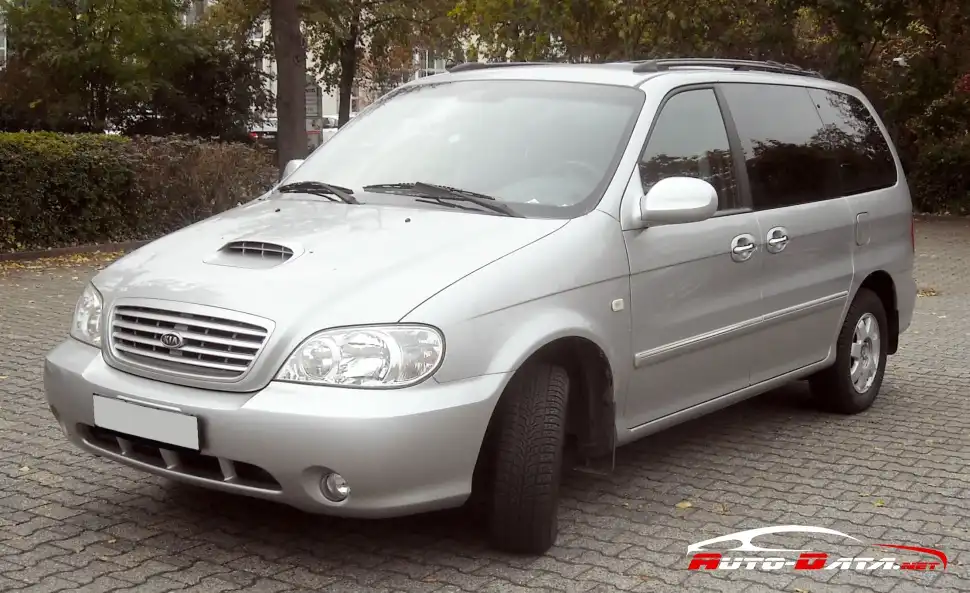
The Kia Carnival, known as the Sedona in North American markets, represented Kia’s entry into the competitive minivan segment. The first generation, designated UP/GQ, was produced from 1998 to 2006, receiving a significant facelift in 2001. The 2.9 CRDI (Common Rail Direct Injection) variant with an automatic transmission, introduced around 2002, was a key offering, particularly in European and Asian markets where diesel engines were favored. This model aimed to provide a balance of fuel efficiency, practicality, and comfort for families. It sat in the mid-range of the Carnival lineup, offering a step up in performance and refinement compared to the base gasoline engines, but positioned below the more expensive, fully-loaded trims.
Technical Specifications
| Brand | Kia |
| Model | Carnival |
| Generation | Carnival I (UP/GQ, facelift 2001) |
| Type (Engine) | 2.9 CRDI (144 Hp) Automatic |
| Start of production | 2002 |
| End of production | 2006 |
| Powertrain Architecture | Internal Combustion engine |
| Body type | Minivan |
| Seats | 7 |
| Doors | 5 |
| Fuel consumption (urban) | 16.4 l/100 km (14.3 US mpg, 17.2 UK mpg, 6.1 km/l) |
| Fuel consumption (extra urban) | 7.1 l/100 km (33.1 US mpg, 39.8 UK mpg, 14.1 km/l) |
| Fuel consumption (combined) | 8.8 l/100 km (26.7 US mpg, 32.1 UK mpg, 11.4 km/l) |
| Fuel Type | Diesel |
| Weight-to-power ratio | 14.5 kg/Hp (69 Hp/tonne) |
| Weight-to-torque ratio | 6.7 kg/Nm (148.5 Nm/tonne) |
| Power | 144 Hp @ 3800 rpm |
| Power per litre | 49.6 Hp/l |
| Torque | 310 Nm @ 2000 rpm (228.64 lb.-ft. @ 2000 rpm) |
| Engine layout | Front, Transverse |
| Engine Model/Code | J3 |
| Engine displacement | 2903 cm3 (177.15 cu. in.) |
| Number of cylinders | 4 |
| Engine configuration | Inline |
| Cylinder Bore | 97.1 mm (3.82 in.) |
| Piston Stroke | 98 mm (3.86 in.) |
| Compression ratio | 19.3:1 |
| Number of valves per cylinder | 4 |
| Fuel injection system | Diesel Commonrail |
| Engine aspiration | Turbocharger, Intercooler |
| Valvetrain | DOHC |
| Engine oil capacity | 6.2 l (6.55 US qt, 5.46 UK qt) |
| Coolant capacity | 9.4 l (9.93 US qt, 8.27 UK qt) |
| Kerb Weight | 2088 kg (4603.25 lbs.) |
| Max. weight | 2675 kg (5897.37 lbs.) |
| Max load | 587 kg (1294.11 lbs.) |
| Fuel tank capacity | 75 l (19.81 US gal, 16.5 UK gal) |
| Length | 4925 mm (193.9 in.) |
| Width | 1900 mm (74.8 in.) |
| Height | 1730 mm (68.11 in.) |
| Wheelbase | 2905 mm (114.37 in.) |
| Front track | 1625 mm (63.98 in.) |
| Rear track | 1600 mm (62.99 in.) |
| Ride height (ground clearance) | 170 mm (6.69 in.) |
| Minimum turning circle | 13 m (42.65 ft.) |
| Drivetrain Architecture | Front wheel drive |
| Number of gears | 4 |
| Gearbox type | Automatic transmission |
| Front suspension | Wishbone |
| Rear suspension | Coil spring |
| Front brakes | Ventilated discs |
| Rear brakes | Drum |
| Assisting systems | ABS (Anti-lock braking system) |
| Steering type | Steering rack and pinion |
| Power steering | Hydraulic |
| Tires size | 215/65 R15 |
| Wheel rims size | 15 |
INTRODUCTION
The Kia Carnival I (UP/GQ) facelift, launched in 2002, brought a more refined and powerful diesel option to the European and Asian minivan markets with the 2.9 CRDI engine. This variant aimed to appeal to buyers seeking a spacious, comfortable, and relatively fuel-efficient vehicle for family transportation. The facelift included cosmetic updates and improvements to the interior, enhancing the overall appeal of the Carnival. The 2.9 CRDI automatic was positioned as a mid-range offering, bridging the gap between the more basic gasoline models and the higher-specification trims.
Powertrain & Engine Architecture
The heart of this Carnival variant is the J3 2.9-liter inline-four cylinder diesel engine. This engine utilizes a common rail direct injection (CRDI) system, a significant advancement over older diesel technologies. CRDI allows for more precise fuel delivery, resulting in improved combustion efficiency, reduced noise, and increased power output. The J3 engine features a turbocharger with an intercooler, further boosting performance. The engine produces 144 horsepower at 3800 rpm and 310 Nm (228.64 lb-ft) of torque at 2000 rpm. The four-speed automatic transmission was a crucial component, designed to provide smooth gear changes and ease of driving. While not as sophisticated as modern automatic transmissions, it was a reliable unit for its time. The engine’s DOHC (Double Overhead Camshaft) valvetrain and 19.3:1 compression ratio contribute to its efficiency and power delivery.
Driving Characteristics
The 2.9 CRDI automatic Carnival offered a noticeable improvement in performance compared to the lower-powered gasoline engines. While not a sports car, the 310 Nm of torque provided ample pulling power for highway cruising and overtaking maneuvers. The automatic transmission, while smooth, wasn’t particularly quick to downshift, so planning ahead was necessary when accelerating. Compared to the manual transmission versions of the 2.9 CRDI, the automatic offered greater convenience but slightly reduced fuel economy and a less engaging driving experience. The gear ratios were tuned for comfortable cruising rather than outright acceleration. The weight of the vehicle (2088 kg / 4603.25 lbs) did impact overall responsiveness, but the engine’s torque helped mitigate this.
Equipment & Trim Levels
The 2.9 CRDI automatic Carnival typically came equipped with features such as air conditioning, power windows, central locking, and an audio system. Higher trim levels added features like alloy wheels, a sunroof, upgraded upholstery, and a more sophisticated audio system. Interior upholstery was generally cloth, with optional leather available on higher-spec models. The dashboard layout was functional and straightforward, prioritizing usability over flashy design. Optional extras included rear parking sensors, a navigation system (rare for this era), and upgraded sound systems.
Chassis & Braking
The Carnival I utilized a front-wheel-drive layout with a wishbone front suspension and a coil spring rear suspension. This setup provided a comfortable ride, although it wasn’t particularly sporty. The front brakes were ventilated discs, offering adequate stopping power, while the rear brakes were drums. ABS (Anti-lock Braking System) was standard, enhancing safety. The suspension was tuned to prioritize ride comfort over handling precision, making it well-suited for long journeys with a full load of passengers. Stabilizer bars were included to reduce body roll during cornering.
Market Reception & Comparison
The 2.9 CRDI automatic Carnival received generally positive reviews, particularly for its spacious interior, comfortable ride, and relatively fuel-efficient diesel engine. Critics noted that the automatic transmission wasn’t the most responsive, and the overall driving experience was more focused on comfort than performance. Compared to the gasoline-powered Carnivals, the 2.9 CRDI offered significantly better fuel economy and more torque. It also provided a quieter and more refined driving experience. Against competitors like the Renault Espace and Volkswagen Sharan, the Carnival offered a compelling value proposition, often undercutting them in price while providing similar levels of practicality and comfort.
Legacy
The Kia Carnival I, particularly the 2.9 CRDI automatic variant, has proven to be a relatively reliable vehicle. The J3 engine, while not without its quirks, is generally durable if properly maintained. Common issues include turbocharger wear and potential problems with the fuel injection system. The automatic transmission is also known to be reliable, but regular fluid changes are essential. Today, these Carnivals are increasingly sought after by enthusiasts and families looking for an affordable and spacious minivan. Parts availability can be a challenge in some regions, but the relatively simple mechanical design makes them relatively easy to repair. The 2.9 CRDI automatic Carnival represents a significant step forward for Kia, demonstrating their ability to produce a competitive and well-rounded minivan.