Technical Specifications
| Brand | Mazda |
| Model | 2 |
| Generation | III (DJ, facelift 2019) |
| Type (Engine) | 1.5 e-Skyactiv-G (90 Hp) M Hybrid |
| Start of production | October, 2021 |
| End of production | March, 2022 |
| Powertrain Architecture | MHEV (Mild Hybrid Electric Vehicle) |
| Body type | Hatchback |
| Seats | 5 |
| Doors | 5 |
| Fuel consumption at Low speed (WLTP) | 5.7 l/100 km (41.3 US mpg, 49.6 UK mpg, 17.5 km/l) |
| Fuel consumption at Medium speed (WLTP) | 4.5 l/100 km (52.3 US mpg, 62.8 UK mpg, 22.2 km/l) |
| Fuel consumption at high speed (WLTP) | 4.1 l/100 km (57.4 US mpg, 68.9 UK mpg, 24.4 km/l) |
| Fuel consumption at very high speed (WLTP) | 5.1 l/100 km (46.1 US mpg, 55.4 UK mpg, 19.6 km/l) |
| Combined fuel consumption (WLTP) | 4.7 l/100 km (50 US mpg, 60.1 UK mpg, 21.3 km/l) |
| CO2 emissions (WLTP) | 107 g/km |
| Fuel consumption (economy) – urban (NEDC) | 5.1 l/100 km (46.1 US mpg, 55.4 UK mpg, 19.6 km/l) |
| Fuel consumption (economy) – extra urban (NEDC) | 4 l/100 km (58.8 US mpg, 70.6 UK mpg, 25 km/l) |
| Fuel consumption (economy) – combined (NEDC) | 4.4 l/100 km (53.5 US mpg, 64.2 UK mpg, 22.7 km/l) |
| CO2 emissions (NEDC) | 100 g/km |
| Fuel Type | Petrol (Gasoline) |
| Acceleration 0 – 100 km/h | 9.8 sec |
| Acceleration 0 – 62 mph | 9.8 sec |
| Acceleration 0 – 60 mph | 9.3 sec |
| Maximum speed | 183 km/h (113.71 mph) |
| Emission standard | Euro 6d |
| Weight-to-power ratio | 12 kg/Hp, 83.4 Hp/tonne |
| Weight-to-torque ratio | 7.1 kg/Nm, 139.9 Nm/tonne |
| Power | 90 Hp @ 6000 rpm |
| Power per litre | 60.2 Hp/l |
| Torque | 151 Nm @ 3500 rpm (111.37 lb.-ft. @ 3500 rpm) |
| Engine layout | Front, Transverse |
| Engine Model/Code | P5 |
| Engine displacement | 1496 cm3 (91.29 cu. in.) |
| Number of cylinders | 4 |
| Engine configuration | Inline |
| Cylinder Bore | 74.5 mm (2.93 in.) |
| Piston Stroke | 85.8 mm (3.38 in.) |
| Compression ratio | 15:1 |
| Number of valves per cylinder | 4 |
| Fuel injection system | Direct injection |
| Engine aspiration | Naturally aspirated engine |
| Engine oil capacity | 4.2 l (4.44 US qt | 3.7 UK qt) |
| Kerb Weight | 1079 kg (2378.79 lbs.) |
| Max. weight | 1540 kg (3395.12 lbs.) |
| Max load | 461 kg (1016.33 lbs.) |
| Trunk (boot) space – minimum | 280 l (9.89 cu. ft.) |
| Trunk (boot) space – maximum | 950 l (33.55 cu. ft.) |
| Fuel tank capacity | 44 l (11.62 US gal | 9.68 UK gal) |
| Max. roof load | 50 kg (110.23 lbs.) |
| Permitted trailer load with brakes (8%) | 1100 kg (2425.08 lbs.) |
| Permitted trailer load with brakes (12%) | 900 kg (1984.16 lbs.) |
| Permitted towbar download | 50 kg (110.23 lbs.) |
| Length | 4070 mm (160.24 in.) |
| Width | 1695 mm (66.73 in.) |
| Height | 1524 mm (60 in.) |
| Wheelbase | 2570 mm (101.18 in.) |
| Front track | 1495 mm (58.86 in.) |
| Rear (Back) track | 1485 mm (58.46 in.) |
| Ride height (ground clearance) | 143 mm (5.63 in.) |
| Minimum turning circle (turning diameter) | 10.4 m (34.12 ft.) |
| Drivetrain Architecture | ICE and electric motor drive the front wheels in mixed mode. |
| Drive wheel | Front wheel drive |
| Number of gears and type of gearbox | 6 gears, manual transmission |
| Front suspension | Independent type McPherson |
| Rear suspension | Torsion |
| Front brakes | Ventilated discs |
| Rear brakes | Drum |
| Assisting systems | ABS (Anti-lock braking system) |
| Steering type | Steering rack and pinion |
| Power steering | Electric Steering |
| Tires size | 185/65 R15; 185/60 R16 |
| Wheel rims size | 15; 16 |
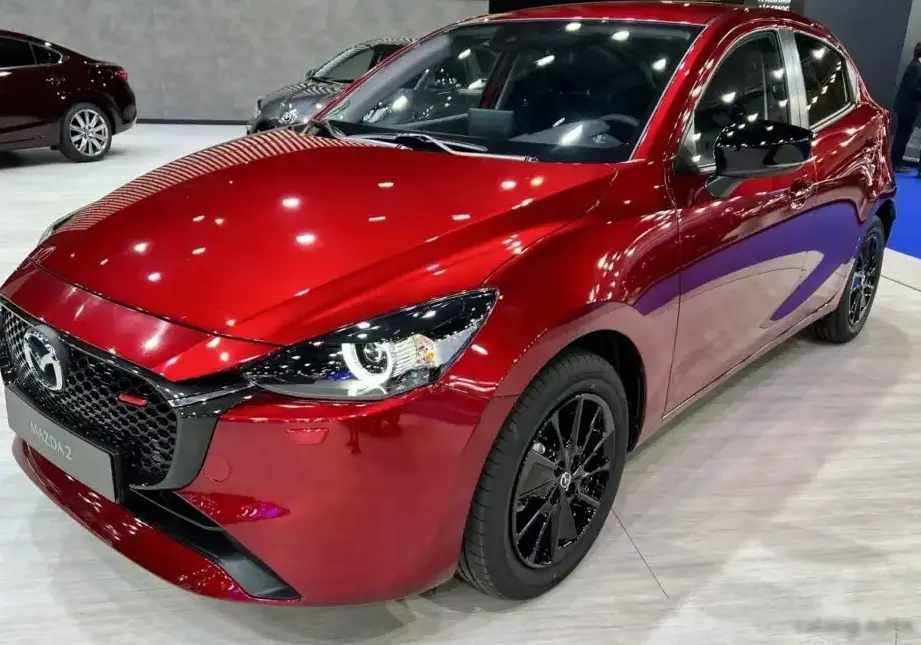
The Mazda 2 III (DJ), particularly the facelifted version introduced in 2019, embodies Mazda’s dedication to crafting subcompact vehicles that prioritize driving enjoyment and fuel efficiency. The 1.5 e-Skyactiv-G (90 hp) M Hybrid, produced from October 2021 to March 2022, was a significant offering in European and Asian markets. This model falls within the DJ generation, a substantial advancement over previous Mazda 2 iterations, built on the platform shared with the Ford Fiesta. The “M Hybrid” designation signifies a mild hybrid system engineered to improve fuel economy and lower emissions. This specific configuration was designed to be an accessible entry point into the Mazda 2 lineup, balancing affordability with Mazda’s renowned driving experience.
Powertrain & Engine Architecture
The core of this Mazda 2 variant is the 1.5-liter P5 engine, a member of Mazda’s Skyactiv-G family. This engine is distinguished by its high compression ratio of 15:1, a result of precise engineering and optimized combustion chamber design. Direct fuel injection is employed, contributing to enhanced fuel efficiency and reduced emissions. The engine produces 90 horsepower at 6000 rpm, with a torque output of 151 Nm (111.37 lb.-ft.) at 3500 rpm. The mild hybrid system incorporates an integrated starter generator (ISG) and a small battery. The ISG assists the engine during acceleration, providing a modest power boost and enabling earlier engine shut-off during deceleration and braking, recovering energy that would otherwise be lost. This recovered energy is then used to assist the engine during restart. The engine is mounted transversely and delivers power to the front wheels through a six-speed manual transmission.
Driving Characteristics
The 1.5-liter 90 hp engine, coupled with the manual transmission, delivers adequate performance for typical urban and suburban driving. Acceleration to 60 mph takes approximately 9.3 seconds, and the top speed reaches around 113.71 mph. While not designed for high performance, the engine is responsive and benefits from Skyactiv technology, offering a linear power delivery. Compared to higher-output Mazda 2 models, this variant feels less spirited during acceleration, especially when carrying a full load. However, its lighter weight contributes to nimble handling and a relatively engaging driving experience. The six-speed gearbox is well-suited to the engine’s characteristics, providing precise shifts and allowing the driver to maintain the engine within its optimal power range.
Equipment & Trim Levels
The 1.5 e-Skyactiv-G M Hybrid typically included a reasonable standard equipment package. This generally featured power windows and mirrors, central locking, a basic audio system with USB connectivity, and air conditioning. Safety features such as ABS, stability control, and multiple airbags were also standard. Optional upgrades and higher trim levels could add features like alloy wheels, a touchscreen infotainment system with smartphone integration (Apple CarPlay and Android Auto), automatic climate control, and advanced safety systems like lane departure warning and automatic emergency braking. Interior upholstery was typically cloth, with a functional and durable design.
Chassis & Braking
The Mazda 2 III utilizes a front-wheel-drive layout with an independent McPherson strut suspension at the front and a torsion beam suspension at the rear. This configuration strikes a balance between ride comfort and handling. The front brakes are ventilated discs, providing good stopping power, while the rear brakes are drums, a cost-saving measure common in this vehicle class. Electric power steering provides light and precise steering feel. The chassis is relatively lightweight, enhancing the car’s agility. Stabilizer bars are fitted to both the front and rear axles to minimize body roll during cornering.
Market Reception & Comparison
The 1.5 e-Skyactiv-G M Hybrid variant was generally well-received by automotive critics as a sensible and economical choice. Its fuel economy figures, particularly as measured by WLTP testing, were competitive within the subcompact segment. Compared to the more powerful engine options in the Mazda 2 range, this variant offered lower running costs but sacrificed some performance. The mild hybrid system was praised for its contribution to fuel efficiency without significantly impacting the driving experience. When compared to rivals like the Volkswagen Polo, Ford Fiesta, and Toyota Yaris, the Mazda 2 distinguished itself with its engaging driving dynamics and stylish design.
Legacy
The 1.5 e-Skyactiv-G M Hybrid powertrain has proven to be relatively reliable, with few widespread issues reported. Skyactiv engines, in general, are known for their durability and longevity. In the used car market, this variant represents a good value proposition, offering a well-equipped and fuel-efficient subcompact car at an affordable price. The mild hybrid system adds a degree of future-proofing, as environmental regulations become increasingly stringent. While not a collector’s item, this Mazda 2 variant remains a practical and enjoyable vehicle for everyday use.