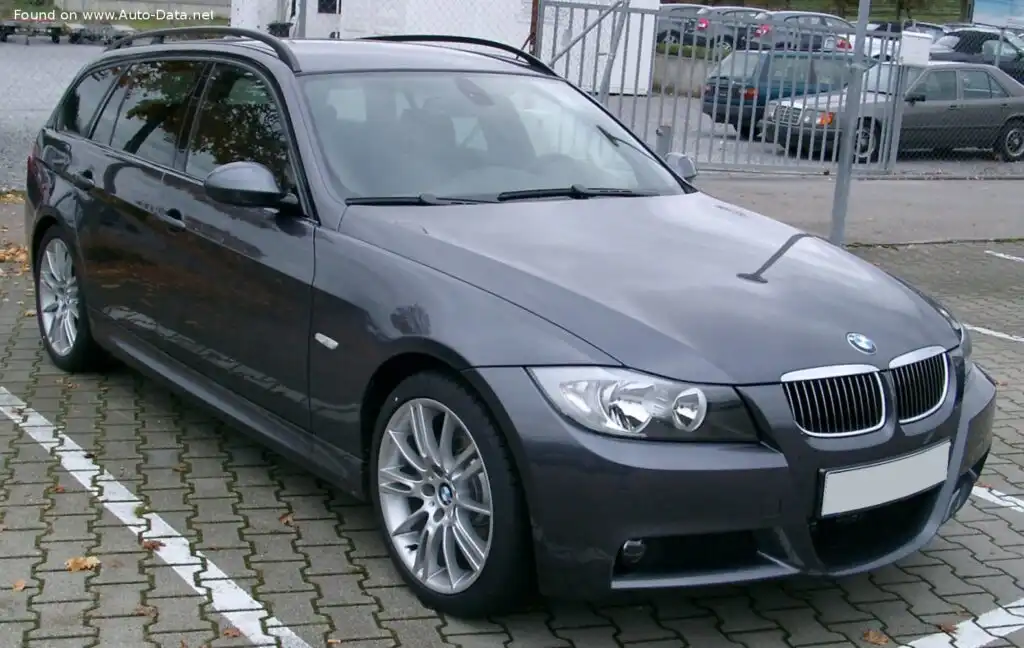
The BMW E91 320d Touring, produced from 2005 to 2007, represents BMW’s entry into the compact executive wagon segment with a focus on fuel efficiency and practicality. Part of the E90 3 Series generation (chassis code E91 for the Touring/wagon variant), the 320d offered a more versatile alternative to the sedan while maintaining BMW’s reputation for driving dynamics. This specific variant, powered by the M47D20TU2 engine and typically paired with a six-speed manual transmission, served as the base model for the E91 range, appealing to buyers prioritizing economy and everyday usability over outright performance. While an automatic transmission was available, the manual was more common and is often preferred by enthusiasts.
Technical Specifications
| Brand | BMW |
| Model | 3 Series |
| Generation | 3 Series Touring (E91) |
| Type (Engine) | 320d (163 Hp) |
| Start of production | 2005 |
| End of production | 2007 |
| Powertrain Architecture | Internal Combustion engine |
| Body type | Station wagon (estate) |
| Seats | 5 |
| Doors | 5 |
| Fuel consumption (urban) | 8.1 l/100 km (29 US mpg, 34.9 UK mpg, 12.3 km/l) |
| Fuel consumption (extra urban) | 4.6 l/100 km (51.1 US mpg, 61.4 UK mpg, 21.7 km/l) |
| Fuel Type | Diesel |
| Acceleration 0 – 100 km/h | 8.6 sec |
| Acceleration 0 – 62 mph | 8.6 sec |
| Acceleration 0 – 60 mph | 8.2 sec |
| Maximum speed | 223 km/h (138.57 mph) |
| Weight-to-power ratio | 9.3 kg/Hp, 107.9 Hp/tonne |
| Weight-to-torque ratio | 4.4 kg/Nm, 225.2 Nm/tonne |
| Power | 163 Hp @ 4000 rpm |
| Power per litre | 81.7 Hp/l |
| Torque | 340 Nm @ 2000 rpm (250.77 lb.-ft. @ 2000 rpm) |
| Engine layout | Front, Longitudinal |
| Engine Model/Code | M47D20TU2 |
| Engine displacement | 1995 cm3 (121.74 cu. in.) |
| Number of cylinders | 4 |
| Engine configuration | Inline |
| Cylinder Bore | 84 mm (3.31 in.) |
| Piston Stroke | 90 mm (3.54 in.) |
| Compression ratio | 17:1 |
| Number of valves per cylinder | 4 |
| Fuel injection system | Diesel Commonrail |
| Engine aspiration | Turbocharger, Intercooler |
| Engine oil capacity | 5.2 l (5.49 US qt | 4.58 UK qt) |
| Coolant | 7.5 l (7.93 US qt | 6.6 UK qt) |
| Kerb Weight | 1510 kg (3328.98 lbs.) |
| Max. weight | 2045 kg (4508.45 lbs.) |
| Max load | 535 kg (1179.47 lbs.) |
| Trunk (boot) space – minimum | 460 l (16.24 cu. ft.) |
| Trunk (boot) space – maximum | 1385 l (48.91 cu. ft.) |
| Fuel tank capacity | 61 l (16.11 US gal | 13.42 UK gal) |
| Length | 4520 mm (177.95 in.) |
| Width | 1817 mm (71.54 in.) |
| Height | 1418 mm (55.83 in.) |
| Wheelbase | 2760 mm (108.66 in.) |
| Front track | 1500 mm (59.06 in.) |
| Rear (Back) track | 1513 mm (59.57 in.) |
| Drivetrain Architecture | Rear wheel drive |
| Number of gears | 6 |
| Type of gearbox | Manual transmission |
| Front suspension | Spring Strut |
| Rear suspension | Coil spring |
| Front brakes | Ventilated discs |
| Rear brakes | Disc |
| Assisting systems | ABS (Anti-lock braking system) |
| Tires size | 205/55 R16 |
| Wheel rims size | 16 |
Powertrain & Engine Architecture
The heart of the E91 320d Touring is the M47D20TU2, a 2.0-liter inline-four diesel engine. This engine is a direct descendant of BMW’s long-running M47 series, known for its robust construction and relatively simple design. The “TU2” designation indicates an updated version with improvements to fuel injection and turbocharging. The engine utilizes a second-generation common rail direct injection system, delivering fuel at extremely high pressures for improved combustion efficiency and reduced emissions. A single turbocharger with an intercooler provides forced induction, boosting power and torque. The engine features four valves per cylinder and a timing chain, contributing to its durability. The six-speed manual transmission, Getrag M6J, was the most common pairing, offering precise shifts and a direct connection to the engine. An optional six-speed automatic transmission was available, but it often detracted from the driving experience and was less fuel-efficient.
Driving Characteristics
The 320d Touring, with its 163 horsepower and 340 Nm (250 lb-ft) of torque, provided a balanced driving experience. Acceleration from 0-60 mph took around 8.2 seconds, respectable for a diesel wagon of this era. The engine’s torque peak, available from 2000 rpm, meant that strong pulling power was readily accessible for everyday driving and overtaking. While not a sports car, the 320d offered a comfortable and composed ride, typical of BMW’s engineering. Compared to the more powerful 330d or the petrol-powered 330i, the 320d prioritized fuel economy and ease of use. The manual transmission allowed for greater driver engagement, while the automatic, though convenient, felt somewhat sluggish in comparison. The rear-wheel-drive configuration contributed to the car’s balanced handling, although traction could be a concern in slippery conditions.
Equipment & Trim Levels
The E91 320d Touring typically came equipped with a reasonable level of standard features. This included automatic climate control, power windows and mirrors, a basic audio system, and alloy wheels. Interior upholstery was usually cloth, although leather was available as an option. Optional extras included a sunroof, navigation system, upgraded audio, parking sensors, and heated seats. Trim levels were relatively simple, with most customization occurring through individual options rather than distinct packages. The overall interior design was functional and well-built, reflecting BMW’s commitment to quality.
Chassis & Braking
The E91 320d Touring utilized a MacPherson strut front suspension and a multi-link rear suspension, providing a good balance of comfort and handling. Stabilizer bars were fitted front and rear to reduce body roll. Braking duties were handled by ventilated discs at the front and solid discs at the rear, equipped with ABS (Anti-lock Braking System). The suspension setup was tuned to provide a comfortable ride without sacrificing too much handling precision. The chassis was relatively lightweight, contributing to the car’s agility.
Market Reception & Comparison
The E91 320d Touring was generally well-received by automotive critics. It was praised for its fuel efficiency, practicality, and comfortable ride. However, some reviewers noted that the engine lacked the outright performance of its larger counterparts. Compared to other wagons in its class, such as the Audi A4 Avant and Volvo V70, the 320d offered a more engaging driving experience. Its fuel economy was competitive, and its reliability was generally good, although diesel particulate filter (DPF) issues could arise with infrequent long-distance driving. The 320d represented a sensible choice for buyers seeking a versatile and economical family car.
Legacy
The E91 320d Touring, particularly the manual transmission variants, has developed a reputation for being a reliable and durable vehicle. The M47D20TU2 engine, while not the most powerful, is known for its longevity when properly maintained. Today, these cars can be found on the used car market at relatively affordable prices. Common maintenance issues include DPF regeneration problems, turbocharger wear, and occasional injector failures. However, with regular servicing and preventative maintenance, the E91 320d Touring can provide many years of reliable service. It remains a popular choice for those seeking a practical and well-built wagon with a touch of BMW’s driving DNA.