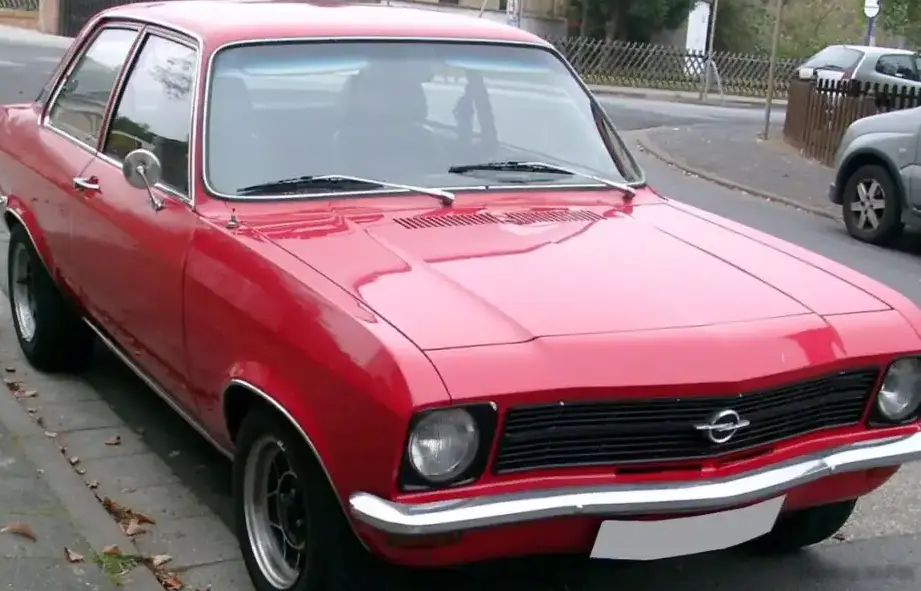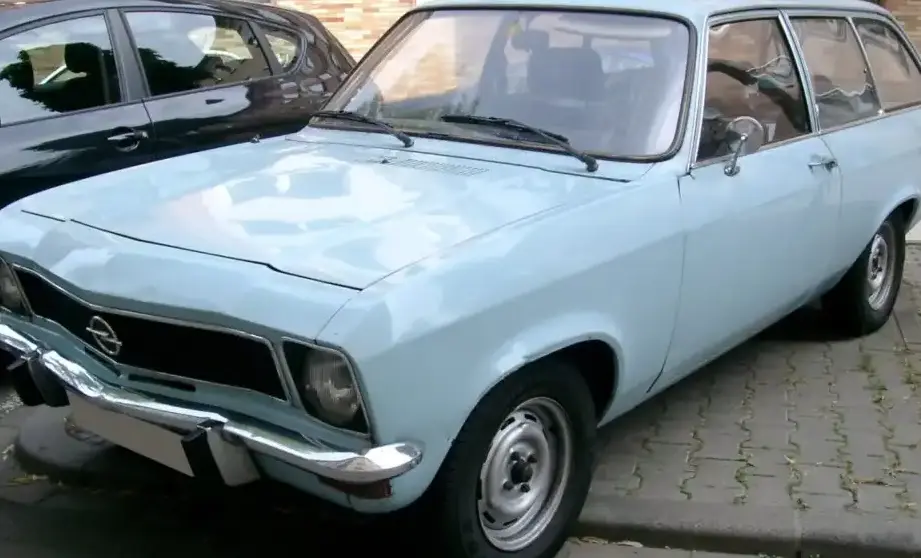
The Opel Ascona A Voyage 1.6 S, produced between November 1970 and December 1974, was a station wagon (estate) variant of the Ascona A series. Positioned as a practical family vehicle, it offered a balance between affordability and space within Opel’s lineup. This particular 1.6 S trim, generating 80 horsepower, represented a mid-range offering, slotting below the more powerful Ascona SR models and above the base-level trims. The Ascona A, and subsequently the Voyage, were crucial models for Opel, aiming to compete with rivals like the Ford Cortina and Hillman Avenger in the European market. The Voyage body style, introduced later in the Ascona A’s lifecycle, expanded the model’s appeal to buyers needing increased cargo capacity.
Technical Specifications
| Brand | Opel |
| Model | Ascona |
| Generation | Ascona A Voyage |
| Type (Engine) | 1.6 S (80 Hp) |
| Start of production | November, 1970 |
| End of production | December, 1974 |
| Powertrain Architecture | Internal Combustion engine |
| Body type | Station wagon (estate) |
| Seats | 5 |
| Doors | 3 |
| Fuel consumption (combined) | 9.7 l/100 km |
| Fuel consumption (US mpg) | 24.2 |
| Fuel consumption (UK mpg) | 29.1 |
| Fuel consumption (km/l) | 10.3 |
| Fuel Type | Petrol (Gasoline) |
| Acceleration 0 – 100 km/h | 15.5 sec |
| Acceleration 0 – 62 mph | 15.5 sec |
| Acceleration 0 – 60 mph | 14.7 sec |
| Maximum speed | 155 km/h (96.31 mph) |
| Weight-to-power ratio | 12.8 kg/Hp |
| Weight-to-torque ratio | 8.5 kg/Nm |
| Power | 80 Hp @ 5200 rpm |
| Power per litre | 50.5 Hp/l |
| Torque | 120 Nm @ 3800 rpm (88.51 lb.-ft. @ 3800 rpm) |
| Engine layout | Front, Longitudinal |
| Engine Model/Code | 16S |
| Engine displacement | 1584 cm3 (96.66 cu. in.) |
| Number of cylinders | 4 |
| Engine configuration | Inline |
| Cylinder Bore | 85 mm (3.35 in.) |
| Piston Stroke | 69.8 mm (2.75 in.) |
| Compression ratio | 9.5:1 |
| Number of valves per cylinder | 2 |
| Fuel injection system | Carburettor |
| Engine aspiration | Naturally aspirated |
| Valvetrain | CIH |
| Engine oil capacity | 3.8 l (4.02 US qt | 3.34 UK qt) |
| Coolant capacity | 6.5 l (6.87 US qt | 5.72 UK qt) |
| Kerb Weight | 1020 kg (2248.72 lbs.) |
| Max. weight | 1535 kg (3384.1 lbs.) |
| Max load | 515 kg (1135.38 lbs.) |
| Fuel tank capacity | 46 l (12.15 US gal | 10.12 UK gal) |
| Permitted trailer load (braked) | 1000 kg (2204.62 lbs.) |
| Permitted trailer load (unbraked) | 500 kg (1102.31 lbs.) |
| Length | 4180 mm (164.57 in.) |
| Width | 1632 mm (64.25 in.) |
| Height | 1400 mm (55.12 in.) |
| Wheelbase | 2430 mm (95.67 in.) |
| Front track | 1331 mm (52.4 in.) |
| Rear track | 1320 mm (51.97 in.) |
| Ride height | 134 mm (5.28 in.) |
| Drag coefficient (Cd) | 0.50 |
| Turning circle | 9.76 m (32.02 ft.) |
| Drivetrain | Rear wheel drive |
| Gearbox | 4 gears, manual transmission |
| Front suspension | Double wishbone, Independent coil spring, Transverse stabilizer |
| Rear suspension | Rigid axle suspension, Transverse stabilizer, Trailing arm, Coil spring |
| Front brakes | Disc |
| Rear brakes | Drum |
| Steering | Steering rack and pinion |
| Tire size | 155/80 R13; 165/80 R13; 185/70 R13 |
| Wheel rims size | 5J x 13; 5.5J x 13 |
Powertrain & Engine Architecture
The Ascona A Voyage 1.6 S was powered by the Opel 16S engine, a 1.6-liter (1584 cc) inline-four cylinder unit. This engine was part of Opel’s CIH (Cylinder Head Inclined) family, known for its robust design and relatively simple maintenance. The ‘S’ designation indicated a slightly higher compression ratio (9.5:1) and a twin-barrel carburetor, contributing to the 80 horsepower output at 5200 rpm and 120 Nm (88.51 lb-ft) of torque at 3800 rpm. The engine featured a single overhead camshaft (SOHC) valvetrain with two valves per cylinder. Power was delivered to the rear wheels via a four-speed manual transmission. The longitudinal engine placement was typical for rear-wheel-drive vehicles of the era, contributing to a balanced weight distribution.
Driving Characteristics
The 1.6 S variant of the Ascona A Voyage offered a comfortable, if not particularly sporty, driving experience. With 80 horsepower propelling a kerb weight of around 1020 kg (2248.72 lbs), acceleration was modest, taking approximately 15.5 seconds to reach 100 km/h (62 mph). The four-speed manual transmission provided adequate gear spacing for everyday driving, but lacked the responsiveness of the five-speed gearboxes found in some contemporary rivals. Compared to the more powerful Ascona SR models, the 1.6 S felt noticeably slower, particularly during overtaking maneuvers. However, the lower power output also translated to slightly better fuel economy. The rear-wheel-drive configuration provided predictable handling, although it wasn’t as forgiving as front-wheel-drive layouts in slippery conditions.
Equipment & Trim Levels
The Ascona A Voyage 1.6 S typically came equipped with basic but functional features. Standard interior appointments included cloth upholstery, a simple dashboard layout with analog gauges, and manually adjustable seats. While not lavish, the interior was reasonably well-built and durable. Optional extras included a radio, upgraded upholstery, and a sunroof. The ‘S’ trim level generally added a few cosmetic enhancements, such as chrome trim and slightly more refined interior materials, compared to the base-level Ascona Voyage models. The focus was on practicality and affordability rather than luxury.
Chassis & Braking
The Ascona A Voyage utilized a conventional chassis design for the early 1970s. The front suspension featured an independent double wishbone setup with coil springs and a transverse stabilizer bar, providing a reasonable level of ride comfort and handling. The rear suspension employed a rigid axle with trailing arms, coil springs, and a transverse stabilizer bar. Braking duties were handled by disc brakes at the front and drum brakes at the rear. While adequate for normal driving conditions, the braking system lacked the stopping power and modulation of more modern systems. Steering was via a rack and pinion system, offering reasonably precise control.
Market Reception & Comparison
The Opel Ascona A Voyage 1.6 S was generally well-received by automotive critics as a practical and affordable family car. It offered a good balance between space, fuel economy, and reliability. However, its performance was often criticized as being somewhat underwhelming, particularly when compared to more powerful rivals. Fuel economy was rated at around 9.7 l/100 km (24.2 US mpg), which was competitive for the time. Compared to the Ascona SR models, the 1.6 S was significantly cheaper to purchase and maintain, making it a popular choice for budget-conscious buyers. The 1.9-liter versions offered more power but came at a higher price point and with increased running costs.
Legacy
The Opel Ascona A Voyage 1.6 S, while not a particularly rare or collectible vehicle today, remains a popular choice among classic car enthusiasts. The 16S engine is known for its durability and relatively simple mechanics, making it relatively easy to maintain. Parts availability is generally good, although some components may be difficult to find. The Ascona A Voyage’s enduring appeal lies in its practicality, affordability, and classic 1970s styling. Well-maintained examples continue to provide reliable and enjoyable transportation for those seeking a taste of automotive history.