
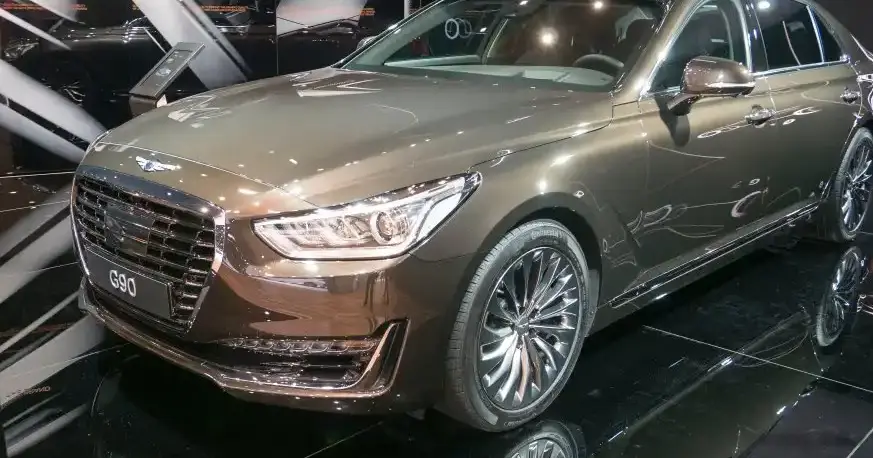
The Genesis G90, initially launched as the Hyundai EQ900 in the South Korean domestic market in 2016, represents Genesis’s initial foray into the luxury sedan segment. This first generation, internally designated as the G90/EQ900 I, aimed to challenge established German and Japanese luxury brands. The 3.3T GDi V6 variant, producing 370 horsepower, served as the mid-range offering in the lineup, positioned between the base 3.8L V6 and the flagship 5.0L V8 models. Production of this initial generation spanned from 2016 to 2018, with the G90 name officially adopted for global markets following the Hyundai brand split.
Technical Specifications
| Brand | Genesis |
| Model | G90/EQ900 |
| Generation | G90/EQ900 I |
| Type (Engine) | 3.3T GDi V6 (370 Hp) Automatic |
| Start of production | 2016 |
| End of production | 2018 |
| Powertrain Architecture | Internal Combustion engine |
| Body type | Sedan |
| Seats | 4-5 |
| Doors | 4 |
| Fuel consumption (urban) | 13.5-13.7 l/100 km (17.4 – 17.2 US mpg) |
| Fuel consumption (extra urban) | 9.3-9.4 l/100 km (25.3 – 25 US mpg) |
| Fuel consumption (combined) | 11.5-11.8 l/100 km (20.5 – 19.9 US mpg) |
| CO2 emissions | 203-211 g/km |
| Fuel Type | Petrol (Gasoline) |
| Weight-to-power ratio | 5.7 kg/Hp |
| Weight-to-torque ratio | 4.1 kg/Nm |
| Power | 370 Hp @ 6000 rpm |
| Torque | 510 Nm @ 1300-4500 rpm (376.16 lb.-ft. @ 1300-4500 rpm) |
| Engine layout | Front, Longitudinal |
| Engine Model/Code | Lambda II / G6DP |
| Engine displacement | 3342 cm3 (203.94 cu. in.) |
| Number of cylinders | 6 |
| Engine configuration | V-engine |
| Fuel injection system | Direct injection |
| Engine oil capacity | 6.9 l (7.29 US qt | 6.07 UK qt) |
| Coolant capacity | 9.8 l (10.36 US qt | 8.62 UK qt) |
| Kerb Weight | 2095-2115 kg (4618.68 – 4662.78 lbs.) |
| Fuel tank capacity | 83 l (21.93 US gal | 18.26 UK gal) |
| Length | 5205 mm (204.92 in.) |
| Width | 1915 mm (75.39 in.) |
| Height | 1495 mm (58.86 in.) |
| Wheelbase | 3160 mm (124.41 in.) |
| Front track | 1640 mm (64.57 in.) |
| Rear track | 1639 mm (64.53 in.) |
| Front overhang | 860 mm (33.86 in.) |
| Rear overhang | 1185 mm (46.65 in.) |
| Drivetrain | Rear wheel drive |
| Number of gears | 8 |
| Gearbox type | Automatic transmission |
| Front brakes | Ventilated discs |
| Rear brakes | Ventilated discs |
Powertrain & Engine Architecture
The heart of the G90 3.3T is the Lambda II 3.3-liter twin-turbocharged V6 engine, designated as the G6DP engine code. This engine utilizes direct injection (GDi) technology, injecting fuel directly into the combustion chamber for improved efficiency and power. The twin-scroll turbochargers minimize turbo lag and provide a broad torque curve. The engine features a dual continuously variable valve timing (CVVT) system, optimizing valve timing for various driving conditions. The eight-speed automatic transmission, developed in-house by Hyundai/Genesis, provides smooth and responsive gear changes. This transmission was designed to handle the substantial torque output of the twin-turbo V6, and features a wide gear ratio spread for both fuel efficiency and performance.
Driving Characteristics
The 3.3T GDi V6 offered a compelling balance between performance and comfort. With 370 horsepower and 376 lb-ft of torque, the G90 provided brisk acceleration, capable of reaching 60 mph in around 5.6 seconds. While not as overtly sporty as some of its European rivals, the G90 prioritized a smooth and refined driving experience. The eight-speed automatic transmission was well-tuned, offering seamless shifts and contributing to a relaxed highway cruising experience. Compared to the base 3.8L V6, the 3.3T offered a noticeable increase in power and responsiveness. However, it didn’t quite match the outright performance of the 5.0L V8, which delivered a more aggressive and engaging driving experience. The rear-wheel-drive configuration contributed to a balanced feel, although it lacked the all-weather capability of all-wheel-drive systems found in some competitors.
Equipment & Trim Levels
The G90 3.3T typically came well-equipped with standard features including leather upholstery, heated and ventilated front seats, a premium audio system, a large infotainment display with navigation, and a suite of advanced safety technologies such as automatic emergency braking, lane departure warning, and adaptive cruise control. Higher trim levels offered additional luxuries such as massaging seats, a rear-seat entertainment system, and upgraded interior trim materials. Optional extras included a panoramic sunroof, premium paint colors, and various driver-assistance packages. The interior design emphasized a minimalist aesthetic with high-quality materials and meticulous attention to detail.
Chassis & Braking
The G90 utilized a multi-link suspension system at all four corners, designed to provide a comfortable and controlled ride. The suspension was tuned to prioritize ride quality over outright handling prowess. Ventilated disc brakes were standard on all four wheels, providing ample stopping power. Anti-lock braking system (ABS) and electronic stability control (ESC) were standard safety features. The G90’s chassis was engineered for rigidity, minimizing body roll and enhancing overall stability. Stabilizer bars were employed at both the front and rear to further reduce body roll during cornering.
Market Reception & Comparison
Critics generally praised the G90 3.3T for its luxurious interior, comfortable ride, and strong performance. However, some reviewers noted that it lacked the brand cachet of established European competitors. Fuel economy was considered average for its class, with combined fuel consumption ranging from 19.9 to 20.5 US mpg. Reliability reports have been generally positive, with owners reporting few major issues. Compared to the 3.8L V6, the 3.3T offered a significant performance upgrade for a relatively modest price increase, making it a popular choice for buyers seeking a balance between luxury and performance. The 5.0L V8, while offering more power, came at a considerably higher price point.
Legacy
The Genesis G90/EQ900 I 3.3T GDi V6 established Genesis as a credible contender in the luxury sedan market. While the first generation was relatively short-lived, it laid the foundation for the brand’s future success. On the used car market, these models represent a good value proposition, offering a significant amount of luxury and technology for the price. The Lambda II 3.3T V6 engine has proven to be a reliable and durable powerplant, with proper maintenance. The eight-speed automatic transmission has also demonstrated good long-term reliability. As Genesis continues to evolve and refine its lineup, the G90/EQ900 I 3.3T will be remembered as a pivotal model in the brand’s history.
