Technical Specifications
| Brand | BMW |
| Model | 3 Series |
| Generation | 3 Series Touring (E91) |
| Type (Engine) | 320i (150 Hp) |
| Start of production | 2005 |
| End of production | 2007 |
| Powertrain Architecture | Internal Combustion engine |
| Body type | Station wagon (estate) |
| Seats | 5 |
| Doors | 5 |
| Fuel consumption (urban) | 10.8 l/100 km (21.8 US mpg) |
| Fuel consumption (extra urban) | 5.7 l/100 km (41.3 US mpg) |
| Fuel Type | Petrol (Gasoline) |
| Acceleration 0 – 100 km/h | 9.4 sec |
| Acceleration 0 – 62 mph | 9.4 sec |
| Acceleration 0 – 60 mph | 8.9 sec |
| Maximum speed | 218 km/h (135.46 mph) |
| Weight-to-power ratio | 9.6 kg/Hp |
| Weight-to-torque ratio | 7.2 kg/Nm |
| Power | 150 Hp @ 6200 rpm |
| Torque | 200 Nm @ 3600 rpm (147.51 lb.-ft. @ 3600 rpm) |
| Engine layout | Front, Longitudinal |
| Engine Model/Code | N46B20B |
| Engine displacement | 1995 cm3 (121.74 cu. in.) |
| Number of cylinders | 4 |
| Engine configuration | Inline |
| Cylinder Bore | 84 mm (3.31 in.) |
| Piston Stroke | 90 mm (3.54 in.) |
| Compression ratio | 10.5:1 |
| Number of valves per cylinder | 4 |
| Fuel injection system | Multi-port manifold injection |
| Engine aspiration | Naturally aspirated engine |
| Engine oil capacity | 4.25 l (4.49 US qt | 3.74 UK qt) |
| Coolant capacity | 7.2 l (7.61 US qt | 6.34 UK qt) |
| Kerb Weight | 1435 kg (3163.63 lbs.) |
| Max. weight | 1970 kg (4343.11 lbs.) |
| Max load | 535 kg (1179.47 lbs.) |
| Trunk (boot) space – minimum | 460 l (16.24 cu. ft.) |
| Trunk (boot) space – maximum | 1385 l (48.91 cu. ft.) |
| Fuel tank capacity | 61 l (16.11 US gal | 13.42 UK gal) |
| Length | 4520 mm (177.95 in.) |
| Width | 1817 mm (71.54 in.) |
| Height | 1418 mm (55.83 in.) |
| Wheelbase | 2760 mm (108.66 in.) |
| Front track | 1500 mm (59.06 in.) |
| Rear track | 1513 mm (59.57 in.) |
| Drivetrain Architecture | Rear wheel drive |
| Number of gears | 6 |
| Gearbox type | Manual transmission |
| Front suspension | Spring Strut |
| Rear suspension | Coil spring |
| Front brakes | Ventilated discs |
| Rear brakes | Disc |
| Assisting systems | ABS (Anti-lock braking system) |
| Tires size | 205/55 R16 |
| Wheel rims size | 16 |
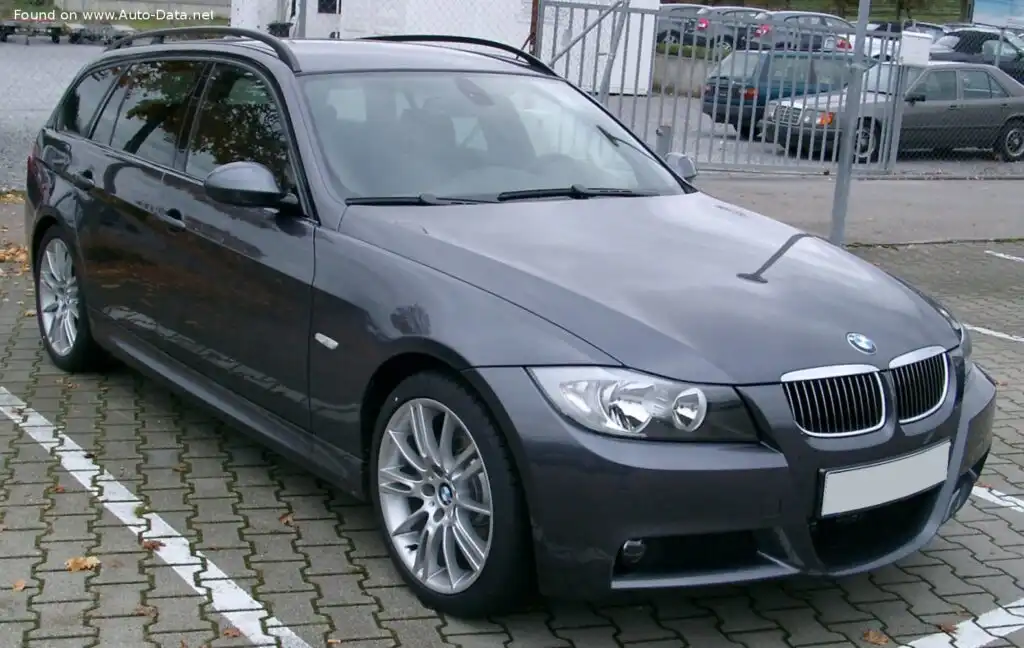
The BMW E91 320i Touring, produced between 2005 and 2007, served as BMW’s entry-level offering into the performance wagon segment during the E90/E91/E92/E93 3 Series generation. The E91 designation specifically identifies the Touring (wagon) body style. Powered by the naturally aspirated 2.0-liter N46B20 engine producing 150 horsepower, the 320i was positioned as the fuel-efficient and accessible option within the lineup, appealing to buyers who prioritized practicality and reasonable running costs over outright performance. This model found a strong foothold in the European market, where wagons have traditionally enjoyed greater popularity than in North America.
Powertrain & Engine Architecture
At the heart of the E91 320i Touring lies the N46B20B, a 2.0-liter inline-four cylinder engine. This naturally aspirated powerplant features double overhead camshafts (DOHC) and four valves per cylinder. BMW’s Double-VANOS variable valve timing system, applied to both intake and exhaust valves, optimizes engine performance and efficiency throughout the rev range. Fuel delivery is handled by a multi-port fuel injection system. The N46 engine is generally known for its smooth operation and respectable fuel economy, though it’s also recognized for potential issues with oil leaks and cooling system components as the engine ages. While a Getrag 220 six-speed manual gearbox was the standard transmission, this article focuses on the variant equipped with the optional six-speed automatic transmission (A5S390R). The automatic, while offering convenience, resulted in a slight decrease in acceleration and fuel economy compared to the manual counterpart.
Driving Characteristics
The 320i Touring with the automatic transmission provides a comfortable and refined driving experience. Delivering 150 horsepower and 147 lb-ft of torque, acceleration is sufficient for everyday driving needs, but it lacks the spirited performance of the 325i or 330i models. The automatic transmission incorporates adaptive shift programming, adjusting shift points based on the driver’s input. However, it can occasionally exhibit hesitation during quick overtaking maneuvers. The rear-wheel-drive layout contributes to balanced handling, a hallmark of BMW vehicles, but the relatively narrow 205/55 R16 tires limit grip during more aggressive driving. The suspension is tuned for comfort, effectively absorbing road imperfections and providing a pleasant ride quality, making it well-suited for long-distance travel. The automatic transmission’s gear ratios are geared towards fuel efficiency, resulting in a relaxed and comfortable cruising experience on the highway.
Equipment & Trim Levels
The 320i Touring typically came standard with features such as air conditioning, power windows, power mirrors, a basic audio system, and alloy wheels. Interior upholstery was generally cloth, with leather upholstery offered as an optional upgrade. A range of optional extras were available, including a sunroof, navigation system, upgraded audio system, heated seats, and parking sensors. Trim levels were relatively straightforward, with most features added individually. The 320i Touring aimed to strike a balance between affordability and comfort, offering a well-equipped vehicle without the higher price point of the more premium models.
Chassis & Braking
The E91 320i Touring utilizes a MacPherson strut front suspension and a multi-link rear suspension, providing a good compromise between ride comfort and handling. The braking system features ventilated disc brakes at the front and solid disc brakes at the rear, complemented by standard Anti-lock Braking System (ABS). The chassis is reinforced to accommodate the wagon body style, enhancing rigidity compared to the sedan version. Stabilizer bars are fitted to both the front and rear axles to minimize body roll during cornering. While generally robust, suspension bushings and shock absorbers may require replacement with increased mileage and age.
Market Reception & Comparison
The E91 320i Touring was generally well-received by automotive critics as a practical and efficient wagon. It was praised for its comfortable ride, spacious interior, and fuel economy. However, some reviewers noted that the 150-horsepower engine felt somewhat underpowered, particularly when the vehicle was fully loaded. Compared to the 325i and 330i Touring models, the 320i offered a more accessible entry point into the BMW wagon lineup, but at the cost of performance. The 320d (diesel) Touring was a popular alternative in Europe, offering even better fuel economy and comparable torque. In terms of reliability, the N46 engine is generally considered reliable, but potential oil leaks and cooling system issues should be addressed proactively during maintenance.
Legacy
Today, the E91 320i Touring represents an affordable entry point into BMW ownership. Models equipped with the automatic transmission are readily available on the used car market. While not the most performance-oriented variant in the E91 lineup, it delivers a practical and comfortable driving experience. The N46 engine, despite its age, is generally durable with proper maintenance. Common issues, such as oil leaks and cooling system problems, are well-documented and typically relatively inexpensive to repair. The E91 320i Touring continues to be a popular choice for buyers seeking a versatile and reliable wagon with the prestige of the BMW brand.