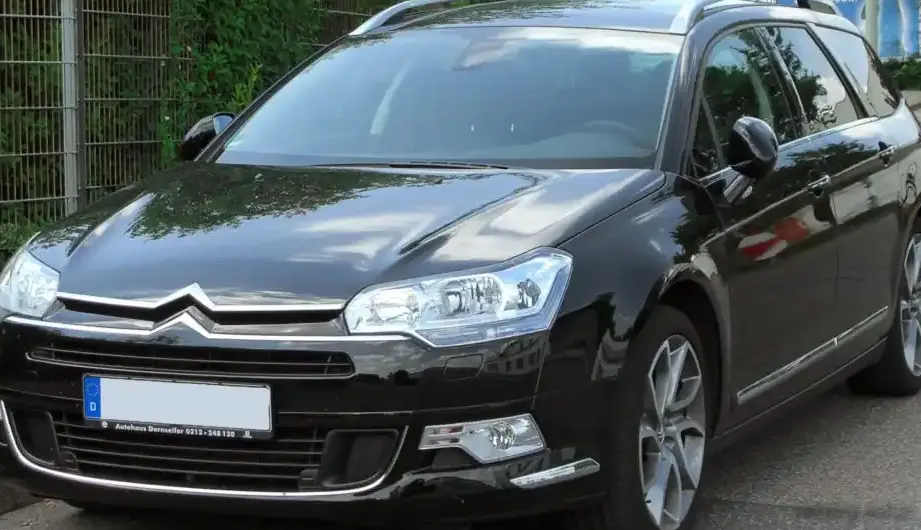
The Citroën C5 II Tourer 1.8 16V, produced between 2008 and 2009, represented a key variant within the second generation (X7) C5 range. Positioned as a mid-range offering in the Tourer (estate) body style, this model aimed to balance practicality, comfort, and affordability for European buyers. It was part of the Phase I refresh of the C5 II, building upon the platform first introduced in 2004. The C5 II, in general, was Citroën’s flagship vehicle, intended to compete with established players like the Ford Mondeo, Peugeot 407, and Volkswagen Passat, offering a distinctive blend of French comfort and technology.
Technical Specifications
| Brand | Citroen |
| Model | C5 |
| Generation | C5 II Tourer (Phase I, 2008) |
| Type (Engine) | 1.8 16V (125 Hp) |
| Start of production | 2008 |
| End of production | 2009 |
| Powertrain Architecture | Internal Combustion engine |
| Body type | Station wagon (estate) |
| Seats | 5 |
| Doors | 5 |
| Fuel consumption (urban) | 11.1 l/100 km (21.2 US mpg, 25.4 UK mpg, 9 km/l) |
| Fuel consumption (extra urban) | 6.3 l/100 km (37.3 US mpg, 44.8 UK mpg, 15.9 km/l) |
| Fuel consumption (combined) | 8.1 l/100 km (29 US mpg, 34.9 UK mpg, 12.3 km/l) |
| CO2 emissions | 192 g/km |
| Fuel Type | Petrol (Gasoline) |
| Acceleration 0 – 100 km/h | 12.8 sec |
| Acceleration 0 – 62 mph | 12.8 sec |
| Acceleration 0 – 60 mph | 12.2 sec |
| Maximum speed | 196 km/h (121.79 mph) |
| Emission standard | Euro 4 |
| Weight-to-power ratio | 12.4 kg/Hp, 80.7 Hp/tonne |
| Weight-to-torque ratio | 9.1 kg/Nm, 109.7 Nm/tonne |
| Power | 125 Hp @ 6000 rpm |
| Power per litre | 71.5 Hp/l |
| Torque | 170 Nm @ 3750 rpm (125.39 lb.-ft. @ 3750 rpm) |
| Engine layout | Front, Transverse |
| Engine Model/Code | 6FY EW7A |
| Engine displacement | 1749 cm3 (106.73 cu. in.) |
| Number of cylinders | 4 |
| Engine configuration | Inline |
| Cylinder Bore | 82.7 mm (3.26 in.) |
| Piston Stroke | 81.4 mm (3.2 in.) |
| Compression ratio | 11:1 |
| Number of valves per cylinder | 4 |
| Fuel injection system | Multi-port manifold injection |
| Engine aspiration | Naturally aspirated engine |
| Engine oil capacity | 5 l (5.28 US qt | 4.4 UK qt) |
| Coolant | 8.8 l (9.3 US qt | 7.74 UK qt) |
| Kerb Weight | 1549 kg (3414.96 lbs.) |
| Max. weight | 2154 kg (4748.76 lbs.) |
| Max load | 605 kg (1333.8 lbs.) |
| Trunk (boot) space – minimum | 505 l (17.83 cu. ft.) |
| Trunk (boot) space – maximum | 1462 l (51.63 cu. ft.) |
| Fuel tank capacity | 71 l (18.76 US gal | 15.62 UK gal) |
| Max. roof load | 80 kg (176.37 lbs.) |
| Permitted trailer load with brakes (12%) | 1300 kg (2866.01 lbs.) |
| Permitted trailer load without brakes | 750 kg (1653.47 lbs.) |
| Permitted towbar download | 64 kg (141.1 lbs.) |
| Length | 4829 mm (190.12 in.) |
| Width | 1860 mm (73.23 in.) |
| Width including mirrors | 2096 mm (82.52 in.) |
| Height | 1491-1495 mm (58.7 – 58.86 in.) |
| Wheelbase | 2815 mm (110.83 in.) |
| Front track | 1586 mm (62.44 in.) |
| Rear (Back) track | 1557 mm (61.3 in.) |
| Front overhang | 1054 mm (41.5 in.) |
| Rear overhang | 960 mm (37.8 in.) |
| Minimum turning circle | 11.7 m (38.39 ft.) |
| Drivetrain Architecture | The Internal combustion engine (ICE) drives the front wheels of the vehicle. |
| Drive wheel | Front wheel drive |
| Number of gears and type of gearbox | 5 gears, manual transmission |
| Front suspension | Double wishbone |
| Rear suspension | Independent multi-link suspension |
| Front brakes | Ventilated discs |
| Rear brakes | Disc |
| Assisting systems | ABS (Anti-lock braking system) |
| Steering type | Steering rack and pinion |
| Power steering | Hydraulic Steering |
| Tires size | 225/55 R17 |
| Wheel rims size | 17 |
Powertrain & Engine Architecture
The C5 II Tourer 1.8 16V utilized the 6FY (EW7A) engine, a 1.8-liter inline-four cylinder petrol engine. This engine was a common choice within the PSA Peugeot Citroën group, known for its relatively smooth operation and decent fuel economy. The ‘16V’ designation indicates the engine features four valves per cylinder, enhancing breathing and power output. Fuel delivery was managed by a multi-port fuel injection system, a standard technology for the time. The engine’s 125 horsepower peak was achieved at 6000 rpm, while its 170 Nm (125 lb-ft) of torque was available at 3750 rpm. The engine featured a compression ratio of 11:1. The transmission paired with this engine was typically a 5-speed manual gearbox, although a 4-speed automatic transmission was also offered, impacting performance and fuel economy.
Driving Characteristics
The 1.8 16V engine, when coupled with the 5-speed manual transmission, provided adequate performance for everyday driving. Acceleration from 0-60 mph took around 12.2 seconds, and top speed was approximately 121.79 mph. However, it wasn’t a particularly sporty engine. The power delivery was linear, but lacked the punch of the higher-output 2.0L or V6 options available in the C5 II range. The automatic transmission, while offering convenience, further dulled performance and increased fuel consumption. The C5 II’s renowned comfort-focused suspension, featuring a double wishbone front and multi-link rear setup, provided a smooth and controlled ride, even with the relatively modest power output of this engine.
Equipment & Trim Levels
The 1.8 16V Tourer typically came equipped with a reasonable level of standard features. These included air conditioning, power windows, central locking, and an RDS stereo system. Higher trim levels, such as Exclusive, added features like alloy wheels, automatic headlights and wipers, a trip computer, and upgraded interior trim. Interior upholstery was generally cloth, with options for leather available on higher-spec models. Safety features included ABS brakes, front airbags, and side airbags.
Chassis & Braking
The C5 II Tourer featured a front-wheel-drive layout. The suspension system, as mentioned, prioritized comfort, with a focus on absorbing road imperfections. The front brakes were ventilated discs, providing good stopping power, while the rear brakes were solid discs. The steering was hydraulic power-assisted rack and pinion, offering a reasonably direct feel. The car’s weight of approximately 1549 kg (3415 lbs) contributed to its stable handling characteristics, but also impacted acceleration and fuel economy.
Market Reception & Comparison
The C5 II Tourer 1.8 16V was generally well-received as a practical and comfortable family car. Critics praised its spacious interior, comfortable ride, and good fuel economy (for its class). However, it was often criticized for its lack of outright performance compared to some of its rivals. Compared to the 2.0L petrol or 2.2L diesel versions, the 1.8L felt underpowered, especially when fully loaded. The diesel models offered significantly better fuel economy and torque, making them a popular choice for long-distance drivers. The 1.8L variant was positioned as the entry-level engine option, appealing to buyers who prioritized affordability and comfort over performance.
Legacy
The 6FY (EW7A) 1.8L engine, while not known for being exceptionally robust, proved to be reasonably reliable in the C5 II. Common issues included occasional problems with the throttle body and ignition coils. The automatic transmission, in particular, required regular servicing to prevent issues. Today, the C5 II Tourer 1.8 16V can be found on the used car market at relatively affordable prices. It remains a viable option for buyers seeking a spacious, comfortable, and practical estate car, provided they are aware of the potential maintenance requirements and the engine’s limitations in terms of performance.