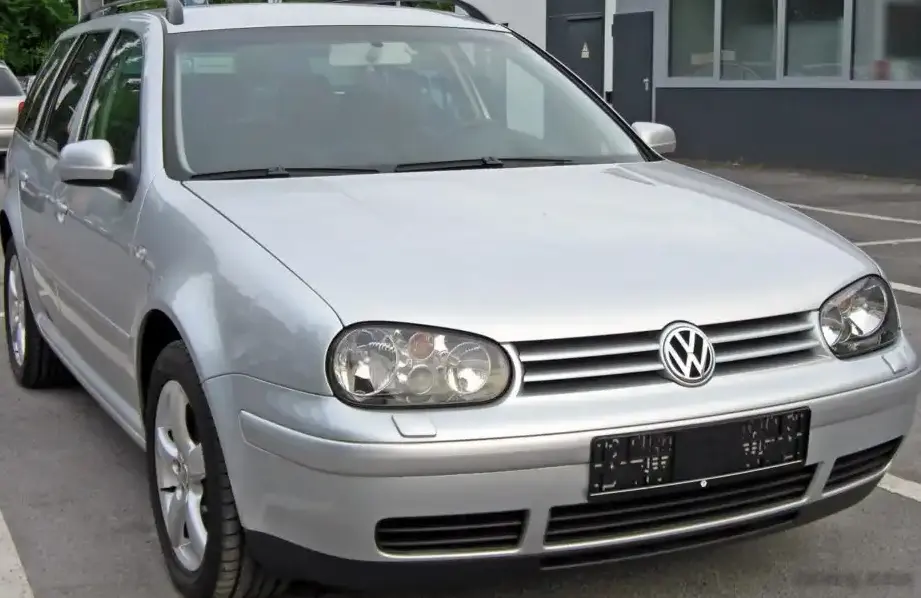
The Volkswagen Golf IV Variant 2.0, equipped with a 116 horsepower engine and automatic transmission, was a key offering in the Golf IV range between 1999 and 2001. Positioned as a practical and comfortable family vehicle, it represented a middle-ground option within the Variant (estate) lineup, slotting between the more economical 1.6-liter models and the performance-oriented 1.8 Turbo and VR6 variants. Built on the Volkswagen Group’s A4 (or 1HX0) platform, shared with models like the Audi A3, SEAT Leon, and Škoda Octavia, the Golf IV Variant 2.0 Automatic aimed to provide a balance of space, usability, and reasonable performance for European buyers.
Technical Specifications
| Brand | Volkswagen |
| Model | Golf |
| Generation | Golf IV Variant |
| Type (Engine) | 2.0 (116 Hp) Automatic |
| Start of production | April, 1999 |
| End of production | April, 2001 |
| Powertrain Architecture | Internal Combustion engine |
| Body type | Station wagon (estate) |
| Seats | 5 |
| Doors | 5 |
| Fuel consumption (urban) | 13.7 l/100 km (17.2 US mpg, 20.6 UK mpg, 7.3 km/l) |
| Fuel consumption (extra urban) | 7 l/100 km (33.6 US mpg, 40.4 UK mpg, 14.3 km/l) |
| Fuel Type | Petrol (Gasoline) |
| Acceleration 0 – 100 km/h | 12.3 sec |
| Acceleration 0 – 62 mph | 12.3 sec |
| Acceleration 0 – 60 mph | 11.7 sec |
| Maximum speed | 190 km/h (118.06 mph) |
| Weight-to-power ratio | 11.1 kg/Hp, 90.3 Hp/tonne |
| Weight-to-torque ratio | 7.7 kg/Nm, 129.2 Nm/tonne |
| Power | 116 Hp @ 5400 rpm |
| Power per litre | 58.5 Hp/l |
| Torque | 166 Nm @ 3600 rpm (122.44 lb.-ft. @ 3600 rpm) |
| Engine layout | Front, Transverse |
| Engine Model/Code | APK, AQY, AZJ |
| Engine displacement | 1984 cm3 (121.07 cu. in.) |
| Number of cylinders | 4 |
| Engine configuration | Inline |
| Cylinder Bore | 82.5 mm (3.25 in.) |
| Piston Stroke | 92.8 mm (3.65 in.) |
| Compression ratio | 10:1 |
| Number of valves per cylinder | 2 |
| Fuel injection system | Multi-port manifold injection |
| Engine aspiration | Naturally aspirated engine |
| Valvetrain | OHC |
| Engine oil capacity | 4 l (4.23 US qt | 3.52 UK qt) |
| Coolant | 5 l (5.28 US qt | 4.4 UK qt) |
| Kerb Weight | 1285 kg (2832.94 lbs.) |
| Max. weight | 1810 kg (3990.37 lbs.) |
| Max load | 525 kg (1157.43 lbs.) |
| Trunk (boot) space – minimum | 460 l (16.24 cu. ft.) |
| Trunk (boot) space – maximum | 1470 l (51.91 cu. ft.) |
| Fuel tank capacity | 55 l (14.53 US gal | 12.1 UK gal) |
| Length | 4397 mm (173.11 in.) |
| Width | 1735 mm (68.31 in.) |
| Height | 1485 mm (58.46 in.) |
| Wheelbase | 2515 mm (99.02 in.) |
| Front track | 1513 mm (59.57 in.) |
| Rear (Back) track | 1494 mm (58.82 in.) |
| Drivetrain Architecture | The Internal combustion engine (ICE) drives the front wheels of the vehicle. |
| Drive wheel | Front wheel drive |
| Number of gears and type of gearbox | 4 gears, automatic transmission |
| Front suspension | Coil spring |
| Rear suspension | Suspension with traction connecting levers |
| Front brakes | Disc |
| Rear brakes | Disc |
| Assisting systems | ABS (Anti-lock braking system) |
| Steering type | Steering rack and pinion |
| Power steering | Hydraulic Steering |
| Tires size | 195/65R15 |
| Wheel rims size | 6J x 15 |
Powertrain & Engine Architecture
The Golf IV Variant 2.0 Automatic utilized engines from the Volkswagen Group’s EA827 family. Engine codes commonly found in this variant include APK, AQY, and AZJ. These are 1.8 and 2.0-liter inline-four cylinder engines featuring multi-point fuel injection and a single overhead camshaft (SOHC) valvetrain. The 2.0-liter engine produced 116 horsepower at 5400 rpm and 166 Nm (122.44 lb-ft) of torque at 3600 rpm. The automatic transmission was typically a four-speed unit, designed for smooth operation and ease of use. While not particularly sporty, this transmission was well-suited to the engine’s torque curve, providing adequate acceleration for everyday driving. The engine’s design prioritized reliability and fuel efficiency over outright performance.
Driving Characteristics
The 2.0-liter engine with the four-speed automatic transmission delivered a comfortable, if not exhilarating, driving experience. Acceleration from 0 to 60 mph took around 11.7 seconds, and top speed was approximately 118 mph. Compared to the manual transmission versions of the same engine, the automatic suffered a slight performance penalty due to the transmission’s inherent efficiency losses. However, the automatic offered a more relaxed driving experience, particularly in urban traffic. The gear ratios were optimized for fuel economy and smooth cruising, rather than aggressive acceleration. Compared to the more powerful 1.8 Turbo or VR6 models, the 2.0 Automatic felt noticeably slower, but it provided a more affordable and economical alternative.
Equipment & Trim Levels
The Golf IV Variant 2.0 Automatic typically came equipped with features such as central locking, electric front windows, power steering, and an ABS anti-lock braking system. Interior upholstery was usually cloth, with options for upgraded materials available. Depending on the market and optional packages, features like air conditioning, alloy wheels, a CD stereo, and heated mirrors could be added. The trim level often dictated the level of standard equipment, with higher trims offering more luxurious appointments. The Golf IV Variant 2.0 Automatic was generally positioned as a mid-range offering, providing a good balance of features and affordability.
Chassis & Braking
The Golf IV Variant 2.0 Automatic featured a MacPherson strut front suspension and a multi-link rear suspension, providing a comfortable and controlled ride. Front and rear disc brakes were standard, offering adequate stopping power for the vehicle’s weight and performance. The ABS system helped to maintain stability during hard braking. The suspension was tuned for comfort, prioritizing ride quality over sporty handling. Stabilizer bars were fitted to both the front and rear axles to reduce body roll during cornering. The chassis was designed to provide a stable and predictable driving experience, making it suitable for a wide range of drivers.
Market Reception & Comparison
The Golf IV Variant 2.0 Automatic was generally well-received by critics as a practical and versatile family vehicle. It offered a good amount of space, comfortable ride, and reasonable fuel economy. However, some reviewers noted that the automatic transmission could feel sluggish at times, and the engine lacked the punch of the more powerful variants. Compared to other estate cars in its class, the Golf IV Variant 2.0 Automatic offered a competitive combination of features, performance, and price. Fuel economy was respectable, averaging around 33.6 mpg on the extra-urban cycle. Reliability was generally good, although routine maintenance was essential to keep the engine and transmission in optimal condition.
Legacy
The Golf IV Variant 2.0 Automatic has proven to be a relatively reliable vehicle, with many examples still on the road today. The EA827 engine is known for its durability, although regular maintenance, including oil changes and timing belt replacements, is crucial. The four-speed automatic transmission is generally robust, but can be prone to wear and tear over time. In the used car market, the Golf IV Variant 2.0 Automatic represents a relatively affordable and practical option for buyers seeking a spacious and comfortable estate car. Its simple mechanical design and readily available parts make it relatively easy to maintain and repair, contributing to its enduring popularity.