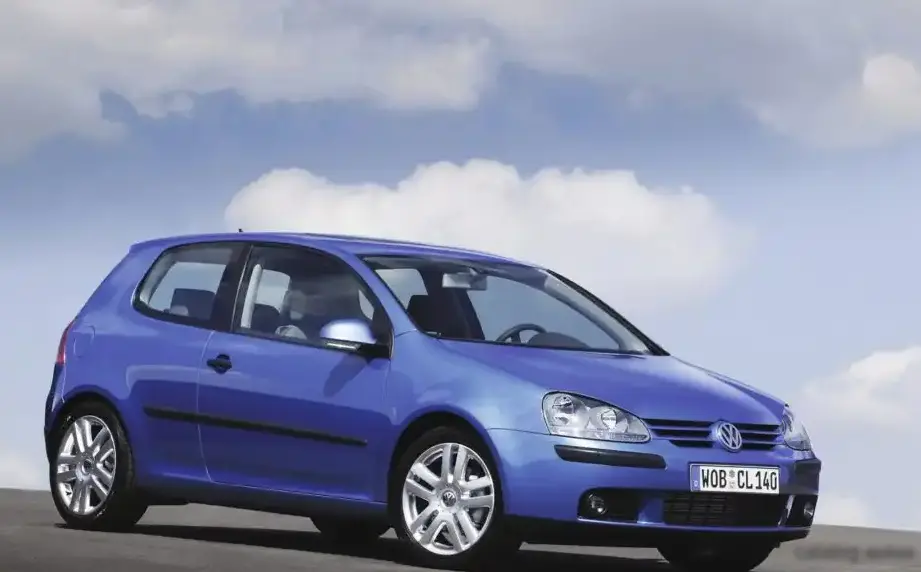
The Volkswagen Golf V, produced from 2003 to 2008, represented a significant evolution for Volkswagen’s iconic hatchback. The 3-door variant, in particular, catered to a market seeking a more sporty and compact option. Among the engine and transmission combinations offered, the 1.6 FSI (115 hp) paired with a 6-speed automatic transmission occupied a crucial mid-range position in many European markets. This configuration aimed to balance fuel efficiency with acceptable performance and convenience, appealing to buyers who prioritized ease of driving over outright speed. It was positioned below the more powerful 2.0 FSI and TDI diesel options, but above the base 1.4-liter models.
Technical Specifications
| Brand | Volkswagen |
| Model | Golf |
| Generation | Golf V (3-door) |
| Type (Engine) | 1.6 FSI (115 Hp) Automatic |
| Start of production | 2003 |
| End of production | 2008 |
| Powertrain Architecture | Internal Combustion engine |
| Body type | Hatchback |
| Seats | 5 |
| Doors | 3 |
| Fuel consumption (urban) | 10.2-10.4 l/100 km (23.1 – 22.6 US mpg, 27.7 – 27.2 UK mpg, 9.8 – 9.6 km/l) |
| Fuel consumption (extra urban) | 6.1-6.2 l/100 km (38.6 – 37.9 US mpg, 46.3 – 45.6 UK mpg, 16.4 – 16.1 km/l) |
| Fuel consumption (combined) | 7.6-7.7 l/100 km (30.9 – 30.5 US mpg, 37.2 – 36.7 UK mpg, 13.2 – 13 km/l) |
| CO2 emissions | 182-185 g/km |
| Fuel Type | Petrol (Gasoline) |
| Acceleration 0 – 100 km/h | 11.5 sec |
| Acceleration 0 – 62 mph | 11.5 sec |
| Acceleration 0 – 60 mph | 10.9 sec |
| Maximum speed | 189 km/h (117.44 mph) |
| Emission standard | Euro 4 |
| Weight-to-power ratio | 10.6 kg/Hp, 94 Hp/tonne |
| Weight-to-torque ratio | 7.9 kg/Nm, 126.7 Nm/tonne |
| Power | 115 Hp @ 6000 rpm |
| Power per litre | 72 Hp/l |
| Torque | 155 Nm @ 4000 rpm (114.32 lb.-ft. @ 4000 rpm) |
| Engine layout | Front, Transverse |
| Engine Model/Code | BAG, BLF, BLP |
| Engine displacement | 1598 cm3 (97.52 cu. in.) |
| Number of cylinders | 4 |
| Engine configuration | Inline |
| Cylinder Bore | 76.5 mm (3.01 in.) |
| Piston Stroke | 86.9 mm (3.42 in.) |
| Compression ratio | 12:1 |
| Number of valves per cylinder | 4 |
| Fuel injection system | Direct injection |
| Engine aspiration | Naturally aspirated engine |
| Valvetrain | DOHC |
| Engine oil capacity | 3.5 l (3.7 US qt | 3.08 UK qt) |
| Coolant capacity | 5.6 l (5.92 US qt | 4.93 UK qt) |
| Kerb Weight | 1223-1394 kg (2696.25 – 3073.24 lbs.) |
| Max. weight | 1800 kg (3968.32 lbs.) |
| Max load | 406-577 kg (895.08 – 1272.07 lbs.) |
| Trunk (boot) space – minimum | 350 l (12.36 cu. ft.) |
| Trunk (boot) space – maximum | 1305 l (46.09 cu. ft.) |
| Fuel tank capacity | 55 l (14.53 US gal | 12.1 UK gal) |
| Max. roof load | 75 kg (165.35 lbs.) |
| Permitted trailer load with brakes (8%) | 1500 kg (3306.93 lbs.) |
| Permitted trailer load with brakes (12%) | 1200 kg (2645.55 lbs.) |
| Permitted trailer load without brakes | 640 kg (1410.96 lbs.) |
| Permitted towbar download | 75 kg (165.35 lbs.) |
| Length | 4204 mm (165.51 in.) |
| Width | 1759 mm (69.25 in.) |
| Width including mirrors | 2010 mm (79.13 in.) |
| Height | 1485 mm (58.46 in.) |
| Wheelbase | 2578 mm (101.5 in.) |
| Front track | 1539 mm (60.59 in.) |
| Rear track | 1528 mm (60.16 in.) |
| Front overhang | 880 mm (34.65 in.) |
| Rear overhang | 746 mm (29.37 in.) |
| Minimum turning circle | 10.9 m (35.76 ft.) |
| Front suspension | Independent, type McPherson with coil spring and anti-roll bar |
| Rear suspension | Independent multi-link spring suspension with stabilizer |
| Front brakes | Ventilated discs |
| Rear brakes | Disc |
| Gearbox | 6 gears, automatic transmission |
| Drive wheel | Front wheel drive |
INTRODUCTION
The Volkswagen Golf V, launched in 2003, marked a departure from its predecessors with a more refined interior, improved build quality, and a focus on technological advancements. The 3-door version, specifically, was aimed at a younger demographic or those prioritizing a more compact and agile feel. The 1.6 FSI engine, coupled with a six-speed automatic transmission, was a popular choice in Europe, offering a balance between fuel economy and usability. This variant wasn’t about outright performance; it was about providing a comfortable and efficient driving experience for everyday use. It sat comfortably in the middle of the Golf V range, offering a step up from the base models while remaining more accessible than the higher-powered options.
Powertrain & Engine Architecture
The heart of this Golf V variant is the 1.6-liter inline-four cylinder engine, designated with engine codes BAG, BLF, or BLP depending on the specific production year and market. This engine utilizes Volkswagen’s FSI (Fuel Stratified Injection) technology, a direct injection system that improves fuel efficiency and power output compared to traditional port fuel injection. The FSI system injects fuel directly into the combustion chamber, allowing for more precise control of the air-fuel mixture and higher compression ratios. The engine features a double overhead camshaft (DOHC) valvetrain with four valves per cylinder, optimizing airflow for improved performance. The six-speed automatic transmission, typically the 6F24A, was chosen for its smooth shifting and efficiency. This transmission features a torque converter and electronic control, adapting to driving conditions for optimal performance.
Driving Characteristics
The 1.6 FSI automatic Golf V delivers a comfortable and predictable driving experience. With 115 horsepower and 155 Nm (114 lb-ft) of torque, acceleration is adequate for everyday driving, though not particularly brisk. The 0-60 mph time of around 10.9 seconds reflects this. The automatic transmission, while smooth, can feel somewhat hesitant during quick acceleration or overtaking maneuvers. The gear ratios are tuned for fuel efficiency, meaning the engine often operates at lower RPMs. Compared to the manual transmission version, the automatic sacrifices some responsiveness, but gains in convenience. Against the more powerful 2.0 FSI or TDI models, the 1.6 FSI automatic feels noticeably slower, but it offers a more relaxed and fuel-efficient driving experience.
Equipment & Trim Levels
The 1.6 FSI automatic Golf V typically came equipped with a reasonable level of standard features. These included power windows, central locking, air conditioning, and an audio system. Interior upholstery was usually cloth, with options for upgraded materials available. Depending on the market and optional packages, features like alloy wheels, a multi-function steering wheel, and a trip computer could be added. Higher trim levels, such as Trendline or Comfortline, offered additional features like automatic climate control, rain-sensing wipers, and a more sophisticated audio system. Safety features included ABS brakes, front airbags, and side airbags.
Chassis & Braking
The Golf V’s chassis utilizes an independent McPherson strut suspension at the front and an independent multi-link suspension at the rear, providing a comfortable ride and good handling characteristics. The 1.6 FSI automatic models typically featured smaller wheels and tires (15-17 inch) compared to the higher-performance variants. Braking duties are handled by ventilated discs at the front and solid discs at the rear. ABS (Anti-lock Braking System) is standard, enhancing braking performance and stability. Stabilizer bars are fitted to both the front and rear axles to reduce body roll during cornering.
Market Reception & Comparison
The 1.6 FSI automatic Golf V was generally well-received by critics as a practical and efficient option. It was praised for its comfortable ride, refined interior, and fuel economy. However, some reviewers noted the engine’s lack of outright power and the automatic transmission’s occasional hesitation. Compared to the 2.0 FSI, the 1.6 FSI offered better fuel economy but significantly less performance. The TDI diesel models provided even better fuel economy and more torque, but at a higher initial cost. In terms of reliability, the 1.6 FSI engine is generally considered to be fairly robust, although issues with the FSI injectors have been reported in some cases.
Legacy
The 1.6 FSI automatic Golf V remains a relatively common sight on used car markets today. Its reputation for reliability and fuel efficiency makes it an attractive option for budget-conscious buyers. While not a performance icon, it represents a well-rounded and practical hatchback that offered a comfortable and convenient driving experience. The FSI engine, while occasionally prone to injector issues, proved to be a significant step forward in terms of fuel efficiency and power delivery. The Golf V, as a whole, solidified the Golf’s position as a benchmark in the compact hatchback segment, and the 1.6 FSI automatic variant played a key role in its success.