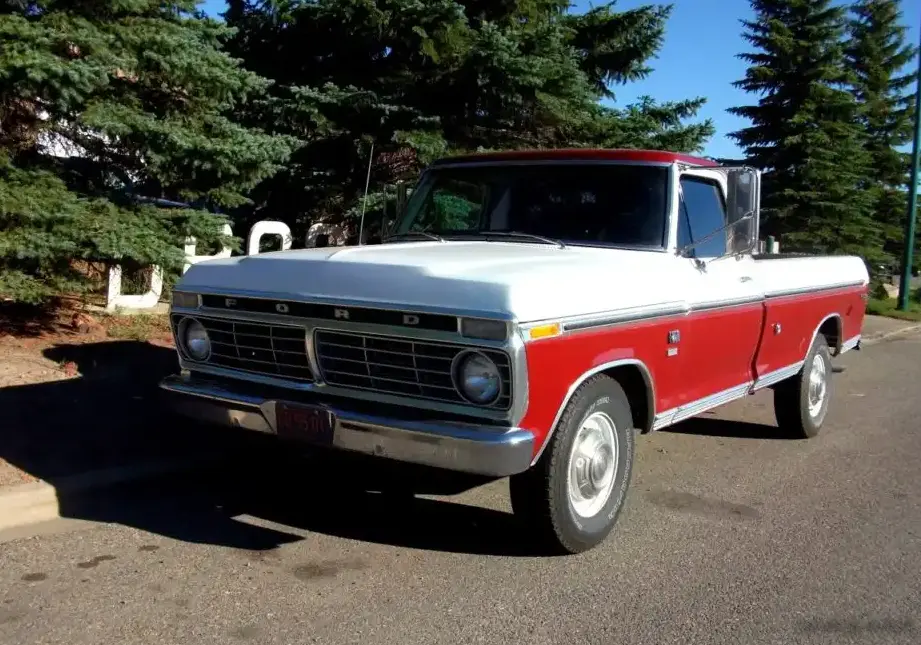
The Ford F-Series F-250 VI Regular Cab, equipped with the 5.9-liter (360 cubic inch) 360 V8 engine producing 145 horsepower and paired with a four-wheel drive system and automatic transmission, represents a significant workhorse offering from Ford during the 1972-1976 model years. This iteration falls within the sixth generation (1973-1979) of the F-Series, a lineage that began in 1948 and has consistently been America’s best-selling truck. The F-250, positioned between the lighter-duty F-100 and the heavier-duty F-350, was designed for buyers needing substantial towing and hauling capacity without the bulk of the F-350. This particular configuration, with its relatively modest horsepower for the era, aimed for a balance between capability and affordability.
Technical Specifications
| Brand | Ford |
| Model | F-Series F-250 |
| Generation | F-Series F-250 VI Regular Cab |
| Type (Engine) | 5.9 360 V8 (145 Hp) 4×4 Automatic |
| Start of production | December, 1972 |
| End of production | 1976 |
| Powertrain Architecture | Internal Combustion engine |
| Body type | Pick-up |
| Seats | 3 |
| Doors | 2 |
| Fuel Type | Petrol (Gasoline) |
| Power | 145 Hp |
| Power per litre | 24.6 Hp/l |
| Engine displacement | 5899 cm3 |
| Engine displacement (cu. in.) | 359.98 cu. in. |
| Number of cylinders | 8 |
| Engine configuration | V-engine |
| Cylinder Bore | 102.87 mm (4.05 in.) |
| Piston Stroke | 88.9 mm (3.5 in.) |
| Fuel injection system | Carburettor |
| Engine aspiration | Naturally aspirated engine |
| Max. weight | 3493 kg (7700.75 lbs.) |
| Trunk (boot) space – minimum | 1852-2070 l (65.4 – 73.1 cu. ft.) |
| Length | 5215 mm (205.31 in.) |
| Wheelbase | 3378 mm (132.99 in.) |
| Wading depth | 681 mm (26.81 in.) |
| Drivetrain Architecture | The Internal combustion engine (ICE) drives the rear wheels permanently, and the front wheels are driven through an electrically or mechanically operated clutch if necessary. |
| Drive wheel | All wheel drive (4×4) |
| Number of gears and type of gearbox | automatic transmission Cruise-O-Matic |
| Front suspension | Independent coil spring |
| Rear suspension | Leaf spring |
| Front brakes | Disc |
| Rear brakes | Drum |
| Steering type | Worm-reduction unit |
| Power steering | Electric Steering |
| Tires size | 235/85 R16.5 |
| Wheel rims size | 6J x 16.5 |
Powertrain & Engine Architecture
The heart of this F-250 is Ford’s 360 cubic inch (5.9-liter) V8 engine. This engine, designated within Ford as the 360 Windsor family, was a mainstay of Ford’s truck and full-size car lineup for many years. The 145 horsepower output was achieved through a two-barrel carburetor, a relatively conservative setup compared to the four-barrel carburetors found on higher-performance versions. The engine featured a cast iron block and cylinder heads, and a hydraulic lifter camshaft for reduced maintenance. The engine’s longitudinal front-engine layout was standard for Ford trucks of this era. The Cruise-O-Matic automatic transmission, a three-speed unit, was the sole transmission option for this configuration. It was known for its durability, but not for its performance. The 4×4 system employed a transfer case allowing the driver to switch between two-wheel drive and four-wheel drive, with a low-range gear for increased torque in challenging off-road conditions.
Driving Characteristics
The 145 horsepower and automatic transmission combination resulted in a truck that prioritized usability over outright speed. Acceleration was modest, and the truck felt most comfortable cruising at highway speeds. The automatic transmission’s gear ratios were geared towards torque multiplication, making it suitable for towing and hauling, but less responsive for quick acceleration. Compared to the optional 390 cubic inch V8, or even the six-cylinder engines available, this 360 V8 automatic felt noticeably slower. However, the automatic transmission made it easier to drive in stop-and-go traffic, a significant advantage for many buyers. The 4×4 system provided enhanced traction in slippery conditions, but also added weight and complexity.
Equipment & Trim Levels
The F-250 Regular Cab was offered in a variety of trim levels, ranging from basic work trucks to more comfortable models. The base trim typically included a vinyl bench seat, basic instrumentation, and minimal exterior trim. Optional extras included a radio, heater, air conditioning, and upgraded interior materials. The F-250 could be equipped with a variety of bed configurations, including a standard pickup bed, a platform stake bed, or a camper shell. Power steering was often an optional extra, as was power brakes. The interior was functional and durable, designed to withstand the rigors of daily use.
Chassis & Braking
The F-250’s chassis was a traditional body-on-frame construction, providing a robust and durable platform. The front suspension utilized independent coil springs, offering a relatively comfortable ride for a truck of this era. The rear suspension employed leaf springs, which were well-suited for carrying heavy loads. The braking system featured disc brakes on the front wheels and drum brakes on the rear wheels. While adequate for the truck’s weight, the braking performance was not particularly strong by modern standards. The steering system utilized a worm-reduction unit, which provided a solid feel but required significant effort, especially at low speeds. Power steering, when equipped, reduced steering effort considerably.
Market Reception & Comparison
The F-250 with the 360 V8 and automatic transmission was viewed as a practical and reliable work truck. Critics generally praised its durability and towing capacity, but noted its lack of performance. Compared to the more powerful 390 V8, this configuration was considered a more economical option, both in terms of initial cost and fuel consumption. However, the 390 V8 offered significantly more power and was preferred by buyers who frequently towed heavy loads. The 360 V8 automatic was a popular choice for buyers who prioritized ease of use and affordability over outright performance. Fuel economy, even for the early 1970s, was relatively poor, averaging around 10-12 miles per gallon.
Legacy
The Ford F-Series F-250 from this era has developed a strong following among classic truck enthusiasts. The 360 V8 engine, while not the most powerful option, is known for its reliability and relative simplicity. Parts availability is generally good, making it relatively easy to maintain and repair. These trucks are often sought after for restoration projects or as daily drivers. The combination of a durable powertrain, a robust chassis, and a classic design has ensured that the F-250 remains a popular choice among truck enthusiasts today. While not a high-performance machine, the 1972-1976 F-250 360 V8 automatic represents a solid and dependable work truck that has stood the test of time.