
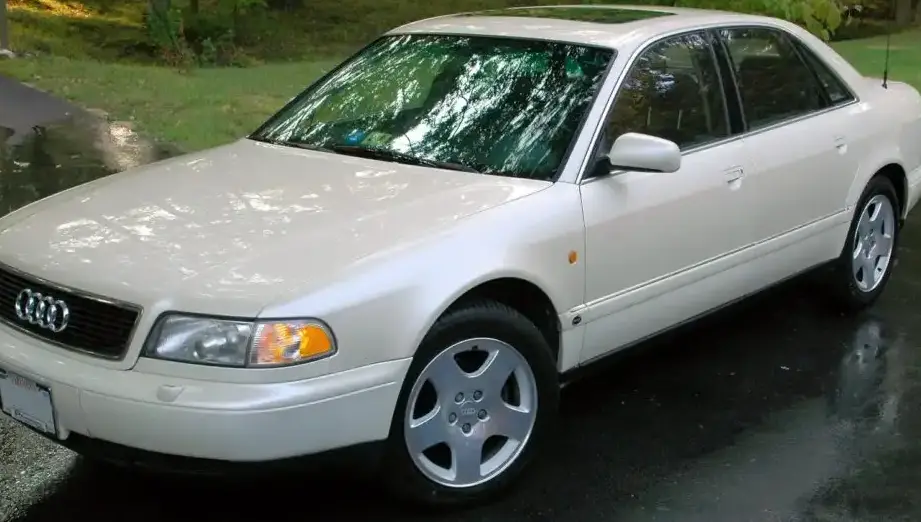
The Audi A8 (D2) 2.5 TDI V6 tiptronic, produced from 1997 to 1998, represented a compelling blend of luxury and diesel efficiency within the flagship A8 range. Positioned as a mid-range offering, it slotted between the more powerful petrol V6 and V8 models, and the higher-output TDI variants. This variant was primarily aimed at European markets where diesel engines were favored for their fuel economy and torque, offering a sophisticated grand touring experience with a focus on comfortable long-distance driving. It was built on the Audi D2 platform (4D chassis code), which also underpinned the first generation Volkswagen Phaeton.
Technical Specifications
| Brand | Audi |
| Model | A8 |
| Generation | A8 (D2, 4D) |
| Type (Engine) | 2.5 TDI V6 (150 Hp) tiptronic |
| Start of production | 1997 |
| End of production | 1998 |
| Powertrain Architecture | Internal Combustion engine |
| Body type | Sedan |
| Seats | 5 |
| Doors | 4 |
| Fuel consumption (economy) – urban (NEDC) | 11.6 l/100 km (20.3 US mpg, 24.4 UK mpg, 8.6 km/l) |
| Fuel consumption (economy) – extra urban (NEDC) | 6.2 l/100 km (37.9 US mpg, 45.6 UK mpg, 16.1 km/l) |
| Fuel consumption (economy) – combined (NEDC) | 8.2 l/100 km (28.7 US mpg, 34.4 UK mpg, 12.2 km/l) |
| CO2 emissions (NEDC) | 221 g/km |
| Fuel Type | Diesel |
| Acceleration 0 – 100 km/h | 11 sec |
| Acceleration 0 – 62 mph | 11 sec |
| Acceleration 0 – 60 mph | 10.5 sec |
| Maximum speed | 214 km/h (132.97 mph) |
| Emission standard | Euro 2 |
| Weight-to-power ratio | 10.8 kg/Hp, 92.3 Hp/tonne |
| Weight-to-torque ratio | 5.2 kg/Nm, 190.8 Nm/tonne |
| Power | 150 Hp @ 4000 rpm |
| Power per litre | 60.1 Hp/l |
| Torque | 310 Nm @ 1500-3200 rpm (228.64 lb.-ft. @ 1500-3200 rpm) |
| Engine layout | Front, Longitudinal |
| Engine Model/Code | AFB |
| Engine displacement | 2496 cm3 (152.32 cu. in.) |
| Number of cylinders | 6 |
| Engine configuration | V-engine |
| Cylinder Bore | 78.3 mm (3.08 in.) |
| Piston Stroke | 86.4 mm (3.4 in.) |
| Compression ratio | 19.5:1 |
| Number of valves per cylinder | 4 |
| Fuel injection system | Direct injection |
| Engine aspiration | Turbocharger, Intercooler |
| Valvetrain | DOHC |
| Engine oil capacity | 6 l (6.34 US qt | 5.28 UK qt) |
| Coolant | 10 l (10.57 US qt | 8.8 UK qt) |
| Kerb Weight | 1625 kg (3582.51 lbs.) |
| Max. weight | 2225 kg (4905.29 lbs.) |
| Max load | 600 kg (1322.77 lbs.) |
| Trunk (boot) space – minimum | 525 l (18.54 cu. ft.) |
| Fuel tank capacity | 90 l (23.78 US gal | 19.8 UK gal) |
| Max. roof load | 100 kg (220.46 lbs.) |
| Permitted trailer load with brakes (8%) | 2100 kg (4629.71 lbs.) |
| Permitted trailer load with brakes (12%) | 2100 kg (4629.71 lbs.) |
| Permitted trailer load without brakes | 750 kg (1653.47 lbs.) |
| Permitted towbar download | 95 kg (209.44 lbs.) |
| Length | 5034 mm (198.19 in.) |
| Width | 1880 mm (74.02 in.) |
| Width including mirrors | 1973 mm (77.68 in.) |
| Height | 1440 mm (56.69 in.) |
| Wheelbase | 2882 mm (113.46 in.) |
| Front track | 1597 mm (62.87 in.) |
| Rear (Back) track | 1586 mm (62.44 in.) |
| Drag coefficient (Cd) | 0.29 |
| Minimum turning circle (turning diameter) | 12.25 m (40.19 ft.) |
| Drivetrain Architecture | The Internal combustion engine (ICE) drives the front wheels of the vehicle. |
| Drive wheel | Front wheel drive |
| Number of gears and type of gearbox | 5 gears, automatic transmission tiptronic |
| Front suspension | Independent multi-link suspension, Transverse stabilizer |
| Rear suspension | Independent on trapezoidal lever, Transverse stabilizer |
| Front brakes | Ventilated discs |
| Rear brakes | Ventilated discs |
| Assisting systems | ABS (Anti-lock braking system) |
| Steering type | Steering rack and pinion |
| Power steering | Hydraulic Steering |
| Tires size | 225/60 R16 |
| Wheel rims size | 7J x 16 |
Powertrain & Engine Architecture
The heart of the A8 2.5 TDI was the AFB engine code, a 2.5-liter V6 diesel engine. This engine utilized a direct injection system, a key technology for improving fuel efficiency and reducing emissions. The direct injection system, coupled with a turbocharger and intercooler, allowed for a good balance of power and torque. The engine featured a double overhead camshaft (DOHC) valvetrain operating four valves per cylinder. The ‘tiptronic’ transmission was a 5-speed automatic gearbox offering both fully automatic operation and a manual shift mode, providing drivers with greater control. This transmission was known for its smooth shifts, but could sometimes feel slightly hesitant compared to more modern automatics.
Driving Characteristics
The 150 hp and 310 Nm (228.64 lb-ft) of torque delivered by the 2.5 TDI engine provided adequate, though not exhilarating, performance. Acceleration from 0-60 mph took around 10.5 seconds, and top speed was rated at 214 km/h (132.97 mph). The engine’s strength lay in its mid-range torque, making it well-suited for effortless cruising and overtaking on highways. Compared to the more powerful V6 and V8 petrol variants, the 2.5 TDI felt noticeably slower, especially during quick acceleration. However, it offered significantly better fuel economy. The tiptronic transmission, while smooth, didn’t offer the responsiveness of a manual gearbox, and could sometimes hunt for gears on inclines.
Equipment & Trim Levels
The A8 2.5 TDI tiptronic typically came well-equipped, reflecting its status as a luxury vehicle. Standard features included leather upholstery, automatic climate control, power-adjustable front seats, and an upgraded audio system. Optional extras included a sunroof, navigation system, and upgraded wood trim. The interior design was characterized by a clean, understated elegance, typical of Audi’s design philosophy at the time. Trim levels were relatively limited, with most variations stemming from the addition of optional packages.
Chassis & Braking
The A8 (D2) featured an independent suspension system on all four wheels, providing a comfortable ride. The front suspension utilized a multi-link setup, while the rear employed a trapezoidal lever design. Both axles were equipped with a transverse stabilizer bar to reduce body roll. Braking duties were handled by ventilated discs on all four wheels, coupled with an Anti-lock Braking System (ABS). The suspension was tuned for comfort rather than outright sportiness, prioritizing a smooth and refined driving experience.
Market Reception & Comparison
The A8 2.5 TDI tiptronic was generally well-received by automotive critics, who praised its fuel efficiency, comfortable ride, and luxurious interior. However, some criticized its relatively modest performance compared to its petrol-powered siblings. Compared to the 2.8L V6 petrol version, the TDI offered significantly better fuel economy (around 8.2 l/100km vs 10.9 l/100km) but slower acceleration. Against the more powerful 3.3 TDI, the 2.5 TDI was a more affordable option, but lacked the extra performance and refinement.
Legacy
The Audi A8 (D2) 2.5 TDI tiptronic, while not the most powerful variant, proved to be a reliable and durable vehicle. The AFB engine, when properly maintained, is known for its longevity. Today, these cars are relatively rare, and well-maintained examples are sought after by enthusiasts. Common issues include wear and tear on the tiptronic transmission and potential problems with the fuel injection system. However, with regular servicing, these cars can continue to provide comfortable and economical transportation for years to come. The A8 D2 laid the groundwork for Audi’s continued success in the luxury car segment, establishing a reputation for quality, innovation, and understated elegance.
