
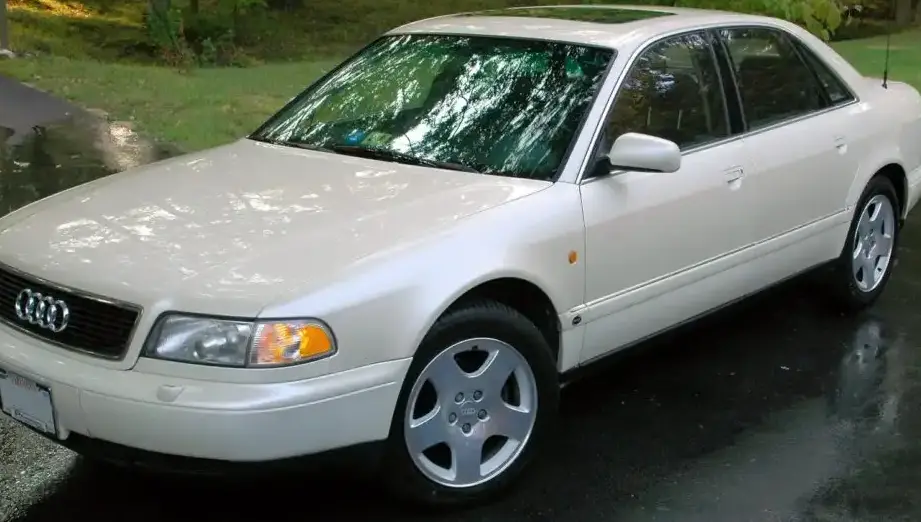
The Audi A8 (D2) 2.8 V6 12V, produced between 1994 and 1996, represents an important iteration of Audi’s flagship luxury sedan. Positioned as a mid-range offering within the D2 A8 lineup – which spanned from the 2.6L inline-six to the potent 4.2L V8 – this variant aimed to balance performance, refinement, and affordability. It was a key model in establishing the A8 as a technologically advanced and comfortable grand tourer, competing with established rivals like the BMW 7 Series and Mercedes-Benz S-Class. The D2 generation, internally designated 4D, was a significant departure for Audi, being the first A8 and utilizing a space frame chassis construction for improved rigidity and reduced weight.
Technical Specifications
| Brand | Audi |
| Model | A8 |
| Generation | A8 (D2, 4D) |
| Type (Engine) | 2.8 V6 12V (174 Hp) |
| Start of production | 1994 |
| End of production | 1996 |
| Powertrain Architecture | Internal Combustion engine |
| Body type | Sedan |
| Seats | 5 |
| Doors | 4 |
| Fuel consumption (urban) | 12.8 l/100 km (18.4 US mpg, 22.1 UK mpg, 7.8 km/l) |
| Fuel consumption (extra urban) | 7.2 l/100 km (32.7 US mpg, 39.2 UK mpg, 13.9 km/l) |
| Fuel Type | Petrol (Gasoline) |
| Acceleration 0 – 100 km/h | 9.1 sec |
| Acceleration 0 – 62 mph | 9.1 sec |
| Acceleration 0 – 60 mph | 8.6 sec |
| Maximum speed | 228 km/h (141.67 mph) |
| Weight-to-power ratio | 8.4 kg/Hp, 119.2 Hp/tonne |
| Weight-to-torque ratio | 5.8 kg/Nm, 171.2 Nm/tonne |
| Power | 174 Hp @ 5500 rpm |
| Power per litre | 62.8 Hp/l |
| Torque | 250 Nm @ 3000 rpm (184.39 lb.-ft. @ 3000 rpm) |
| Engine layout | Front, Longitudinal |
| Engine Model/Code | AAH |
| Engine displacement | 2771 cm3 (169.1 cu. in.) |
| Number of cylinders | 6 |
| Engine configuration | V-engine |
| Cylinder Bore | 82.5 mm (3.25 in.) |
| Piston Stroke | 86.4 mm (3.4 in.) |
| Compression ratio | 10.3:1 |
| Number of valves per cylinder | 2 |
| Fuel injection system | Multi-port manifold injection |
| Engine aspiration | Naturally aspirated engine |
| Valvetrain | SOHC |
| Engine oil capacity | 5 l (5.28 US qt | 4.4 UK qt) |
| Coolant | 11 l (11.62 US qt | 9.68 UK qt) |
| Kerb Weight | 1460 kg (3218.75 lbs.) |
| Max. weight | 2060 kg (4541.52 lbs.) |
| Max load | 600 kg (1322.77 lbs.) |
| Trunk (boot) space – minimum | 525 l (18.54 cu. ft.) |
| Fuel tank capacity | 80 l (21.13 US gal | 17.6 UK gal) |
| Max. roof load | 100 kg (220.46 lbs.) |
| Permitted trailer load with brakes (8%) | 1900 kg (4188.78 lbs.) |
| Permitted trailer load with brakes (12%) | 1500 kg (3306.93 lbs.) |
| Permitted trailer load without brakes | 750 kg (1653.47 lbs.) |
| Permitted towbar download | 75 kg (165.35 lbs.) |
| Length | 5034 mm (198.19 in.) |
| Width | 1880 mm (74.02 in.) |
| Width including mirrors | 1973 mm (77.68 in.) |
| Height | 1440 mm (56.69 in.) |
| Wheelbase | 2882 mm (113.46 in.) |
| Front track | 1597 mm (62.87 in.) |
| Rear (Back) track | 1586 mm (62.44 in.) |
| Ride height (ground clearance) | 150 mm (5.91 in.) |
| Drag coefficient (Cd) | 0.28 |
| Minimum turning circle (turning diameter) | 12.3 m (40.35 ft.) |
| Drivetrain Architecture | The Internal combustion engine (ICE) drives the front wheels of the vehicle. |
| Drive wheel | Front wheel drive |
| Number of gears and type of gearbox | 5 gears, manual transmission |
| Front suspension | Independent multi-link suspension, Transverse stabilizer |
| Rear suspension | Independent on trapezoidal lever, Transverse stabilizer |
| Front brakes | Ventilated discs |
| Rear brakes | Disc |
| Assisting systems | ABS (Anti-lock braking system) |
| Steering type | Steering rack and pinion |
| Power steering | Hydraulic Steering |
| Tires size | 225/60 R16 |
| Wheel rims size | 7 J x 16 |
Powertrain & Engine Architecture
The heart of the A8 2.8 V6 was the AAH engine, a 2.8-liter naturally aspirated V6. This engine featured a 90-degree V-angle, contributing to a smoother running character. It utilized a single overhead camshaft (SOHC) design per cylinder bank, operating 12 valves (two per cylinder). Fuel delivery was managed by a Bosch Motronic multi-port fuel injection system, optimizing for both performance and fuel efficiency. The AAH engine was known for its relatively robust construction and decent power output for its displacement. The 5-speed manual transmission was the standard offering, providing a direct connection to the engine. While an automatic transmission was available, it impacted performance and fuel economy.
Driving Characteristics
The 174 horsepower and 184 lb-ft of torque offered by the 2.8 V6, coupled with the manual transmission, provided adequate, though not exhilarating, performance. Acceleration from 0-60 mph took around 8.6 seconds, and top speed was approximately 141 mph. The engine felt responsive in the mid-range, making it suitable for everyday driving and highway cruising. Compared to the higher-output 4.2L V8, the 2.8L felt noticeably less powerful, particularly during overtaking maneuvers. However, it offered a more balanced driving experience, with less weight over the front axle. The manual transmission allowed for greater driver control, while the automatic option, though convenient, resulted in a more subdued driving experience and slightly slower acceleration.
Equipment & Trim Levels
The A8 2.8 V6 typically came well-equipped, reflecting its luxury positioning. Standard features included leather upholstery, power-adjustable front seats, automatic climate control, and an upgraded audio system. Wood trim was commonly found throughout the interior, enhancing the sense of luxury. Optional extras included a sunroof, upgraded audio systems (often Bose), and parking sensors. The trim level was generally consistent across the 2.8 V6 models, with options being the primary way to personalize the vehicle. The interior design was understated and elegant, prioritizing comfort and functionality.
Chassis & Braking
The D2 A8’s defining feature was its aluminum space frame chassis, a revolutionary design at the time. This construction significantly reduced weight compared to traditional steel chassis, improving handling and fuel efficiency. The front suspension utilized an independent multi-link setup with a transverse stabilizer bar, while the rear employed an independent trapezoidal lever suspension, also with a stabilizer bar. Braking duties were handled by ventilated discs at the front and solid discs at the rear, assisted by an Anti-lock Braking System (ABS). The suspension provided a comfortable ride, absorbing bumps effectively while maintaining good body control.
Market Reception & Comparison
The A8 2.8 V6 was generally well-received by automotive critics. It was praised for its comfortable ride, refined interior, and advanced technology, particularly the aluminum space frame. However, some critics noted that the 2.8L engine lacked the outright performance of its larger displacement rivals. Compared to the 4.2L V8, the 2.8L offered better fuel economy (around 18.4 mpg city / 32.7 mpg highway) and a lower purchase price. The 2.6L inline-six was even more economical but offered significantly less power. The 2.8 V6 represented a sweet spot for buyers seeking a balance of luxury, performance, and affordability.
Legacy
The A8 2.8 V6 (AAH engine) has proven to be a relatively reliable powertrain, although age-related issues are common in used examples. The AAH engine is known for its durability, but regular maintenance is crucial. Potential issues include oil leaks, timing belt failure (requiring replacement every 60,000-90,000 miles), and sensor failures. The aluminum space frame, while innovative, can be expensive to repair in the event of significant damage. Today, the D2 A8 2.8 V6 represents an affordable entry point into the world of luxury sedans, offering a comfortable and refined driving experience for those willing to invest in its upkeep. It remains a respected example of early 2000s German engineering.
