
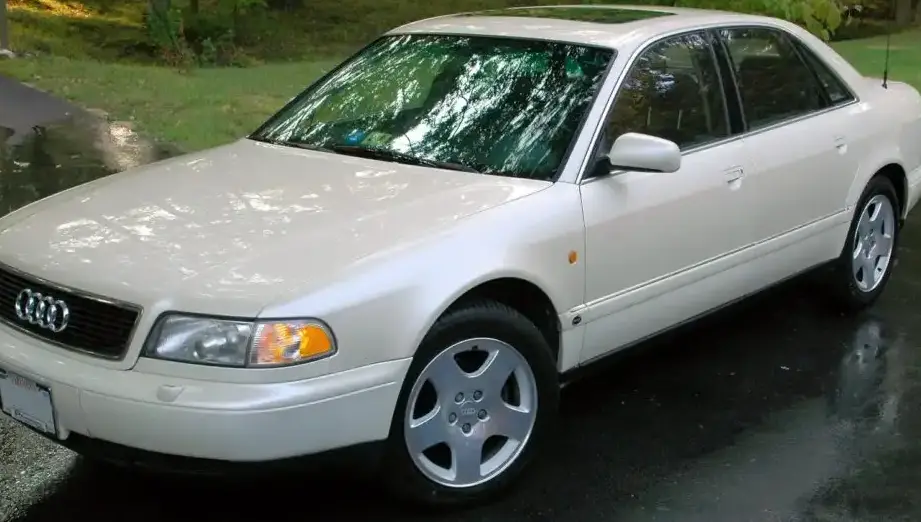
The Audi A8 (D2) 2.8 V6 quattro, produced between 1994 and 1996, represented a significant step forward for Audi’s flagship sedan. Part of the first generation (D2/4D) A8 range, this variant occupied a middle ground in the lineup, offering a balance between performance and affordability. It was positioned below the more powerful V8 models and above the entry-level 2.6L inline-six. The D2 A8 was notable for being the first Audi to feature the brand’s Torsen-based quattro all-wheel drive system as standard equipment, and for its use of aluminum construction in the front end to reduce weight. This model played a crucial role in establishing the A8 as a competitor to established luxury sedans from Mercedes-Benz and BMW in the North American and European markets.
Technical Specifications
| Brand | Audi |
| Model | A8 |
| Generation | A8 (D2, 4D) |
| Type (Engine) | 2.8 V6 12V (174 Hp) quattro |
| Start of production | 1994 |
| End of production | 1996 |
| Powertrain Architecture | Internal Combustion engine |
| Body type | Sedan |
| Seats | 5 |
| Doors | 4 |
| Fuel consumption (urban) | 13.9 l/100 km (16.9 US mpg) |
| Fuel consumption (extra urban) | 7.6 l/100 km (30.9 US mpg) |
| Fuel Type | Petrol (Gasoline) |
| Acceleration 0 – 100 km/h | 9.1 sec |
| Acceleration 0 – 62 mph | 9.1 sec |
| Acceleration 0 – 60 mph | 8.6 sec |
| Maximum speed | 228 km/h (141.67 mph) |
| Weight-to-power ratio | 8.7 kg/Hp |
| Weight-to-torque ratio | 6.1 kg/Nm |
| Power | 174 Hp @ 5500 rpm |
| Power per litre | 62.8 Hp/l |
| Torque | 250 Nm @ 3000 rpm (184.39 lb.-ft. @ 3000 rpm) |
| Engine layout | Front, Longitudinal |
| Engine Model/Code | AAH |
| Engine displacement | 2771 cm3 (169.1 cu. in.) |
| Number of cylinders | 6 |
| Engine configuration | V-engine |
| Cylinder Bore | 82.5 mm (3.25 in.) |
| Piston Stroke | 86.4 mm (3.4 in.) |
| Compression ratio | 10.3:1 |
| Number of valves per cylinder | 2 |
| Fuel injection system | Multi-port manifold injection |
| Engine aspiration | Naturally aspirated engine |
| Valvetrain | SOHC |
| Engine oil capacity | 5 l (5.28 US qt | 4.4 UK qt) |
| Coolant | 11 l (11.62 US qt | 9.68 UK qt) |
| Kerb Weight | 1520 kg (3351.03 lbs.) |
| Max. weight | 2120 kg (4673.8 lbs.) |
| Max load | 600 kg (1322.77 lbs.) |
| Trunk (boot) space – minimum | 525 l (18.54 cu. ft.) |
| Fuel tank capacity | 80 l (21.13 US gal | 17.6 UK gal) |
| Max. roof load | 100 kg (220.46 lbs.) |
| Permitted trailer load with brakes (8%) | 2050 kg (4519.48 lbs.) |
| Permitted trailer load with brakes (12%) | 1600 kg (3527.4 lbs.) |
| Permitted trailer load without brakes | 750 kg (1653.47 lbs.) |
| Permitted towbar download | 75 kg (165.35 lbs.) |
| Length | 5034 mm (198.19 in.) |
| Width | 1880 mm (74.02 in.) |
| Width including mirrors | 1973 mm (77.68 in.) |
| Height | 1440 mm (56.69 in.) |
| Wheelbase | 2882 mm (113.46 in.) |
| Front track | 1597 mm (62.87 in.) |
| Rear (Back) track | 1586 mm (62.44 in.) |
| Ride height (ground clearance) | 150 mm (5.91 in.) |
| Drag coefficient (Cd) | 0.28 |
| Minimum turning circle (turning diameter) | 12.4 m (40.68 ft.) |
| Drivetrain Architecture | The Internal combustion engine (ICE) drives permanently the four wheels of the vehicle. |
| Drive wheel | All wheel drive (4×4) |
| Number of gears and type of gearbox | 5 gears, manual transmission |
| Front suspension | Independent multi-link suspension, Transverse stabilizer |
| Rear suspension | Independent on trapezoidal lever, Transverse stabilizer |
| Front brakes | Ventilated discs |
| Rear brakes | Disc |
| Assisting systems | ABS (Anti-lock braking system) |
| Steering type | Steering rack and pinion |
| Power steering | Hydraulic Steering |
| Tires size | 225/60 R16 |
| Wheel rims size | 7J x 16 |
INTRODUCTION
The Audi A8 (D2) 2.8 V6 quattro, launched in 1994, was a key component of Audi’s strategy to compete in the full-size luxury sedan segment. This model year represented the initial phase of D2 production, before the introduction of more advanced engine options and technologies. The 2.8L V6, paired with Audi’s quattro all-wheel drive, offered a compelling combination of performance and all-weather capability. It was designed to appeal to buyers who desired the prestige of the A8 but didn’t require the higher price point of the V8 models. The D2 A8 platform, designated 4D, was revolutionary for its time, incorporating a space frame construction using aluminum to reduce weight and improve rigidity.
Powertrain & Engine Architecture
The heart of the A8 2.8 V6 quattro is the AAH engine, a 2.8-liter (2771 cc) naturally aspirated V6. This engine features a 90-degree V-angle, contributing to a smoother engine operation. It utilizes a single overhead camshaft (SOHC) design with two valves per cylinder. Fuel delivery is managed by a Bosch Motronic multi-port fuel injection system. The AAH engine produces 174 horsepower at 5500 rpm and 250 Nm (184 lb-ft) of torque at 3000 rpm. The engine’s longitudinal mounting and the standard quattro all-wheel drive system necessitate a transmission tunnel running the length of the vehicle. The transmission offered in this variant was a 5-speed manual. The quattro system employs a Torsen differential, which automatically distributes torque between the front and rear axles based on traction conditions. This system provides enhanced stability and grip, particularly in adverse weather.
Driving Characteristics
The A8 2.8 V6 quattro offered a refined and comfortable driving experience. While not overtly sporty, the 174 hp engine provided adequate power for everyday driving and highway cruising. Acceleration from 0 to 60 mph took approximately 8.6 seconds, and the car had a top speed of 141.67 mph. The quattro all-wheel drive system significantly enhanced handling and stability, especially on slippery surfaces. The 5-speed manual transmission allowed for a more engaging driving experience compared to the later available automatic options. The gear ratios were tuned for a balance between fuel efficiency and performance, with a relatively tall fifth gear for relaxed highway cruising. Compared to the more powerful V8 models, the 2.8L V6 felt less urgent in its acceleration, but it offered a more fuel-efficient and accessible entry point into the A8 range.
Equipment & Trim Levels
The A8 2.8 V6 quattro came reasonably well-equipped as standard. Interior features included cloth upholstery, power windows, power locks, and a basic audio system. Air conditioning was also standard. Optional extras included leather upholstery, a sunroof, upgraded audio systems, and wood trim. The dashboard layout was clean and functional, with a focus on ergonomics. Safety features included ABS anti-lock brakes and airbags. The trim level was generally consistent across the 2.8 V6 models, with options being the primary way to personalize the vehicle.
Chassis & Braking
The A8 D2 featured an independent suspension system on all four wheels. The front suspension utilized a multi-link design with a transverse stabilizer bar, while the rear suspension employed a trapezoidal lever setup, also with a stabilizer bar. This configuration provided a comfortable ride and good handling characteristics. Braking duties were handled by ventilated discs at the front and solid discs at the rear, coupled with the ABS anti-lock braking system. The chassis construction, utilizing aluminum in the front end, contributed to a relatively lightweight vehicle for its size, improving handling and fuel efficiency.
Market Reception & Comparison
The Audi A8 2.8 V6 quattro was generally well-received by automotive critics. It was praised for its comfortable ride, refined interior, and the security of the quattro all-wheel drive system. However, some critics noted that the 2.8L V6 engine lacked the outright performance of its competitors’ V8 offerings. Fuel economy was considered reasonable for a vehicle of its size and class. Compared to the A8 4.2 V8, the 2.8L model offered a lower purchase price and better fuel efficiency, but at the expense of performance. Compared to the later 2.6L inline-six models, the 2.8 V6 provided a noticeable increase in power and refinement.
Legacy
The Audi A8 (D2) 2.8 V6 quattro remains a sought-after classic among Audi enthusiasts. The AAH engine is generally considered reliable, although regular maintenance is essential. Common issues include oil leaks and sensor failures. The quattro all-wheel drive system is robust but requires periodic servicing. Today, these cars can be found in good condition, often with relatively low mileage. They represent a unique blend of luxury, performance, and technological innovation from the early 1990s. The D2 A8 established Audi as a serious contender in the luxury sedan market and paved the way for future generations of the A8.
