Technical Specifications
| Brand | Jaguar |
| Model | XF |
| Generation | XF (X260, facelift 2020) |
| Type (Engine) | 2.0i (300 Hp) AWD Automatic |
| Start of production | October, 2020 |
| End of production | 2024 |
| Powertrain Architecture | Internal Combustion engine |
| Body type | Sedan |
| Seats | 5 |
| Doors | 4 |
| Combined fuel consumption (WLTP) | 8.6-9.3 l/100 km (27.4 – 25.3 US mpg, 32.8 – 30.4 UK mpg, 11.6 – 10.8 km/l) |
| CO2 emissions (WLTP) | 193-211 g/km |
| Fuel Type | Petrol (Gasoline) |
| Acceleration 0 – 100 km/h | 6.1 sec |
| Acceleration 0 – 62 mph | 6.1 sec |
| Acceleration 0 – 60 mph | 5.8 sec |
| Maximum speed | 250 km/h (155.34 mph) |
| Emission standard | Euro 6d |
| Weight-to-power ratio | 5.8 kg/Hp, 172 Hp/tonne |
| Weight-to-torque ratio | 4.4 kg/Nm, 229.4 Nm/tonne |
| Power | 300 Hp @ 5500 rpm |
| Power per litre | 150.2 Hp/l |
| Torque | 400 Nm @ 1500-4500 rpm (295.02 lb.-ft. @ 1500-4500 rpm) |
| Engine layout | Front, Longitudinal |
| Engine Model/Code | Ingenium / PT204 |
| Engine displacement | 1997 cm3 (121.86 cu. in.) |
| Number of cylinders | 4 |
| Engine configuration | Inline |
| Cylinder Bore | 83 mm (3.27 in.) |
| Piston Stroke | 92.29 mm (3.63 in.) |
| Compression ratio | 9.5:1 |
| Number of valves per cylinder | 4 |
| Fuel injection system | Direct injection |
| Engine aspiration | Turbocharger, Intercooler |
| Engine oil capacity | 7 l (7.4 US qt | 6.16 UK qt) |
| Kerb Weight | 1744 kg (3844.86 lbs.) |
| Trunk (boot) space – minimum | 459 l (16.21 cu. ft.) |
| Trunk (boot) space – maximum | 1484 l (52.41 cu. ft.) |
| Fuel tank capacity | 74 l (19.55 US gal | 16.28 UK gal) |
| Permitted trailer load with brakes (12%) | 1900 kg (4188.78 lbs.) |
| Permitted trailer load without brakes | 750 kg (1653.47 lbs.) |
| Length | 4962 mm (195.35 in.) |
| Width with mirrors folded | 1982 mm (78.03 in.) |
| Width including mirrors | 2089 mm (82.24 in.) |
| Height | 1456 mm (57.32 in.) |
| Wheelbase | 2960 mm (116.54 in.) |
| Front track | 1602 mm (63.07 in.) |
| Rear (Back) track | 1605 mm (63.19 in.) |
| Front overhang | 847 mm (33.35 in.) |
| Rear overhang | 1155 mm (45.47 in.) |
| Drag coefficient (Cd) | 0.26 |
| Minimum turning circle (turning diameter) | 11.63 m (38.16 ft.) |
| Drivetrain Architecture | All wheel drive (4×4). ICE drives rear wheels, front wheels engaged via clutch. |
| Number of gears and type of gearbox | 8 gears, automatic transmission ZF |
| Front suspension | Double wishbone |
| Rear suspension | Independent coil spring |
| Front brakes | Ventilated discs, 350 mm |
| Rear brakes | Ventilated discs, 325 mm |
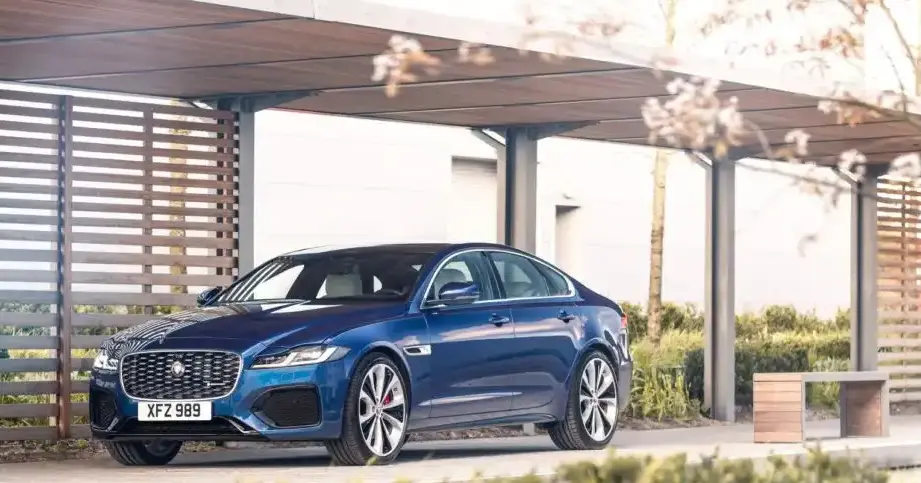
The Jaguar XF (X260) facelift, introduced in October 2020 and produced through 2024, represented a significant refresh of the second-generation XF. Among the engine options available, the 2.0i variant producing 300 horsepower with all-wheel drive and an eight-speed automatic transmission occupied a key position in the lineup. This model aimed to broaden the XF’s appeal, providing a more accessible entry point into the Jaguar executive sedan experience while still delivering a premium driving experience. It served as a bridge between the more economical four-cylinder options and the higher-performance six-cylinder models.
Powertrain & Engine Architecture
At the heart of the XF 2.0i AWD is Jaguar’s Ingenium engine family, specifically the PT204 code. This 1997cc inline-four cylinder engine utilizes direct fuel injection and is coupled with a single twin-scroll turbocharger and intercooler. The Ingenium engines were designed for modularity and efficiency, featuring lightweight construction and advanced technologies. The 300 horsepower output is achieved through careful tuning of the engine management system and the turbocharger. The eight-speed automatic transmission, sourced from ZF, is a crucial component, known for its smooth shifts and responsiveness. This transmission is programmed for both comfort and performance, adapting to the driver’s style. The AWD system is a full-time all-wheel-drive system, utilizing a multi-plate clutch to distribute torque between the front and rear axles as needed, enhancing traction and stability.
Driving Characteristics
The 2.0i AWD XF delivers a refined and capable driving experience. While not as overtly sporty as the six-cylinder variants, the 300 horsepower and 400 Nm (295 lb-ft) of torque provide ample power for everyday driving and confident overtaking. The eight-speed automatic transmission contributes to smooth acceleration, and the AWD system provides enhanced grip in various weather conditions. The gear ratios are tuned to balance fuel efficiency with performance, with lower gears providing quick acceleration and higher gears optimizing fuel economy during cruising. Compared to the manual transmission options (not widely available in this configuration), the automatic offers greater convenience, particularly in urban environments. The 0-60 mph time of 5.8 seconds is respectable for a luxury sedan of this size.
Equipment & Trim Levels
The 2.0i AWD typically came standard with a generous level of equipment, reflecting Jaguar’s commitment to luxury. Standard features included leather upholstery, a touchscreen infotainment system with navigation, Apple CarPlay and Android Auto compatibility, a premium sound system, and a suite of advanced driver-assistance systems (ADAS) such as lane keeping assist, adaptive cruise control, and automatic emergency braking. Optional extras included a panoramic sunroof, upgraded leather trim, heated and ventilated seats, and a head-up display. Trim levels varied by market, but generally offered increasing levels of luxury and technology. The 2.0i AWD often served as a base for higher-spec trims, allowing customers to add options to personalize their vehicle.
Chassis & Braking
The XF (X260) utilizes a double wishbone front suspension and an independent coil spring rear suspension, providing a comfortable and controlled ride. The suspension is tuned to balance handling and comfort, offering a good compromise for both city driving and long-distance journeys. Braking duties are handled by ventilated discs on all four wheels, with larger discs at the front for increased stopping power. The XF is equipped with ABS, electronic brake-force distribution, and brake assist. The chassis is constructed from a combination of aluminum and steel, contributing to both rigidity and weight reduction.
Market Reception & Comparison
The 2.0i AWD XF was generally well-received by critics, who praised its blend of performance, efficiency, and luxury. It was seen as a more accessible entry point into the XF range, appealing to buyers who prioritized fuel economy and comfort over outright performance. Compared to the higher-output six-cylinder models, the 2.0i AWD offered comparable levels of luxury and technology at a lower price point. Fuel economy was a key advantage, with the 2.0i AWD achieving around 27.4-25.3 US mpg in combined driving. Reliability was generally good, although some owners reported minor issues with the infotainment system.
Legacy
The Jaguar XF 2.0i AWD (X260) represents a significant step in Jaguar’s efforts to broaden its appeal and compete in the executive sedan segment. The Ingenium engine proved to be a reliable and efficient powerplant, and the ZF eight-speed automatic transmission continues to be highly regarded. On the used car market, these models offer a compelling value proposition, providing a luxurious and well-equipped sedan at a reasonable price. The combination of performance, efficiency, and technology makes it a desirable option for buyers seeking a premium driving experience.