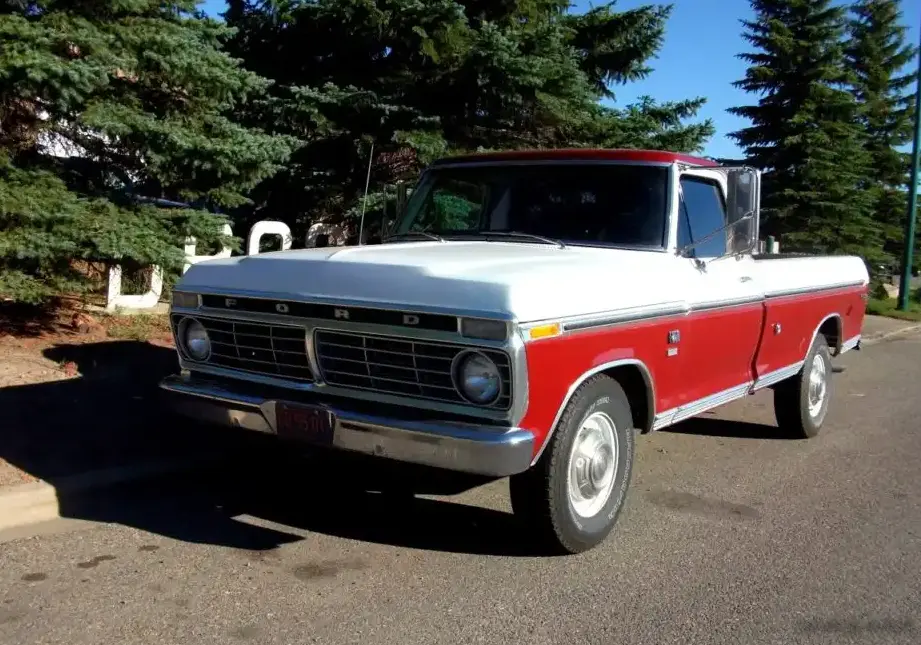
The Ford F-250 VI Regular Cab, specifically equipped with the 7.5-liter 460 cubic inch V8 engine producing 245 horsepower and paired with an automatic transmission, represents a significant iteration of Ford’s long-running F-Series pickup truck line. Produced from 1973 to 1976, this variant occupied a middle ground within the F-250 range, offering a balance between capability and affordability for buyers needing more than the F-100 could provide, but not requiring the full-duty capacity of the F-350. This generation, known as the sixth series, saw substantial styling and feature updates compared to its predecessor, solidifying the F-Series’ position as America’s best-selling truck.
Technical Specifications
| Brand | Ford |
| Model | F-Series F-250 |
| Generation | F-Series F-250 VI Regular Cab |
| Type (Engine) | 7.5 460 V8 (245 Hp) Automatic |
| Start of production | February, 1973 |
| End of production | 1976 |
| Powertrain Architecture | Internal Combustion engine |
| Body type | Pick-up |
| Seats | 3 |
| Doors | 2 |
| Fuel Type | Petrol (Gasoline) |
| Power | 245 Hp |
| Power per litre | 32.5 Hp/l |
| Engine displacement | 7538 cm3 / 460 cu. in. |
| Number of cylinders | 8 |
| Engine configuration | V-engine |
| Piston Stroke | 97.79 mm / 3.85 in. |
| Fuel injection system | Carburettor |
| Engine aspiration | Naturally aspirated engine |
| Max. weight | 3674 kg / 8099.78 lbs. |
| Trunk (boot) space – minimum | 1852-2070 l / 65.4 – 73.1 cu. ft. |
| Length | 5215 mm / 205.31 in. |
| Wheelbase | 3378 mm / 132.99 in. |
| Wading depth | 681 mm / 26.81 in. |
| Drivetrain Architecture | The Internal combustion engine (ICE) drives the rear wheels of the vehicle. |
| Drive wheel | Rear wheel drive |
| Number of gears and type of gearbox | automatic transmission Cruise-O-Matic |
| Front suspension | Independent coil spring |
| Rear suspension | Leaf spring |
| Front brakes | Disc |
| Rear brakes | Drum |
| Steering type | Cone worm with recirculation balls |
| Power steering | Electric Steering |
| Tires size | 215/85 R16.5 |
| Wheel rims size | 6J x 16.5 |
Powertrain & Engine Architecture
The heart of this F-250 variant is Ford’s 460 cubic inch (7.5-liter) V8 engine. This engine, part of the 335-series Ford big-block engine family, was a mainstay of Ford’s truck and large car lineup for many years. The 1973-1976 iteration produced 245 horsepower, delivered through a two-barrel carburetor. While not the highest output available in the F-250 range (some versions offered higher horsepower ratings), it provided ample torque for hauling and towing. The engine’s longitudinal front-engine layout was standard for the F-Series. The automatic transmission was the Cruise-O-Matic, a three-speed unit known for its durability and relatively smooth operation. This transmission was well-suited to the engine’s torque curve, providing adequate acceleration and pulling power.
Driving Characteristics
The F-250 with the 460 V8 and Cruise-O-Matic offered a driving experience focused on capability rather than outright speed. Acceleration was adequate for the time, but the truck’s substantial weight (over 8,000 lbs) meant it wasn’t particularly nimble. The automatic transmission’s gear ratios were optimized for towing and hauling, prioritizing low-end torque over quick acceleration. Compared to the available manual transmissions, the Cruise-O-Matic offered greater convenience, especially in stop-and-go traffic or when navigating hilly terrain. However, it did result in a slight reduction in fuel economy and a less direct connection to the engine. The leaf spring rear suspension provided a firm ride, particularly when unladen, but it was essential for handling heavy loads.
Equipment & Trim Levels
The F-250 VI Regular Cab with the 460 V8 typically came standard with basic features expected of a work truck. This included a vinyl bench seat, a simple dashboard with basic gauges, and a heavy-duty radiator. Options included upgraded interior trim, such as cloth upholstery, a radio, and air conditioning. Power steering was often included, but power brakes and power windows were less common. The trim level largely depended on the buyer’s preferences and budget. The F-250 offered a step up in luxury compared to the base F-100, but it wasn’t positioned as a premium truck like some of the higher-end trim packages available on other Ford models.
Chassis & Braking
The F-250’s chassis was built for durability and load-carrying capacity. It featured a robust frame and a solid rear axle suspended by leaf springs. The front suspension utilized independent coil springs, providing a more comfortable ride than a traditional solid axle setup. Braking duties were handled by disc brakes at the front and drum brakes at the rear. While adequate for the time, the braking system wasn’t particularly powerful by modern standards. The truck rode on 6J x 16.5 inch wheels fitted with 215/85 R16.5 tires, chosen for their load-carrying capacity and durability.
Market Reception & Comparison
The 1973-1976 Ford F-250 with the 460 V8 and automatic transmission was generally well-received by buyers who needed a capable and reliable work truck. Critics praised the engine’s torque and the transmission’s durability. However, fuel economy was a concern, especially during the energy crisis of the 1970s. Compared to the smaller F-100, the F-250 offered greater towing and hauling capacity. Compared to the F-350, it provided a slightly more manageable size and weight. The 460 V8 was often seen as a good compromise between power and fuel efficiency, although the smaller six-cylinder and 302 V8 engines offered better fuel economy at the expense of performance.
Legacy
The Ford F-250 VI Regular Cab with the 460 V8 and automatic transmission has become a popular choice among classic truck enthusiasts. The 460 engine is known for its reliability and relatively simple maintenance requirements. Parts availability is generally good, although some components can be difficult to find. These trucks are often sought after for restoration projects or as daily drivers. While fuel economy is poor by modern standards, the truck’s robust construction and ample power make it a capable and enjoyable vehicle. Today, well-maintained examples command a respectable price in the used car market, reflecting their enduring appeal and historical significance as a quintessential American work truck.