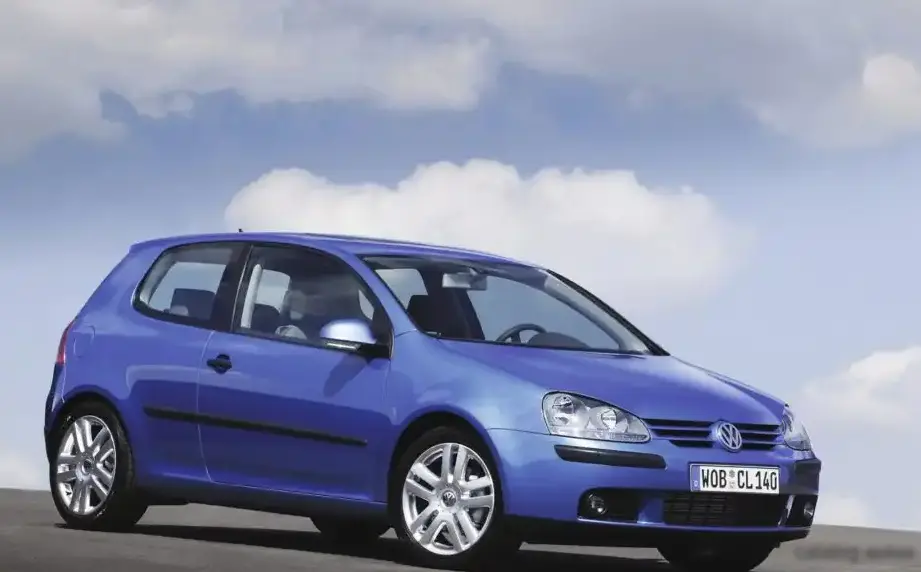
The Volkswagen Golf Mk5, produced from late 2003 through 2009, represented a significant leap forward for Volkswagen’s iconic hatchback. The 3-door variant, particularly the 2.0 TDI 8V (140 hp) model equipped with a Direct-Shift Gearbox (DSG), was a popular choice in European markets. Introduced in November 2005 and continuing through 2008, this configuration aimed to balance fuel efficiency, performance, and modern convenience within the Golf V range (chassis code 1HX0/A3). It occupied a mid-range position in the lineup, offering a step up from the base petrol engines while remaining more accessible than the higher-performance GTI or diesel variants.
Technical Specifications
| Brand | Volkswagen |
| Model | Golf |
| Generation | Golf V (3-door) |
| Type (Engine) | 2.0 TDI 8V (140 Hp) DPF DSG |
| Start of production | November, 2005 |
| End of production | 2008 |
| Powertrain Architecture | Internal Combustion engine |
| Body type | Hatchback |
| Seats | 5 |
| Doors | 3 |
| Fuel consumption (economy) – urban (NEDC) | 7.9-8.1 l/100 km (29.8 – 29 US mpg, 35.8 – 34.9 UK mpg, 12.7 – 12.3 km/l) |
| Fuel consumption (economy) – extra urban (NEDC) | 4.9-5.1 l/100 km (48 – 46.1 US mpg, 57.6 – 55.4 UK mpg, 20.4 – 19.6 km/l) |
| Fuel consumption (economy) – combined (NEDC) | 6-6.2 l/100 km (39.2 – 37.9 US mpg, 47.1 – 45.6 UK mpg, 16.7 – 16.1 km/l) |
| CO2 emissions (NEDC) | 162-167 g/km |
| Fuel Type | Diesel |
| Acceleration 0 – 100 km/h | 9.3 sec |
| Acceleration 0 – 62 mph | 9.3 sec |
| Acceleration 0 – 60 mph | 8.8 sec |
| Maximum speed | 203 km/h (126.14 mph) |
| Emission standard | Euro 4 |
| Weight-to-power ratio | 9.4 kg/Hp, 106.4 Hp/tonne |
| Weight-to-torque ratio | 4.1 kg/Nm, 243.2 Nm/tonne |
| Power | 140 Hp @ 4000 rpm |
| Torque | 320 Nm @ 1750-2500 rpm (236.02 lb.-ft. @ 1750-2500 rpm) |
| Engine layout | Front, Transverse |
| Engine Model/Code | EA188 / BMM |
| Engine displacement | 1968 cm3 (120.09 cu. in.) |
| Number of cylinders | 4 |
| Engine configuration | Inline |
| Cylinder Bore | 81 mm (3.19 in.) |
| Piston Stroke | 95.5 mm (3.76 in.) |
| Compression ratio | 18.5:1 |
| Number of valves per cylinder | 2 |
| Fuel injection system | Pump-nozzle (Unit Injector) |
| Engine aspiration | Turbocharger, Intercooler |
| Valvetrain | SOHC |
| Engine oil capacity | 3.8 l (4.02 US qt | 3.34 UK qt) |
| Coolant | 8 l (8.45 US qt | 7.04 UK qt) |
| Kerb Weight | 1316-1486 kg (2901.28 – 3276.07 lbs.) |
| Max. weight | 1900 kg (4188.78 lbs.) |
| Max load | 414-584 kg (912.71 – 1287.5 lbs.) |
| Trunk (boot) space – minimum | 350 l (12.36 cu. ft.) |
| Trunk (boot) space – maximum | 1305 l (46.09 cu. ft.) |
| Fuel tank capacity | 55 l (14.53 US gal | 12.1 UK gal) |
| Max. roof load | 75 kg (165.35 lbs.) |
| Permitted trailer load with brakes (8%) | 1700 kg (3747.86 lbs.) |
| Permitted trailer load with brakes (12%) | 1500 kg (3306.93 lbs.) |
| Permitted trailer load without brakes | 690 kg (1521.19 lbs.) |
| Permitted towbar download | 75 kg (165.35 lbs.) |
| Length | 4204 mm (165.51 in.) |
| Width | 1759 mm (69.25 in.) |
| Width including mirrors | 2010 mm (79.13 in.) |
| Height | 1485 mm (58.46 in.) |
| Wheelbase | 2578 mm (101.5 in.) |
| Front track | 1539 mm (60.59 in.) |
| Rear (Back) track | 1528 mm (60.16 in.) |
| Front overhang | 880 mm (34.65 in.) |
| Rear overhang | 746 mm (29.37 in.) |
| Minimum turning circle (turning diameter) | 10.9 m (35.76 ft.) |
| Drivetrain Architecture | The Internal combustion engine (ICE) drives the front wheels of the vehicle. |
| Drive wheel | Front wheel drive |
| Number of gears and type of gearbox | 6 gears, automatic transmission DSG |
| Front suspension | Independent, type McPherson with coil spring and anti-roll bar |
| Rear suspension | Independent multi-link spring suspension with stabilizer |
| Front brakes | Ventilated discs |
| Rear brakes | Disc |
INTRODUCTION
The Golf Mk5 2.0 TDI 8V DPF DSG represented a significant step towards diesel efficiency and performance in the compact hatchback segment. Built on the Volkswagen Group’s A5 platform (shared with the Audi A3 and SEAT Leon), the Mk5 Golf aimed to elevate the standard for build quality, refinement, and technology. The 2.0 TDI engine, part of the EA188 family, was a key component in Volkswagen’s diesel strategy, offering a balance between power and economy. The inclusion of a Diesel Particulate Filter (DPF) addressed growing environmental concerns, while the DSG transmission provided smooth and quick gear changes, enhancing the driving experience.
Powertrain & Engine Architecture
The heart of this Golf variant is the EA188 2.0-liter TDI engine, specifically the BMM code. This engine is a four-cylinder, inline diesel featuring a cast iron block and aluminum cylinder head. It utilizes a pump-nozzle (unit injector) fuel injection system, a technology known for its precise fuel delivery and contribution to efficient combustion. The engine is turbocharged and intercooled, boosting power output to 140 horsepower at 4000 rpm and 320 Nm (236 lb-ft) of torque between 1750 and 2500 rpm. The 8-valve configuration (two valves per cylinder) was a cost-effective design choice, prioritizing reliability and fuel economy over outright performance. The DSG (Direct-Shift Gearbox) is a six-speed dual-clutch transmission. It operates like a traditional automatic but offers the efficiency and responsiveness of a manual gearbox by pre-selecting the next gear.
Driving Characteristics
The 2.0 TDI with the DSG transmission provided a surprisingly refined and capable driving experience. While not as sporty as the petrol-powered GTI, the diesel offered ample torque for everyday driving and overtaking. The DSG transmission contributed to smooth acceleration and minimized power loss during gear changes. The gear ratios were tuned for a balance between fuel efficiency and responsiveness. Compared to the 1.9 TDI variants, the 2.0 TDI offered more power and a broader torque curve. Manual transmission versions of the 2.0 TDI felt more engaging, but the DSG provided a level of convenience that appealed to a wider range of drivers. The 3-door body style further enhanced the Golf’s agility, making it feel nimble in city traffic and on winding roads.
Equipment & Trim Levels
The 2.0 TDI DSG typically came with a reasonable level of standard equipment. This included air conditioning, power windows, central locking, and an integrated audio system. Higher trim levels added features such as alloy wheels, a multi-function steering wheel, and upgraded interior upholstery. Optional extras included a sunroof, parking sensors, and a navigation system. Interior materials were generally of good quality, reflecting Volkswagen’s commitment to build quality. The dashboard layout was functional and ergonomic, with clear instrumentation and intuitive controls.
Chassis & Braking
The Golf Mk5 featured an independent suspension system on both the front and rear axles. The front suspension utilized a McPherson strut design, while the rear employed a multi-link setup. This configuration provided a comfortable ride and good handling characteristics. The 2.0 TDI models typically came equipped with ventilated disc brakes on the front axle and solid discs on the rear. Anti-lock Braking System (ABS) was standard. The suspension was tuned to provide a balance between comfort and handling, with stabilizer bars helping to reduce body roll during cornering. The weight distribution was relatively balanced, contributing to the Golf’s predictable handling.
Market Reception & Comparison
The Golf Mk5 2.0 TDI DSG was well-received by automotive critics and consumers alike. It was praised for its fuel efficiency, comfortable ride, and refined driving experience. Compared to other diesel hatchbacks of the time, the Golf offered a compelling combination of performance, economy, and build quality. The DSG transmission was a particular highlight, offering a level of convenience and responsiveness that was not commonly found in other vehicles in its class. However, some critics noted that the engine could be somewhat noisy under hard acceleration. Fuel economy figures consistently hovered around 6.0-6.2 l/100km (39.2-37.9 US mpg), making it an attractive option for drivers seeking to minimize their fuel costs.
Legacy
The EA188 2.0 TDI engine, as found in the Golf Mk5, proved to be a relatively reliable powertrain, although early versions were susceptible to DPF issues if not properly maintained. The DSG transmission, while generally robust, can require expensive repairs if not serviced according to Volkswagen’s recommendations. Today, well-maintained examples of the Golf Mk5 2.0 TDI DSG are sought after by enthusiasts and practical drivers alike. They offer a blend of classic Volkswagen styling, modern features, and reasonable running costs. The Golf Mk5 solidified Volkswagen’s reputation for building high-quality, refined, and efficient hatchbacks, and the 2.0 TDI DSG variant remains a popular choice in the used car market.