
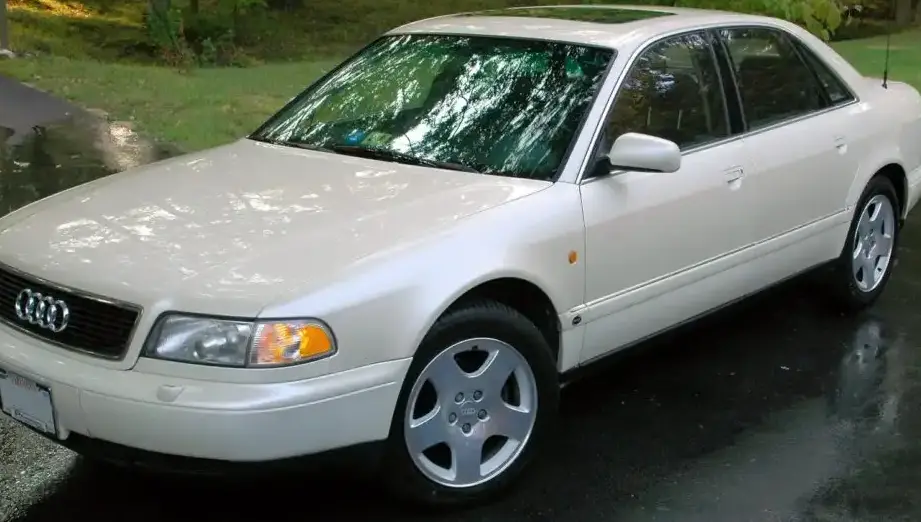
The Audi A8 (D2) 2.8 V6 30V tiptronic, produced between 1996 and 1998, represented a significant entry point into Audi’s flagship luxury sedan range. Positioned within the first generation of the A8 (internally designated D2 or 4D), this variant offered a blend of performance and refinement, appealing to buyers seeking a comfortable and technologically advanced vehicle without the higher price tag of the V8 models. It served as a crucial volume seller, broadening the A8’s appeal beyond the traditional top-tier luxury market. The D2 A8 was a groundbreaking vehicle for Audi, being the first Audi to feature all-aluminum construction of the body, reducing weight and improving rigidity.
Technical Specifications
| Brand | Audi |
| Model | A8 |
| Generation | A8 (D2, 4D) |
| Type (Engine) | 2.8 V6 30V (193 Hp) tiptronic |
| Start of production | 1996 |
| End of production | 1998 |
| Powertrain Architecture | Internal Combustion engine |
| Body type | Sedan |
| Seats | 5 |
| Doors | 4 |
| Fuel consumption (economy) – urban (NEDC) | 16.4 l/100 km (14.3 US mpg, 17.2 UK mpg, 6.1 km/l) |
| Fuel consumption (economy) – extra urban (NEDC) | 7.5 l/100 km (31.4 US mpg, 37.7 UK mpg, 13.3 km/l) |
| Fuel consumption (economy) – combined (NEDC) | 10.8 l/100 km (21.8 US mpg, 26.2 UK mpg, 9.3 km/l) |
| CO2 emissions (NEDC) | 257 g/km |
| Fuel Type | Petrol (Gasoline) |
| Acceleration 0 – 100 km/h | 9.9 sec |
| Acceleration 0 – 62 mph | 9.9 sec |
| Acceleration 0 – 60 mph | 9.4 sec |
| Maximum speed | 233 km/h (144.78 mph) |
| Emission standard | Euro 2 |
| Weight-to-power ratio | 8.1 kg/Hp, 123.7 Hp/tonne |
| Weight-to-torque ratio | 5.6 kg/Nm, 179.5 Nm/tonne |
| Power | 193 Hp @ 6000 rpm |
| Power per litre | 69.6 Hp/l |
| Torque | 280 Nm @ 3200 rpm (206.52 lb.-ft. @ 3200 rpm) |
| Engine layout | Front, Longitudinal |
| Engine Model/Code | ACK, APR |
| Engine displacement | 2771 cm3 (169.1 cu. in.) |
| Number of cylinders | 6 |
| Engine configuration | V-engine |
| Cylinder Bore | 82.5 mm (3.25 in.) |
| Piston Stroke | 86.4 mm (3.4 in.) |
| Compression ratio | 10.6:1 |
| Number of valves per cylinder | 5 |
| Fuel injection system | Multi-port manifold injection |
| Engine aspiration | Naturally aspirated engine |
| Valvetrain | DOHC |
| Engine oil capacity | 5 l (5.28 US qt | 4.4 UK qt) |
| Coolant | 11 l (11.62 US qt | 9.68 UK qt) |
| Kerb Weight | 1560 kg (3439.21 lbs.) |
| Max. weight | 2160 kg (4761.98 lbs.) |
| Max load | 600 kg (1322.77 lbs.) |
| Trunk (boot) space – minimum | 525 l (18.54 cu. ft.) |
| Fuel tank capacity | 80 l (21.13 US gal | 17.6 UK gal) |
| Max. roof load | 100 kg (220.46 lbs.) |
| Permitted trailer load with brakes (8%) | 1900 kg (4188.78 lbs.) |
| Permitted trailer load with brakes (12%) | 1600 kg (3527.4 lbs.) |
| Permitted trailer load without brakes | 750 kg (1653.47 lbs.) |
| Permitted towbar download | 75 kg (165.35 lbs.) |
| Length | 5034 mm (198.19 in.) |
| Width | 1880 mm (74.02 in.) |
| Width including mirrors | 1973 mm (77.68 in.) |
| Height | 1440 mm (56.69 in.) |
| Wheelbase | 2882 mm (113.46 in.) |
| Front track | 1597 mm (62.87 in.) |
| Rear (Back) track | 1586 mm (62.44 in.) |
| Drag coefficient (Cd) | 0.30 |
| Minimum turning circle (turning diameter) | 12.3 m (40.35 ft.) |
| Drivetrain Architecture | The Internal combustion engine (ICE) drives the front wheels of the vehicle. |
| Drive wheel | Front wheel drive |
| Number of gears and type of gearbox | 5 gears, automatic transmission tiptronic |
| Front suspension | Independent multi-link suspension, Transverse stabilizer |
| Rear suspension | Independent on trapezoidal lever, Transverse stabilizer |
| Front brakes | Ventilated discs |
| Rear brakes | Ventilated discs |
| Assisting systems | ABS (Anti-lock braking system) |
| Steering type | Steering rack and pinion |
| Power steering | Hydraulic Steering |
| Tires size | 225/60 R16 |
| Wheel rims size | 7J x 16 |
Powertrain & Engine Architecture
The 2.8 V6 engine, identified by engine codes ACK and APR, is a naturally aspirated, 2.8-liter (2771 cc) V6. It features a 90-degree V-angle, contributing to a smoother engine operation. The engine utilizes a multi-port fuel injection system, delivering fuel directly to the intake ports. The cylinder head incorporates four valves per cylinder (30V total) actuated by a double overhead camshaft (DOHC) design. This valvetrain configuration optimizes airflow for improved performance. The engine’s 193 horsepower at 6000 rpm and 280 Nm (206.52 lb-ft) of torque at 3200 rpm provided adequate power for the A8’s substantial weight. Paired with this engine was a 5-speed tiptronic automatic transmission. This transmission allowed for both fully automatic operation and driver-selectable gear changes, offering a degree of control not found in traditional automatics. The tiptronic system used a torque converter for smooth launches and low-speed driving, and electronically controlled clutches for quicker shifts when in manual mode.
Driving Characteristics
The 2.8 V6 tiptronic A8 offered a comfortable and refined driving experience, prioritizing smoothness over outright performance. Acceleration from 0-60 mph took approximately 9.4 seconds, and top speed was limited to 144.78 mph. While not a sports sedan, the engine provided sufficient power for highway cruising and overtaking maneuvers. The tiptronic transmission, while offering manual shift capability, wasn’t as responsive as a traditional manual gearbox. Gear ratios were tuned for fuel efficiency and comfort, resulting in a slightly less engaging driving experience compared to the 6-speed manual options available on other A8 variants. The automatic transmission’s programming favored early upshifts to conserve fuel, which could sometimes leave the engine feeling slightly strained during aggressive acceleration.
Equipment & Trim Levels
The 2.8 V6 tiptronic A8 typically came standard with a generous array of features for its time, including leather upholstery, power-adjustable front seats with memory function, automatic climate control, a premium sound system, and alloy wheels. Safety features included ABS brakes, traction control, and airbags. Optional extras included a sunroof, upgraded sound systems, rear seat entertainment, and various wood trim options. The interior design emphasized luxury and sophistication, with high-quality materials and a clean, understated aesthetic. The A8’s interior was a significant step up in terms of perceived quality compared to its competitors.
Chassis & Braking
The A8 (D2) featured an independent suspension system on all four wheels, utilizing a multi-link setup at the front and a trapezoidal lever arrangement at the rear. This suspension design provided a comfortable ride and good handling characteristics. Stabilizer bars were fitted to both the front and rear axles to reduce body roll during cornering. Braking duties were handled by ventilated disc brakes on all four wheels, providing ample stopping power. The ABS system helped to prevent wheel lockup during hard braking, enhancing safety and control. The steering was a rack-and-pinion system with hydraulic power assistance, offering precise and responsive steering feel.
Market Reception & Comparison
The 2.8 V6 tiptronic A8 was generally well-received by automotive critics. It was praised for its comfortable ride, luxurious interior, and advanced technology. However, some critics noted that the engine lacked the outright performance of the V8 models. Compared to the 2.6L V6 and 3.0L V6 variants, the 2.8L offered a noticeable performance improvement. Compared to the flagship 4.2L V8, it provided a more affordable entry point into the A8 range, albeit with a compromise in performance. Fuel economy was reasonable for a luxury sedan of its size, averaging around 21.8 US mpg in combined driving. Reliability was generally good, although some owners reported issues with the automatic transmission and electrical components.
Legacy
The Audi A8 (D2) 2.8 V6 tiptronic remains a desirable classic car today, particularly among enthusiasts who appreciate its blend of luxury, technology, and understated styling. The ACK and APR engines are generally considered reliable, although regular maintenance is essential to prevent issues. The tiptronic transmission, while advanced for its time, can be prone to failure if not properly maintained. Parts availability is generally good, although some components may be difficult to find. The D2 A8’s pioneering use of all-aluminum construction and its advanced features helped to establish Audi as a leading luxury car brand. Today, well-maintained examples command a premium in the used car market, appealing to collectors and enthusiasts alike.
