
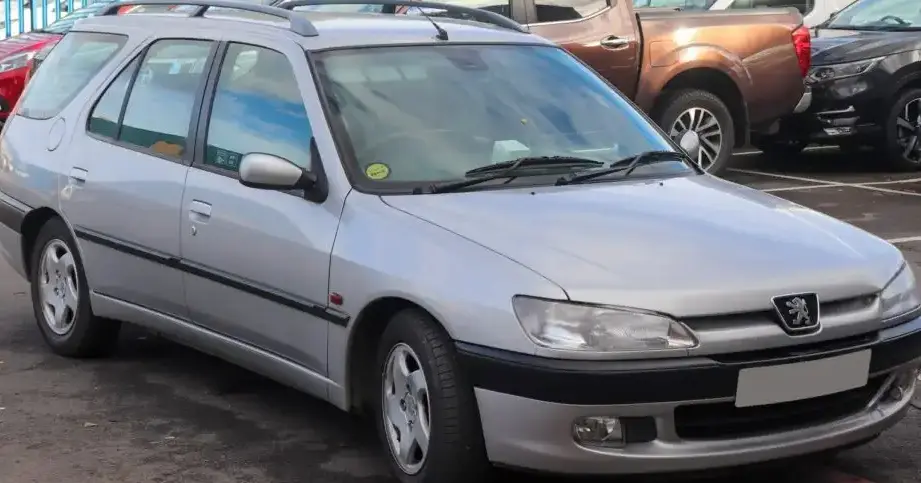
The Peugeot 306 Break 1.6i, produced between 2000 and 2002, represents a practical and affordable variant within the broader 306 range. As a station wagon (estate) version of the popular 306, the Break offered increased cargo capacity and versatility, appealing to families and those requiring additional space. This particular 1.6i model, equipped with a 99 horsepower engine, served as an entry-level option within the Break lineup, prioritizing fuel efficiency and affordability over outright performance. It was positioned below the more powerful 2.0-liter variants and diesel options, targeting buyers seeking a sensible and economical family vehicle. The 306 Break (7E) falls within the first generation of the 306, known for its robust build and relatively simple mechanicals.
Technical Specifications
| Brand | Peugeot |
| Model | 306 |
| Generation | 306 Break (7E) |
| Type (Engine) | 1.6i (99 Hp) |
| Start of production | 2000 year |
| End of production | 2002 year |
| Powertrain Architecture | Internal Combustion engine |
| Body type | Station wagon (estate) |
| Seats | 5 |
| Doors | 5 |
| Fuel consumption (economy) – urban | 9.1 l/100 km (25.8 US mpg, 31 UK mpg, 11 km/l) |
| Fuel consumption (economy) – extra urban | 5.6 l/100 km (42 US mpg, 50.4 UK mpg, 17.9 km/l) |
| Fuel consumption (economy) – combined | 6.9 l/100 km (34.1 US mpg, 40.9 UK mpg, 14.5 km/l) |
| CO2 emissions | 165 g/km |
| Fuel Type | Petrol (Gasoline) |
| Weight-to-power ratio | 11.6 kg/Hp, 86.1 Hp/tonne |
| Weight-to-torque ratio | 8.3 kg/Nm, 120 Nm/tonne |
| Power | 99 Hp @ 5750 rpm |
| Power per litre | 62.4 Hp/l |
| Torque | 138 Nm @ 3250 rpm (101.78 lb.-ft. @ 3250 rpm) |
| Engine layout | Front, Transverse |
| Engine Model/Code | NFT TU5JP |
| Engine displacement | 1587 cm3 (96.84 cu. in.) |
| Number of cylinders | 4 |
| Engine configuration | Inline |
| Cylinder Bore | 78.5 mm (3.09 in.) |
| Piston Stroke | 82 mm (3.23 in.) |
| Number of valves per cylinder | 2 |
| Fuel injection system | Multi-port manifold injection |
| Engine aspiration | Naturally aspirated engine |
| Engine oil capacity | 3.2 l (3.38 US qt, 2.82 UK qt) |
| Coolant | 6.1 l (6.45 US qt, 5.37 UK qt) |
| Kerb Weight | 1150 kg (2535.32 lbs.) |
| Max. weight | 1605 kg (3538.42 lbs.) |
| Max load | 455 kg (1003.1 lbs.) |
| Trunk (boot) space – minimum | 440 l (15.54 cu. ft.) |
| Trunk (boot) space – maximum | 1510 l (53.33 cu. ft.) |
| Fuel tank capacity | 60 l (15.85 US gal, 13.2 UK gal) |
| Permitted trailer load with brakes (12%) | 1000 kg (2204.62 lbs.) |
| Permitted trailer load without brakes | 590 kg (1300.73 lbs.) |
| Length | 4338 mm (170.79 in.) |
| Width | 1680 mm (66.14 in.) |
| Height | 1415 mm (55.71 in.) |
| Wheelbase | 2580 mm (101.57 in.) |
| Front track | 1423-1433 mm (56.02 – 56.42 in.) |
| Rear (Back) track | 1424-1432 mm (56.06 – 56.38 in.) |
| Front overhang | 815 mm (32.09 in.) |
| Rear overhang | 943 mm (37.13 in.) |
| Drivetrain Architecture | The Internal combustion engine (ICE) drives the front wheels of the vehicle. |
| Drive wheel | Front wheel drive |
| Number of gears and type of gearbox | 5 gears, manual transmission |
| Front suspension | Wishbone |
| Rear suspension | Trailing arm |
| Front brakes | Disc |
| Rear brakes | Drum |
| Assisting systems | ABS (Anti-lock braking system) |
| Steering type | Steering rack and pinion |
| Power steering | Hydraulic Steering |
| Tires size | 185/65 R14 |
| Wheel rims size | 14 |
Powertrain & Engine Architecture
The 306 Break 1.6i utilizes the Peugeot NFT (TU5JP) engine, a 1.6-liter inline-four cylinder gasoline engine. This engine is a naturally aspirated design, meaning it doesn’t employ a turbocharger or supercharger. It features a multi-port fuel injection system, delivering fuel directly into the intake ports, and a two-valve-per-cylinder configuration. The engine produces 99 horsepower at 5750 rpm and 138 Nm (101.78 lb-ft) of torque at 3250 rpm. The engine’s design prioritizes fuel efficiency and reliability over high performance. The 5-speed manual transmission was the standard offering for this variant, providing a balance between fuel economy and drivability. The transmission’s gear ratios were tuned for everyday driving, with a focus on maximizing fuel efficiency at cruising speeds.
Driving Characteristics
The 1.6i engine, paired with the manual transmission, provided adequate, though not exhilarating, performance. Acceleration was modest, with a 0-60 mph time estimated around 12-13 seconds. The engine felt most comfortable in the mid-range, offering sufficient power for overtaking maneuvers on open roads. The manual gearbox allowed for precise control over the engine’s power delivery, and the gear ratios were well-suited to the engine’s characteristics. Compared to the more powerful 2.0-liter versions, the 1.6i felt noticeably slower, but it offered a more economical and relaxed driving experience. The suspension, tuned for comfort, provided a reasonably smooth ride, even on uneven surfaces.
Equipment & Trim Levels
The 1.6i Break typically came with a fairly basic level of equipment, reflecting its position as an entry-level model. Standard features generally included power steering, central locking, and an AM/FM radio. Interior upholstery was typically cloth, and the dashboard featured a simple, functional design. Optional extras included air conditioning, electric windows, and a sunroof. Higher trim levels, such as the XR or XT, added features like alloy wheels, upgraded interior trim, and additional safety equipment.
Chassis & Braking
The 306 Break featured a front-wheel-drive layout with independent wishbone suspension at the front and a trailing arm suspension at the rear. The front brakes were disc brakes, providing good stopping power, while the rear brakes were drum brakes, a cost-saving measure common in this class of vehicle. Anti-lock Braking System (ABS) was available, enhancing safety by preventing wheel lockup during hard braking. The steering was a rack-and-pinion system with hydraulic power assistance, providing light and precise steering feel.
Market Reception & Comparison
The Peugeot 306 Break 1.6i was generally well-received as a practical and affordable family vehicle. Critics praised its spacious interior, comfortable ride, and fuel efficiency. However, some criticized its lack of power and relatively basic equipment level. Compared to other station wagons in its class, such as the Ford Focus Estate or the Vauxhall/Opel Astra Estate, the 306 Break offered a competitive package, particularly in terms of value for money. The 1.6i engine offered better fuel economy than the 2.0-liter variants, but at the expense of performance. The diesel models provided even better fuel economy, but were generally more expensive to purchase.
Legacy
The Peugeot 306 Break 1.6i has proven to be a relatively reliable vehicle, with many examples still on the road today. The NFT (TU5JP) engine is known for its durability, and the manual transmission is also generally robust. However, like any older vehicle, it is susceptible to age-related issues, such as corrosion and wear and tear on suspension components. In the used car market, the 306 Break 1.6i remains an affordable option for those seeking a practical and economical station wagon. Its simple mechanicals make it relatively easy to maintain and repair, and parts are generally readily available. It represents a solid, if unspectacular, choice for budget-conscious buyers.
