
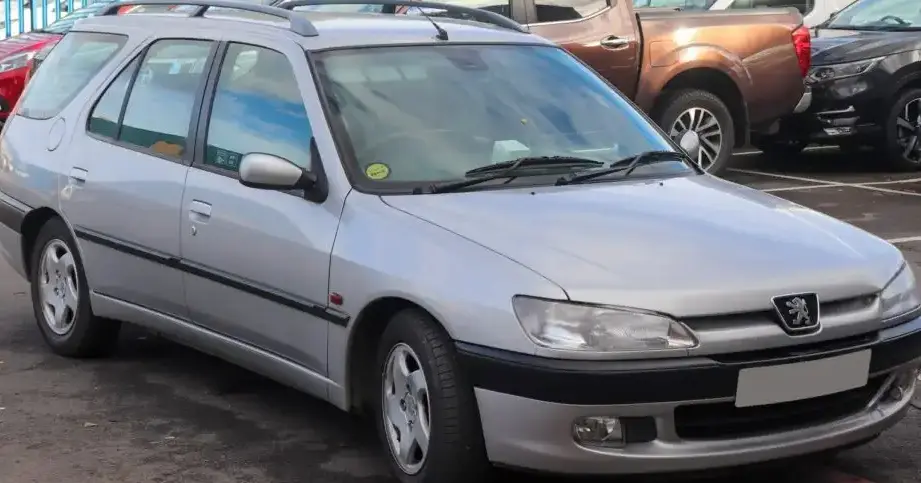
The Peugeot 306 Break 1.6i Automatic, produced between 2000 and 2002, represents a practical and accessible variant within the broader 306 range. Part of the 7E series denoting the station wagon (estate) body style, this model aimed to provide family-oriented transportation with a focus on affordability and ease of use. It occupied a mid-to-lower position in the 306 Break lineup, offering a less expensive alternative to the more powerful 2.0-liter engines and sportier trims. The 306, as a whole, was Peugeot’s competitor in the compact family car segment, and the Break version specifically targeted buyers needing increased cargo capacity.
Technical Specifications
| Brand | Peugeot |
| Model | 306 |
| Generation | 306 Break (7E) |
| Type (Engine) | 1.6i (99 Hp) Automatic |
| Start of production | 2000 year |
| End of production | 2002 year |
| Powertrain Architecture | Internal Combustion engine |
| Body type | Station wagon (estate) |
| Seats | 5 |
| Doors | 5 |
| Fuel consumption (urban) | 11 l/100 km (21.4 US mpg, 25.7 UK mpg, 9.1 km/l) |
| Fuel consumption (extra urban) | 5.9 l/100 km (39.9 US mpg, 47.9 UK mpg, 16.9 km/l) |
| Fuel consumption (combined) | 7.8 l/100 km (30.2 US mpg, 36.2 UK mpg, 12.8 km/l) |
| CO2 emissions | 185 g/km |
| Fuel Type | Petrol (Gasoline) |
| Weight-to-power ratio | 11.8 kg/Hp, 85 Hp/tonne |
| Weight-to-torque ratio | 8.4 kg/Nm, 118.5 Nm/tonne |
| Power | 99 Hp @ 5750 rpm |
| Power per litre | 62.4 Hp/l |
| Torque | 138 Nm @ 3250 rpm (101.78 lb.-ft. @ 3250 rpm) |
| Engine layout | Front, Transverse |
| Engine Model/Code | NFT TU5JP |
| Engine displacement | 1587 cm3 (96.84 cu. in.) |
| Number of cylinders | 4 |
| Engine configuration | Inline |
| Cylinder Bore | 78.5 mm (3.09 in.) |
| Piston Stroke | 82 mm (3.23 in.) |
| Number of valves per cylinder | 2 |
| Fuel injection system | Multi-port manifold injection |
| Engine aspiration | Naturally aspirated engine |
| Engine oil capacity | 3.2 l (3.38 US qt | 2.82 UK qt) |
| Coolant capacity | 6.1 l (6.45 US qt | 5.37 UK qt) |
| Kerb Weight | 1165 kg (2568.39 lbs.) |
| Max. weight | 1635 kg (3604.56 lbs.) |
| Max load | 470 kg (1036.17 lbs.) |
| Trunk (boot) space – minimum | 440 l (15.54 cu. ft.) |
| Trunk (boot) space – maximum | 1510 l (53.33 cu. ft.) |
| Fuel tank capacity | 60 l (15.85 US gal | 13.2 UK gal) |
| Permitted trailer load with brakes (12%) | 1000 kg (2204.62 lbs.) |
| Permitted trailer load without brakes | 620 kg (1366.87 lbs.) |
| Length | 4338 mm (170.79 in.) |
| Width | 1680 mm (66.14 in.) |
| Height | 1415 mm (55.71 in.) |
| Wheelbase | 2580 mm (101.57 in.) |
| Front track | 1423-1433 mm (56.02 – 56.42 in.) |
| Rear track | 1424-1432 mm (56.06 – 56.38 in.) |
| Front overhang | 815 mm (32.09 in.) |
| Rear overhang | 943 mm (37.13 in.) |
| Drivetrain Architecture | Front wheel drive |
| Number of gears and type of gearbox | 4 gears, automatic transmission |
| Front suspension | Wishbone |
| Rear suspension | Trailing arm |
| Front brakes | Disc |
| Rear brakes | Drum |
| Assisting systems | ABS (Anti-lock braking system) |
| Steering type | Steering rack and pinion |
| Power steering | Hydraulic Steering |
| Tires size | 185/65 R14 |
| Wheel rims size | 14 |
Powertrain & Engine Architecture
The 1.6i engine, designated NFT and belonging to the TU5JP series, is a naturally aspirated, inline-four cylinder petrol engine. This engine was a mainstay in many Peugeot and Citroën vehicles of the era. It utilizes a multi-port fuel injection system, providing a balance between fuel efficiency and performance. The engine features a single overhead camshaft (SOHC) operating two valves per cylinder. The automatic transmission paired with this engine is a four-speed unit, designed for smooth, if not particularly sporty, gear changes. This transmission was chosen for its ease of use and suitability for everyday driving, rather than outright performance. The engine’s relatively modest output was well-suited to the automatic transmission, preventing excessive strain on the gearbox.
Driving Characteristics
The 306 Break 1.6i Automatic offered a comfortable, but unhurried, driving experience. With 99 horsepower, acceleration was adequate for typical commuting and highway cruising, but it lacked the punch of the higher-powered 2.0-liter variants. The automatic transmission, while convenient, resulted in some power loss compared to the manual transmission options. Gear ratios were optimized for fuel economy and smooth operation, rather than rapid acceleration. In real-world conditions, overtaking maneuvers required careful planning. Compared to the manual version, the automatic felt noticeably slower, particularly in the mid-range. However, the automatic provided a more relaxed driving experience, especially in congested urban environments.
Equipment & Trim Levels
The 1.6i Automatic trim typically included features such as central locking, power steering, and an AM/FM radio. Air conditioning was often an optional extra. Interior upholstery was generally cloth, with a relatively simple dashboard layout. Higher trim levels, if selected, could add features like alloy wheels, electric windows, and upgraded audio systems. The focus of this trim level was practicality and value, offering essential features without the expense of more luxurious options. Safety features were relatively basic for the time, typically including a driver’s airbag and ABS (Anti-lock Braking System).
Chassis & Braking
The 306 Break featured a front-wheel-drive layout with independent wishbone suspension at the front and a trailing arm suspension at the rear. This setup provided a reasonable balance between ride comfort and handling. The front brakes were disc brakes, while the rear brakes were drum brakes – a cost-saving measure common in this segment. ABS was standard, enhancing braking performance and stability, particularly on slippery surfaces. The suspension was tuned for comfort, prioritizing a smooth ride over sporty handling. Stabilizer bars were present, but were relatively thin compared to those found on higher-performance 306 models.
Market Reception & Comparison
The 306 Break 1.6i Automatic was generally well-received as a practical and affordable family car. Critics praised its spacious interior, comfortable ride, and reasonable fuel economy. However, the engine’s lack of power and the automatic transmission’s somewhat sluggish performance were often noted as drawbacks. Compared to the 2.0-liter versions, the 1.6i Automatic offered significantly lower performance but also lower running costs. The 1.9 TDI diesel variant provided superior fuel economy and torque, but at a higher initial price. The 1.6i Automatic appealed to buyers prioritizing ease of use and affordability over outright performance.
Legacy
The Peugeot 306 Break 1.6i Automatic, while not a particularly exciting vehicle, proved to be a reliable and durable workhorse. The TU5JP engine is known for its longevity, and the four-speed automatic transmission, while not cutting-edge, is generally robust. In the used car market, these models are often sought after for their affordability and practicality. Maintenance is relatively straightforward, and parts availability is generally good. While not a collector’s item, the 306 Break 1.6i Automatic remains a viable option for those seeking a budget-friendly and dependable estate car.
